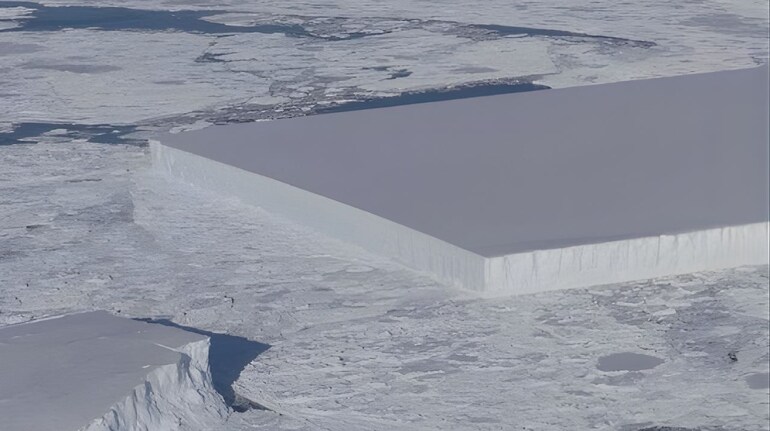

One of the largest and oldest icebergs ever recorded is now rapidly melting after drifting across the Southern Ocean for nearly four decades. The massive iceberg, known as Iceberg A23a, is currently breaking apart in the warmer waters of the South Atlantic, scientists say.
Researchers monitoring the iceberg believe that the once-colossal block of ice may completely disintegrate within weeks as rising ocean temperatures and strong currents weaken its structure.
A giant iceberg once twice the size of London
When A23a first broke away from Antarctica in 1986, it was enormous. The iceberg covered roughly 4,000 square kilometres, making it almost twice the size of Greater London.
Scientists estimated its weight at nearly 1 trillion tonnes. The iceberg originally calved from the Filchner–Ronne Ice Shelf in the Weddell Sea, a region known for producing some of the largest icebergs in the world.
A23a is an iceberg that has fascinated scientists, was once the oldest and biggest in the world, and its 40yr journey is coming to an end in weeks thanks to melting, fracturing, and spectacular disintegration...https://t.co/x6jz7rGuVvpic.twitter.com/EAd8bLnxrH— mmnjug™ (@mmnjug) March 8, 2026
Stuck in one place for decades
Despite its massive size, A23a did not immediately drift away after breaking off. For more than 3 decades, the iceberg remained trapped on the seabed in the Weddell Sea.
Scientists believe it became grounded due to its immense thickness, preventing ocean currents from moving it. It finally broke free in 2020, when shifting currents began pushing the iceberg northward into the open waters of the Southern Ocean.
A long journey across the ocean
After breaking free, A23a began a slow journey across the Southern Ocean, carried by powerful ocean currents. During its drift, the iceberg gradually fractured into smaller sections while spinning through large oceanic gyres.
At one point, it moved close to South Georgia Island. Scientists closely monitored its path because massive icebergs can sometimes disrupt local ecosystems or interfere with shipping routes.
Why the iceberg is melting now?
As A23a moved further north, it entered warmer waters of the South Atlantic, which accelerated melting. Satellite observations show that the iceberg has developed large cracks and meltwater pools on its surface, causing it to break into smaller fragments. Over time, its size has shrunk from thousands of square kilometres to just a fraction of its original area.
The end of a four-decade iceberg
The iceberg is nearing the end of its long life. After nearly 40 years drifting across Antarctic waters, the once-giant ice mass may soon vanish completely. The disappearance of A23a marks the end of an extraordinary natural journey.
Scientists say studying such icebergs provides valuable insights into Antarctic ice dynamics, ocean currents and climate processes.
Discover the latest Business News, Sensex, and Nifty updates. Obtain Personal Finance insights, tax queries, and expert opinions on Moneycontrol or download the Moneycontrol App to stay updated!
Find the best of Al News in one place, specially curated for you every weekend.
Stay on top of the latest tech trends and biggest startup news.