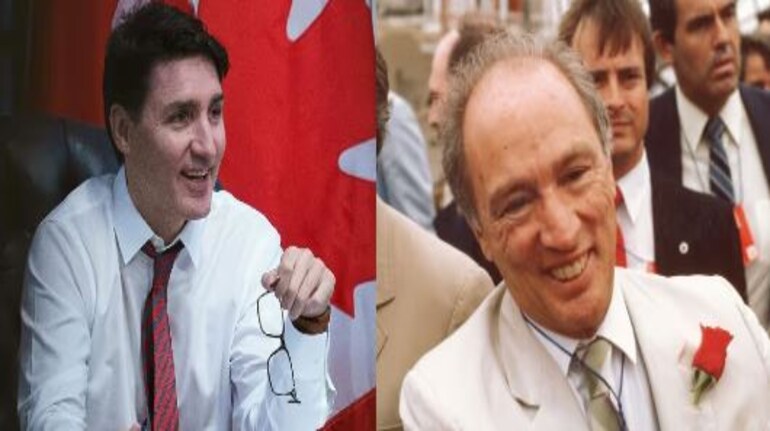
India and Canada are facing an unprecedented diplomatic standoff over the assassination of Sikh separatist leader Hardeep Singh Nijjar. The Canadian government accused India of orchestrating the assassination of Nijjar on June 18, 2023, in British Columbia. Despite New Delhi's appeal to Canada to provide “specific and relevant” evidence, the Trudeau dispensation is yet to provide credible proof.
Additionally, during a hearing on foreign interference, Trudeau discussed the murder of Nijjar and admitted that he had not provided concrete evidence to India regarding the incident. Trudeau mentioned that the information was primarily based on intelligence rather than hard proof, suggesting a collaborative effort to investigate the situation further.
This current deterioration in bilateral ties is not an isolated incident but part of a broader pattern of discord between India and Canada during the Trudeau family’s tenure.
Smear campaign for political gainsThe Trudeau government is engaging in a smear campaign for political gain, with national elections looming in 2025. In addition to his desperate attempt to brighten his chances for the upcoming national polls, Trudeau, is battling the insecurities of a minority government and facing predictions from state intelligence about a public revolt over a dire economic situation. He is hoping to draw political mileage by promoting the idea of an independent Khalistan, at the cost of bilateral relations.
History repeating itself?The roots of this diplomatic rift can be traced back to Justin Trudeau's father, Pierre Elliott Trudeau, who also faced challenges in relations with India. Way back in 1982, then Prime Minister Indira Gandhi locked horns with Justin Trudeau’s father, Pierra Trudeau, on the Khalistan issue. Issues reached a boil when Surjan Singh Gill established a Khalistan office in exile in Vancouver. Pierre Trudeau even shielded Talwinder Singh Parmar, a member of Babbar Khalsa who advocated attacks on Indian missions abroad.
Kanishka bombing and India unsuccessful attempt to extradite Talwinder Singh ParmarThe deadly bombing of an Air India flight in 1985 is back in the news after relations between India and Canada hit a new low. On 23 June 1985, an Air India flight travelling from Canada to India via London, exploded off the Irish coast, killing all 329 people on board.
The cause was a bomb in a suitcase that was transferred to the flight even though the ticket holder had not boarded. The victims included 268 Canadian citizens, mostly of Indian origin, and 24 Indians. Only 131 bodies were retrieved from the sea.
Most of the victims of the Kanishka bombing were Canadians. Talwinder Singh Parmar, who had been protected by the Trudeau administration, was identified as the mastermind behind the attack. But the case against Parmar - whom India had unsuccessfully tried to get extradited from Canada in the early 1980s - was flimsy and he was released. Investigators now believe that Parmar - who was killed by police in India in 1992 - was the mastermind behind the attack.
Discover the latest Business News, Sensex, and Nifty updates. Obtain Personal Finance insights, tax queries, and expert opinions on Moneycontrol or download the Moneycontrol App to stay updated!
Find the best of Al News in one place, specially curated for you every weekend.
Stay on top of the latest tech trends and biggest startup news.