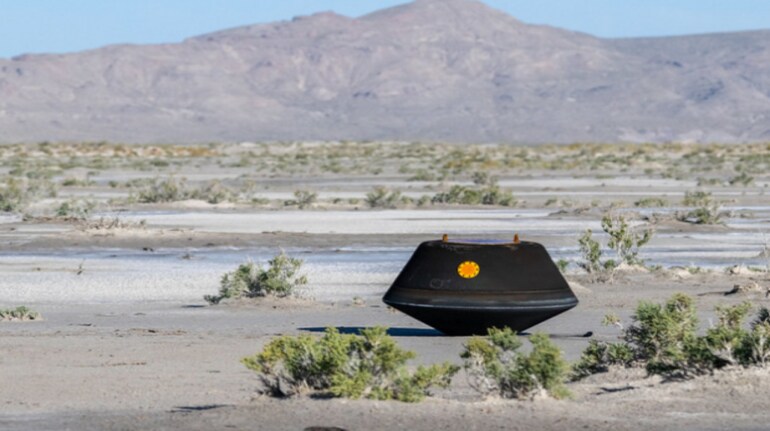
OSIRIS-REx (Origins, Spectral Interpretation, Resource Identification, and Security–Regolith Explorer), launched in 2016, successfully returned to Earth on September 24, a capsule with the samples of asteroid Bennu.
Following the capsule's touchdown at the Department of Defense’s Test and Training Range in Salt Lake City, Utah, the samples will be transported to the Johnson Space Center in Houston, Texas. Here, a team of small particle experts will diligently study these samples to gain insights into how our planet and the solar system formed some 4.5 billion years ago.
Christopher Snead, Advanced Small Particle Processor & a deputy curator for OSIRIS-REx sample collection, and Mari Montoya, a curation specialist at the Johnson Space Center, provided in-depth information about the precise processes and procedures followed in curating the samples.
Here is the understanding of the curation unit and the curation process:According to Christopher Snead, carbonaceous asteroids like Bennu give valuable insights into the origins of the solar system. John explained that they frequently observe asteroids remotely from Earth to gather information about their composition. He said the spectra of these samples will be compared with the actual samples gathered. This approach, he said, will help them enhance their understanding when conducting surveys of the solar system for other asteroids.
Additionally, he noted that the aim of a mission like the rubble pile asteroid Bennu is also to understand if there is a possibility of the asteroid hitting Earth one day.
Snead said that a larger sample, such as the one taken from Bennu, will provide researchers with a complete understanding of its composition. He emphasised that research on these samples will continue for a considerable amount of time. He also emphasised the need for developing specialised tools that are now lacking for the analysis of the Bennu samples.
Christopher emphasized that sample return missions are gaining importance in the field of planetary science. He also noted, "Even the spacecraft that we bring back that get hit by micrometeorite impacts, we preserve those spacecraft hardware as part of our collection."
Snead highlighted the need to prevent chemical reactions between the Earth's oxygen and the samples. He said that it's crucial to avoid exposing materials that have never encountered an oxygen atmosphere to it. "We don't want something that's never been in an oxygen atmosphere to suddenly see oxygen because we know from fresh meteorite falls that very soon after a meteorite falls, the atmosphere starts reacting with some of the compounds and the minerals in that meteorite," he said.
Snead noted that the container containing the samples maintains an environment that is "very close to 100 percent composed of nitrogen".
Snead also said that a crucial aspect of their work is taking note of "a catalog of the samples". This catalog includes details, such as the sample's origin, photographs, and if applicable, their weight.
This information provides a resource for researchers to make informed decisions, he said. Furthermore, Snead said they are exploring the use of instruments like X-ray Computed Tomography (XCT) to examine samples.
Mari Montoya, highlighting the importance of OSIRIS-REx and the exceptional qualities of the Bennu sample, pointed out that this sample contains fundamental organic components that have the potential to offer valuable insights into the origin of life on Earth, and the emergence of life in the universe.
About the role of the curation facility in preserving samples under ideal conditions, Montoya underscored the importance of clean rooms, said, "ISO 5 clean rooms, sealed off laboratories from the rest of the building, meet precise standards for particle cleanliness to protect the samples from contamination".
Discover the latest Business News, Sensex, and Nifty updates. Obtain Personal Finance insights, tax queries, and expert opinions on Moneycontrol or download the Moneycontrol App to stay updated!
Find the best of Al News in one place, specially curated for you every weekend.
Stay on top of the latest tech trends and biggest startup news.