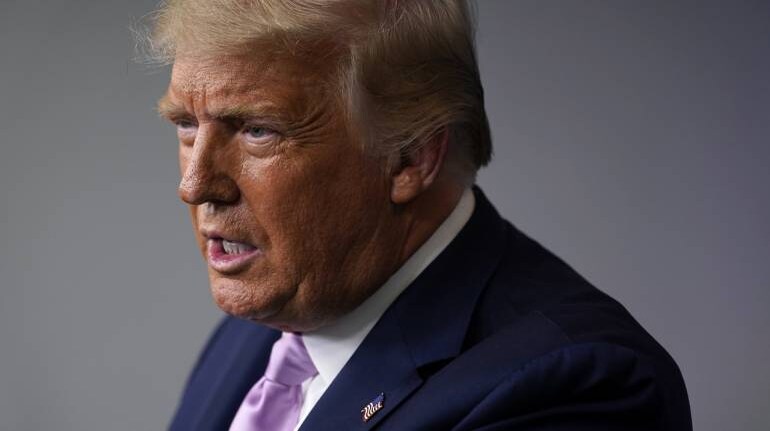
For nearly four years, President Donald Trump has publicly railed against the North Atlantic Treaty Organization, angrily demanding that its members pay more for Europe’s collective defense. In private, Trump has gone further — speaking repeatedly about withdrawing altogether from the 71-year-old military alliance, according to those familiar with the conversations.
In a second term, he may get his chance.
Recent accounts by former senior national security officials in the Trump administration have contributed to growing unease on Capitol Hill and across Europe, as they lend credence to a scenario in which Trump, emboldened by reelection, and potentially surrounded by an inexperienced, second-term national security team, could finally move to undermine — or even end — America’s NATO membership.
These former officials warn that such a move would be one of the biggest global strategic shifts in generations and a major victory for President Vladimir Putin of Russia.
Although Trump has been known to have expressed interest in withdrawing America from NATO since 2018, new evidence of his thinking has emerged in the run up to the November election.
This summer, Trump’s former national security adviser, John Bolton, published a book that described the president as repeatedly saying he wanted to quit the alliance. Last month, Bolton speculated to a Spanish newspaper that Trump might even spring an “October surprise” shortly before the election by declaring his intention to leave NATO in a second term.
And in a new book published this week, New York Times reporter Michael S. Schmidt wrote that Trump’s former chief of staff John Kelly, a retired Marine four-star general, told others that “one of the most difficult tasks he faced with Trump was trying to stop him from pulling out of NATO.” One person who has heard Kelly speak in private settings confirmed that he has made such remarks.
Although the president routinely complains that other NATO members should spend more on defense — often betraying confusion about how the 30-nation alliance operates — Trump has not publicly threatened to leave it. During the Republican National Convention last week, he boasted of having pressured other NATO members into increasing their defense budgets, but did not suggest he had bigger changes in mind for the alliance. A 50-point second-term agenda released by Trump’s campaign last month made no specific mention of NATO, although it featured a familiar promise to “get allies to pay their fair share.”
On Wednesday, Trump spoke in North Carolina at an event commemorating the 75th anniversary of the end of World War II — a conflict from whose ashes NATO was formed to protect Western Europe from the Soviet Union — but made no mention of a continuing US security relationship with the Continent.
For the past several months, the security establishments in Washington and Europe have briefly exhaled, concluding that Trump is unlikely to challenge the alliance’s core tenets before the end of this term. But as the election approaches, experts say that anxiety is growing.
“It is a real risk,” said Thomas Wright, director of the Center on the United States and Europe at the Brookings Institution, a think tank in Washington. “We know from Kelly and Bolton that he wanted to go much farther in the first term. If he feels that he has been totally vindicated in the election, and he feels that people have endorsed his policies, I think he could effectively withdraw from NATO.”
Congress would most likely move to block any effort by Trump to exit the alliance altogether, but experts said he could deal it a near-lethal blow in other ways. One would be to undermine a provision in the original treaty, Article 5, which calls for collective self-defense and which every past president has interpreted as a promise to defend any member from military attacks, but which Trump has questioned in the past.
“He could just reinterpret it as, ‘I could just send a strongly-worded letter,’” Wright said.
Jorge Benitez, a senior fellow at the Atlantic Council, a think tank in Washington, noted that the Trump administration announced plans in July to withdraw 12,000 US troops from Germany, the strategic heart of the alliance, and sought to cut funding for the Pentagon’s European Deterrence Initiative, a program whose funding the administration initially called for increasing and pointed to as evidence of the president’s support for the alliance.
European officials, Benitez said, “see the escalation of negative steps, and they are definitely concerned that that negative pattern could continue if Trump is reelected.”
On Capitol Hill, Democrats focused on security issues say a reelected Trump could permanently reshape the relationship between America and Europe, which has been defined for generations by Washington’s bipartisan role as a leader and protector of the continent.
“Withdrawing from NATO would be nothing short of catastrophic and further highlights the historic importance of this election,” said Sen. Jeanne Shaheen, D-N.H.
“Bipartisan support for NATO in Congress is unwavering and overwhelming, and there are significant procedural hurdles if any president were to choose this path,” added Shaheen, a senior member of the Senate Foreign Relations Committee. “President Trump has undermined trans-Atlantic relations from day one, and the only one reaping the benefits is Vladimir Putin. Speculation of a future withdrawal is in itself a victory for the Kremlin and beyond Putin’s wildest dreams.”
European diplomats are exceedingly cautious when speaking on the subject, fearful of provoking Trump. One ambassador from a NATO nation declined to comment on a hypothetical scenario. But people who have spoken to these senior diplomats say that a Trump victory will create a new sense of emergency across Europe.
Trump has grown increasingly confident in his own command of national security, and where he once surrounded himself with strong-willed, establishment figures to help him navigate war and diplomacy, he now relies more on less experienced advisers who are less inclined to challenge him.
Gone are seasoned officials with a strong loyalty to NATO and the trans-Atlantic relationship, including Kelly; Jim Mattis, another retired Marine four-star general and Trump’s first defense secretary; and H.R. McMaster, a retired three-star Army general and Trump’s former national security adviser.
Their current successors are not thought to be acting as strong checks on Trump’s instincts. Trump even jokingly referred recently to his current defense secretary, Mark T Esper, as “Yesper.”
An iconoclast in many other ways, Bolton is a believer in NATO, and has said he was appalled by Trump’s talk of quitting the alliance. In his book, Bolton recalls how Trump, just before a 2018 visit to NATO headquarters in Brussels, dictated remarks saying that “we will walk out” of the pact and “not defend those” who have failed to meet their spending commitments. (Bolton said he was prepared to resign if Trump delivered the remarks. He and other officials talked the president out of it.)
Since then, Trump has settled for haranguing NATO members to meet their collective pledge to spend at least 2 percent of their gross domestic product on military spending, something only the United States and eight other members now do.
Trump frequently complains about those who do not, but refers to their spending as delinquent “payments,” suggesting that he fails to understand that the spending at issue is almost entirely in regards to how much NATO members spend on their own militaries, which are coordinated by the alliance. (NATO does have a comparatively small shared budget for administrative costs and some military equipment.)
Trump also regularly misstates how much that spending has increased since he took office.
During the Republican convention, he boasted that member nations “were very far behind in their defense payments, but at my strong urging, they agreed to pay $130 billion more a year,” a figure he said would “ultimately go up to $400 billion a year.”
The figures are wildly exaggerated, reflecting cumulative spending hikes in the defense budgets of NATO members over several years — dating to before the start of Trump’s presidency — and are not annual increases.
Trump has hinted in the past that he might not come to the defense of NATO countries that are not meeting the alliance’s target of spending on defense.
Constanze Stelzenmüller, a senior fellow at the Brookings Institution who specializes in relations with Germany, said that Trump could simply make that U.S. policy, blowing a hole in the alliance’s collective defense ethos.
“So, assuming there is a second Trump term, even if the president doesn’t decide on one fine morning he wants to leave NATO, there are a variety of ways that much harm can be done to the alliance,” she said.
c.2020 The New York Times Company
Discover the latest Business News, Sensex, and Nifty updates. Obtain Personal Finance insights, tax queries, and expert opinions on Moneycontrol or download the Moneycontrol App to stay updated!
Find the best of Al News in one place, specially curated for you every weekend.
Stay on top of the latest tech trends and biggest startup news.