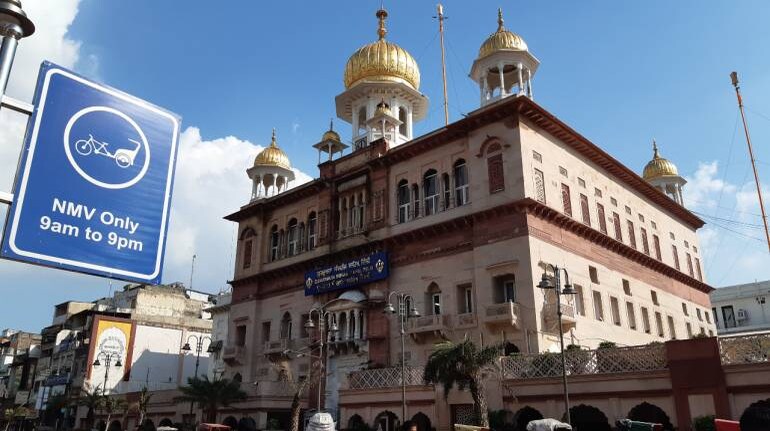
As you step out of the Lal Quila Metro Station on the Violet line, and turn right towards Chandni Chowk, a different sight greets you these days.
The ubiquitous, choc-a-bloc traffic synonymous with the wholesale market in the heart of Old Delhi is gone. The exasperating noise emanating from vehicles that would honk non-stop, breaking all permitted decibel levels, has drastically reduced. The overhead, ugly dangling utility wires are missing, and the skyline is clearer.
The teeming crowds are present, but spread out all over the road, which is now a pedestrian-friendly, sandstone-paved thoroughfare, with motorised vehicles (except licensed rickshaws) barred from 9 am to 9pm. All of a sudden, the super-busy market seemed to have slowed down a little.
Welcome to the revamped Chandni Chowk, thrown open earlier this month as part of a project to reinvigorate the congested Walled City and make it tourist-friendly.
The Delhi High Court is monitoring the project to restore the lost glory of the Mughal-era shopping arcade, which over time has become one of Delhi’s biggest wholesale and retail hubs, where everything from garments to electricals and electronics to food grains to jewellery to spectacles is sold.
So how does the refurbished market fare for stakeholders such as shoppers, tourists, traders and residents? The answer is mixed. Tourists and shoppers this writer spoke to were delighted at the new hangout zone while many traders and locals seemed a tad unhappy.
A delight for consumers and touristsFor shoppers used to the usual destinations such as Lajpat Nagar, Sarojini Nagar and Karol Bagh, or foodies looking for authentic Delhi-6 recipes, it is a new-found experience.
Preeti Dwivedi, a marketing executive, was food-joint-hopping with her friends at Paranthe Wali Gali. “I had lunch here. Next is dessert at Annapurna Sweets as suggested by my Bengali colleagues. I heard there is a dry fruit market at Khari Baoli. Will buy some for my mom back home in Ratlam.”
Dwivedi, who has been living in Lajpat Nagar for six years, had never visited Old Delhi earlier. “I could never gather courage because of the crowds and congestion. After I saw photographs of the redone market, I decided to pay a visit. I am enjoying every bit of it.”
The market now looks smarter and neater and is convenient to walk around for sure, as the 1.3-km stretch from the Red Fort crossing to the Fatehpuri mosque is completely out of bounds for motorised traffic for 12 hours. The lurking fear that you could be knocked down by a vehicle or a porter carrying goods is gone.
Signages at key spots guide shoppers. The central verge has flowering plants and ornamental shrubs. Stone benches have been installed at regular intervals. The middle lanes, demarcated by small stone pillars, are for non-motorised vehicles such as rickshaws.
The power, telephone and other utility cables have gone underground. The transformers have been shifted to the central verge. LED streetlights have been installed and new toilets built at four spots. There are plans to introduce golf carts for people with walking difficulties. CCTV cameras keep an eye on the proceedings.
A few lanes away, Shreekanth Ramakrishnan, a tourist who had come from Thrissur, Kerala, with his family, was doing some serious shopping in the lehenga markets in and around Nai Sarak, Naya Katra and behind Town Hall.
“We used to visit Karol Bagh but never tried Chandni Chowk. A guest at our hotel insisted we try it once. It was easy reaching here. We took the Metro. There is so much to buy and explore,” Ramakrishnan said in a mix of Hindi and English.

Shop owners and businessmen had a different reaction, though. Many traders this writer spoke to across the length of the market were not as upbeat as expected.
The reasons were varied. The majority were not happy with the curfew on loading and unloading of bulk goods during daytime. Some felt the blanket ban on cars from 9am to 9pm would deter serious and bulk buyers. Others were of the view that the increased footfall won’t result in serious business as most visitors were just sightseers and would benefit only food joints.
“This is a government decision, what do I say? Cars are not allowed. We have to come early or stay back for loading or unloading, which has been allowed before 9am or after 9pm,” said a jeweller at the Dariba Kalan jewellery market, who refused to be named. “First we took a hit during Covid and now this.”
A couple of hundred metres away, near Town Hall, a readymade garment shop owner was waiting for customers. He said he lost many customers ever since cars were barred. “See for yourself. All these people are sightseers. At best, the food outlets will gain. There are elderly people and women who cannot walk all the way to the Metro with goods,” said the shop owner, who didn’t want to be named.
His neighbour, who sells lehengas, joined the conversation. He said they have to pay extra for unloading goods as the big trucks are parked at quite a distance from his shop. “This place was barricaded for months during renovation. Then Covid came. We had hopes from the festive season to make up for the losses but do not know what to expect.”
Pradeep Gupta, president of the Chemical Merchants Association and a former councillor, argued that shops towards Red Fort and Bhagirath Place may not take a hit but those located at the far end would suffer. “Customers who don’t know the area won’t venture beyond Fountain Chowk. If you observe, the crowds thin out as you approach Town Hall and Khari Baoli side.”
Lack of parking, Gupta claimed, will deter bulk buyers as they have to park at a distance or near Red Fort and take a rickshaw to their destinations, and vice versa. “Bulk buyers for, say, weddings, will not walk with stuff in their hands or on a rickshaw.”
Inner lanes still congestedLocals had their share of complaints too. They say while the main road has been beautified, the inner lanes and katras have been ignored and the chaos has shifted to these areas.
They were not entirely wrong. The scene at the narrow alleys and arterial roads leading to Chandni Chowk—which the government plans to revamp in the next phase—was different. Rickshaws, carts and humans were all jostling for space on the clogged and damaged roads.
“Look at the road leading to the Old Delhi Station; it is a black spot and in such a bad shape. Tourists who come from the station via that road won’t get a good impression,” Gupta said.
At Esplanade Road, a fight had broken out between an e-rickshaw operator, who was trying to take a U-turn, and a rickshaw-puller. A long queue of carts and rickshaws formed in just 10 minutes. A policeman was quick to intervene and restore the traffic flow. The scene was similar at Nai Sarak, Dariba Kalan, the road leading to Old Delhi Railway Station, near Fatehpuri Mosque and other lanes.
Near the Fatehpuri tri-junction, a civil defence volunteer was trying hard to stop unlicensed rickshaws from entering Chandni Chowk. “Managing them is tough. Only licensed rickshaws will be allowed. All rickshaws from nearby areas have come here after hearing that only non-motorised vehicles will be allowed,” he said.
Burhanuddun, a local who runs a workshop at Fatehpuri, said moving from one side of Chandni Chowk to the other has become difficult. “If we have to go to the Old Delhi Railway Station from Dariba, Nai Sarak or Ballimaran on a bike, or vice-versa, we have to take a long detour,” he explained.
At another lane near Town Hall, a private guard was having an argument with a biker, who was trying to enter the main road. “Bike riders quarrel when we block them. It is difficult to manage alone.” The biker argued he had some urgent work.
A hawker selling cut fruits in another alley said life hadn’t changed in the inner lanes, which, he claimed, had become even more congested.
Many locals raised concerns about medical emergencies. “What do we do then? Take a cycle rickshaw?” asked Gupta, who lives in Nai Sarak. “All roads are blocked for vehicles. It is like a jail. What will happen when schools reopen?” he said.
Gupta pointed to the problem of unauthorised rickshaws and encroachments by shops and hawkers, saying they violate non-squatting, non-hawking orders of courts. The central verge has been taken over, he said. “People hang clothes, and keep piles of goods everywhere.”
Many locals said they were not taken into account during the planning stage. “The ground realities were totally ignored,” they said.
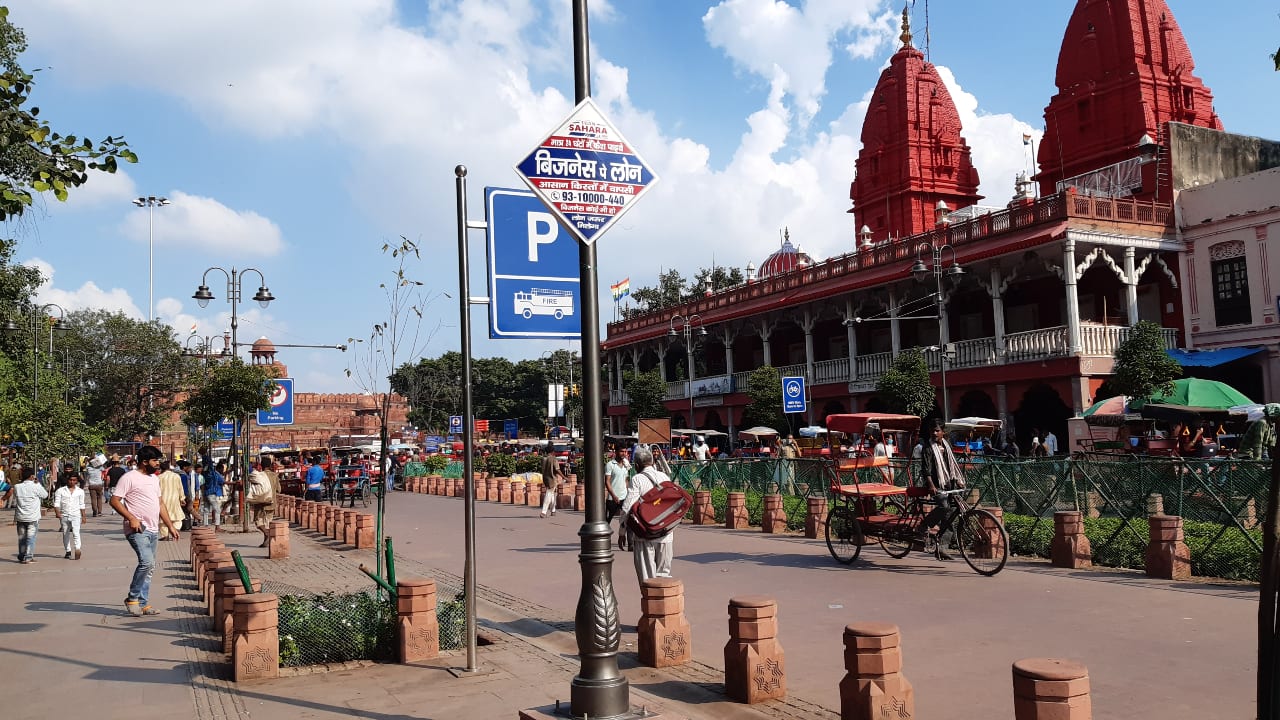 The main road now is a pedestrian-friendly, sandstone-paved thoroughfare. But the inner lanes and katras, locals say, are still crowded and chaotic.Reclaiming the streets
But then there were other traders who are at ease with the developments, saying whatever has happened is for the better.
Rakesh Mehra, a kulfi-seller, is one such person. “We all make small adjustments to improve our lives, don’t we? The same is happening here. Things will get streamlined. There is so much order here now,” he said. The arrival of the Metro, coupled with the pedestrianisation, Mehra said, has made Chandni Chowk a tourist-friendly and shopper-friendly experience.
Chandni Chowk has two Metro stations—Lal Quila on the Violet line and Chandni Chowk on the Yellow line—which have made the area accessible from any part of Delhi-NCR.
A dry fruits merchant at Khari Baoli felt along similar lines. “There has been a little inconvenience but we can adjust. This place was always congested. Now it is easier on my ears with the honking gone. Buyers will come anyway.”
At the electricals and electronics hubs of Bhagirath Place and Lala Lajpat Rai markets, most sellers were happy, saying the revamp is a boon for them.
“Those who avoided this place now can come, shop and eat without any hassle. The value of Bhagirath Place and Lala Lajpat Rai markets has doubled,” said Md Sawab, who owns an electronics shop.
Residents who support the decision say the pedestrianisation move has helped them to reclaim their streets, and given them some breathing space from the endless congestion.
Abu Sufiyan, a local resident who runs an online platform called Purani Dilli Walon Ki Baatein, said the revamp has helped local residents to revive their community engagement, culture and raised the area’s heritage value, though it is nothing compared with what it used to be in the pre-Independence days.
Towards late evening, local residents step out from their homes in the congested bylanes for a breath of fresh air in Chandni Chowk, which is the only open space in the area.
“It has become a sort of a family space like India Gate. You will see families chatting, having ice-cream, kids skating, playing badminton and cycling till late in the night,” Sufiyan says, a thought echoed by Garima Gupta, managing director, Shahjahanabad Redevelopment Corporation (SRDC), a special purpose body under the Delhi government, which is implementing the project.
Sufiyan said many original inhabitants had moved out of Old Delhi as the neighbourhood had become unliveable because of rampant commercialisation and haphazard development over decades. “People had started doing whatever they wanted, which is not right,” Sufiyan said.
The project, Sufiyan said, is a step in the right direction to re-establish and revive the lost culture of Chandni Chowk. “There was a need to remind people that living is not just about having a roof above your head," Sufiyan said. "You need to have a lifestyle, a sense of belonging, which is the key essence of the project.”
Change is for the betterSenior government officials and trader representatives actively associated with the revamp say the long-awaited project will boost tourism, help businesses and rejuvenate Chandni Chowk, which, along with the nearby Sadar Bazar and Jama Masjid areas, have immense heritage value, apart from being north India’s biggest wholesale hubs.
“Business cannot flourish if customers can’t reach shops. It is people who shop, not vehicles. We made space for pedestrians. They now move around freely, without the fear of being knocked down. We have made the place accessible to all,” Garima Gupta said.
In response to the locals' complaints, she said the inner lanes, katras and facades of Chandni Chowk will be developed in the next phase. “It is a step-by-step process. The inner lanes connecting other heritage sites will be made pedestrian and shopper-friendly.”
Golf carts will be introduced to ferry people from one spot to another and make it more accessible for those who find it hard to walk, she said. “The place is not completely blocked. People can always take rickshaws to reach motorised zones.”
Referring to encroachments and illegal rickshaws, the SRDC MD said a special task force oversees all violations and takes action. “There are teething troubles in every new project. Encroachments are a major problem all over Delhi. We are working to make things smoother,” she said.
The development was challenging given the character of the area, Garima Gupta said. “Stakeholder consultation was the backbone of the project. There were no dharnas, no protests during the revamp. All agencies, including MCDs, police and others, played their part well,” she added.
Sanjay Bhargava, president of the Chandni Chowk Sarv Vyapar Mandal (CCSVM), said they had been keen on the project for more than 21 years, which finally bore fruit after the Delhi High Court’s intervention.
The Chandni Chowk redevelopment project was first discussed in 1998 but it never took off. There were various reasons, including multiplicity of authorities controlling various departments. The foundation of the project was laid 20 years later, in December 2018, but it got further delayed because of a ban on construction during the winter months when pollution peaks in Delhi and then the Covid-19 outbreak.
Bhargava said Chandni Chowk was sinking under its own pressure and needed relief. “We wanted to bring in some order. Everybody has to survive,” he said.
Giving an analogy, he said a place meant for 500 is filled with 50,000 people, which explains the extent of the problem. People did business on the road, from thelas, from small rooms where one can barely sit, let alone store goods, he explained. “Just because everybody was doing whatever they wanted doesn’t mean this was right and would go on for ever.”
Speaking about traders’ complaints, Bhargava said commercial loading and unloading was anyway barred during daytime on court orders. Wholesale buyers, he said, do not pick up stuff at the spot. “Goods are packed, loaded and transported according to a process. Transporters always work at night.”
The redevelopment, he summed up, has helped the business to boom as more shoppers have started coming in. “Consumers are now finding it easy to move around buy stuff. We have high expectations from the festive season, provided there is no third wave of Covid.”
Regardless of all complaints and teething troubles, the new-look Chandni Chowk is definitely is worth a walk.
Discover the latest Business News, Sensex, and Nifty updates. Obtain Personal Finance insights, tax queries, and expert opinions on Moneycontrol or download the Moneycontrol App to stay updated!
Find the best of Al News in one place, specially curated for you every weekend.
Stay on top of the latest tech trends and biggest startup news.