






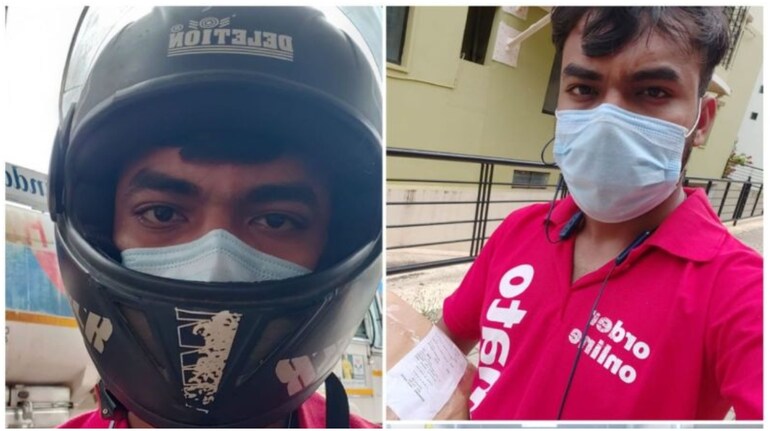
A startup founder has described how working as a Zomato delivery partner in Bengaluru enabled him to fund his education, remain financially independent and later establish his own company, and has said that the experience informed his decision to publicly support Zomato founder Deepinder Goyal amid ongoing debates around gig work and rapid delivery models.
In a LinkedIn post, Suraj Biswas, founder and chief executive of deep-tech firm Assessli, said he “stands with Zomato” and “stands with Deepinder”, stating that his views were shaped by direct personal experience rather than observation from outside the gig economy.
Biswas wrote that during 2020–21, before his college schedule was fully underway and prior to launching Assessli, he worked as a Zomato delivery partner in Bengaluru. Describing that phase of his life, he wrote: “Not a story for sympathy. A story of independence, dignity, and opportunity.”
He said he undertook delivery work to pay his college fees, support members of his early startup team and maintain financial independence. Referring to his current position, Biswas wrote: “Today I run a Deeptech Startup Assessli ™ as founder and employ 40+ techies operating from offices in Bengaluru and Kolkata.”
According to Biswas, his monthly earnings as a delivery partner were approximately Rs 40,000, and he personally knew riders who earned between Rs 80,000 and Rs 90,000 per month. He added that the role did not involve academic qualifications or social advantage. “No degree checks. No background privilege. Just effort + tech + execution,” he wrote.
Biswas also recounted the risks associated with the job, stating that he had experienced “food snatching and life-threatening moments” while making deliveries. He said he had accessed medical insurance provided through Zomato and that the company had offered support during emergencies. “When things went wrong, Zomato coordinated with police and supported me,” he wrote. Reflecting on that experience, he added: “That’s when I truly understood the power of well-built tech + systems. This is also where my obsession with building impactful technology came from.”
Addressing the ongoing public discussion around 10-minute delivery timelines and conditions for gig workers, Biswas said that delivery work should be understood as voluntary and flexible. “This was independent gig work, not forced labour,” he wrote, adding that many delivery partners work across more than one platform simultaneously.
He further argued that commitment in gig work is determined by flexibility rather than exclusivity. “Loyalty in gig work is flexibility-driven, not contract-driven,” he said, claiming that more than half of riders operate on two or three platforms at the same time, based on his own experience.
Biswas questioned whether a fixed-salary, full-time employment model with platform exclusivity would be viable. “If Zomato made it a fixed-salary, full-time job with exclusivity… how many riders would actually stay?” he asked, adding that such a structure would not be sustainable in the long term.
Criticising calls for bans and regulatory reactions, Biswas argued that they would not address unemployment. “What actually solves unemployment?” he wrote. “Not bans. Not outrage. Not unrealistic expectations.” Instead, he called for the expansion of technology-driven platforms that can provide income opportunities for individuals without formal education.
He said Zomato’s broader impact extended beyond food delivery. “Zomato didn’t just deliver food. It delivered economic mobility at scale,” Biswas wrote, adding: “Deepinder Goyalbuilt systems that allowed: Students to earn, Migrants to survive cities, Millions to work on their own terms.”
Summarising his position, he wrote: “So yes, unapologetically— I stand with Zomato. I stand with Deepinder. And I stand for systems that create opportunity, not entitlement. If you’ve lived this life, you’ll understand. If you haven’t, maybe listen to those who have.”
The post prompted debate online, with several users expressing support for Biswas’s views. One user wrote: “I relate to this deeply. I worked with Zomato, and like many others, got backed out post–COVID. That phase taught me more than any classroom ever could. Zomato wasn’t just a job or a gig work — it was exposure, resilience, and a launchpad. It showed me what scale, systems, and tech-led opportunity actually look like on the ground.”
Another commenter said: “This perspective really matters, especially coming from someone who has lived this experience firsthand. Gig work means different things to different people and for many, it represents flexibility, dignity, and independence. The system isn’t perfect, but it has clearly created real opportunities.”
"This resonated deeply. I've seen this ecosystem from close quarters the hunger to earn, the need for flexibility, and the dignity that comes with choosing your own hours. For many, gig work isn't a "problem to fix," it's a bridge to education, stability, and self-belief," a user remarked.
However, others disagreed with Biswas’s assessment, arguing that broader structural concerns surrounding minimum earnings, healthcare access and long-term social security for gig workers could not be set aside, even if individual experiences were positive.
"But this can not be the reason for exclusive exclusion. The wider topic and point of concern is there should be wider policy regarding wage security, health security and social security. Gig can never become formal employment unless it is recognised by govt rule under minimum wage act," a user added.
Another user noted, "Choice is the real driver here. Speed works because riders opt in and systems are built for flexibility. Take that away, and opportunity quietly disappears."
Discover the latest Business News, Sensex, and Nifty updates. Obtain Personal Finance insights, tax queries, and expert opinions on Moneycontrol or download the Moneycontrol App to stay updated!
Find the best of Al News in one place, specially curated for you every weekend.
Stay on top of the latest tech trends and biggest startup news.




