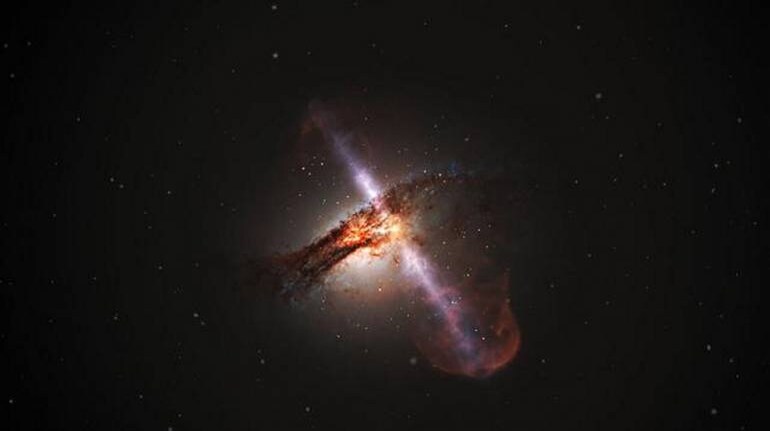
The scientific community has announced the detection of an unforeseen collision of a neutron star with a black hole, and a collision between three possible black hole mergers and two neutron stars.
The scientists made the observations last month after three gravitational wave detectors – two LIGO detectors in the United States and one Virgo detector in Italy -- turned on for an observational campaign that started on April 1.
The collision of neutron stars can be detected through the gravitational waves they release in space. The detections made so far are being treated as assumptions until further data can be gathered to corroborate it, reported CNN.com.
David Reitze, Executive Director, LIGO, said: “We’re already seeing hints of the first observation of a black hole swallowing a neutron star. If this is proven correct, it would be a trifecta for LIGO and Virgo -- in three years, we will have observed every kind of black hole and neutron star collision known. However, claims of detections require a lot of painstaking work that goes in checking and rechecking. So, so we will have to see how far the data takes us.”
The first signal of gravitational waves was picked up back in February 2016. The first neutron star collision was observed in 2017. Thus it started a whole new field of astronomy that involved studying gravitational waves.
Neutron stars are remnants of supernovae, the smallest stars in the universe. Though their dimensions are close to that of a larger state such as Maharashtra, they are very dense, with masses greater than that of our Sun.
On April 25, the Virgo detector along with one of the LIGO detectors picked up a signal suggestive of a neutron star merger. Scientists believe the collision took place between 370 to 640 million light-years away from the Earth.
The following day, another similar signal was picked up by all the three detectors; this one indicated a collision a black hole and a neutron star, which is a phenomenon mankind observed and recorded for the first time.
However, it cannot be said for certain if it was indeed a merger with a black hole or yet another merger between two neutron stars, since this collision took place farther away, approximately 900 million to 1.6 billion light-years from the Earth.
So far, the collaboration between LIGO and Virgo has detected evidence of 13 black hole mergers, gravitational waves, two neutron star mergers, and a likely collision between a black hole and a neutron star. Studying black hole mergers is important because the gravitational waves these produce warp the space-time continuum.
Discover the latest Business News, Sensex, and Nifty updates. Obtain Personal Finance insights, tax queries, and expert opinions on Moneycontrol or download the Moneycontrol App to stay updated!
Find the best of Al News in one place, specially curated for you every weekend.
Stay on top of the latest tech trends and biggest startup news.