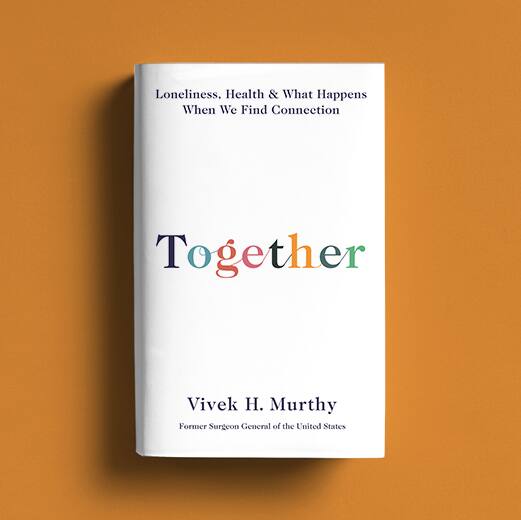
Vivek H Murthy’s book Together: Loneliness, Health and What Happens When We Find Connection (2020) could not have come at a better time. The COVID-19 pandemic has led to drastic changes in the nature, quality and frequency of human connection. While online modes of communication have helped people to stay connected, the lack of person-to- person contact is sorely missed by those who have not been able to meet their families, friends and other loved ones for a whole year.
The author is an American physician who served as the 19th surgeon general of the United States and is also a nominee to be the 21st surgeon general. The US surgeon general is the federal government’s spokesperson on public health and is nominated by the president.
Murthy, who was born to Indian parents who migrated from Karnataka, earned his MD from the Yale School of Medicine. He has spoken widely about loneliness as an epidemic and gun violence as a threat to public health.
Published by Profile Books in association with Wellcome Collection—a London-based museum and library—this book underscores the need for social connection to ensure physical and emotional health.
Murthy writes, “Just as hunger and thirst are our body’s ways of telling us we need to eat and drink, loneliness is the natural signal that reminds us when we need to connect with other people. There’s no cause for shame in that. Yet hunger and thirst feel much more acceptable to acknowledge and talk about than loneliness.”
This is such an apt description. It would be difficult to count the number of people who bury themselves in work, seek refuge in food, numb their pain with sex, or distract themselves with alcohol instead of seeking connection as an antidote to loneliness.
Reaching out can be terribly difficult, especially for those who consider self-reliance a virtue and dependence as a weakness. Being vulnerable is also challenging for people, particularly men who are taught in patriarchal societies to bottle up their feelings and tough up.
The situation is perhaps worse during the pandemic because people who are overstretched may have little time or energy to be there for others. That said, people do show up in surprising, and wonderfully creative ways, in times of crisis. Those who hesitate to name their need for connection can also train themselves to do things differently.
Murthy writes, “By learning to recognize and address the signals early, we can intervene to forge connections when loneliness strikes, instead of allowing it to become a constant in our daily lives.”

The willingness to learn such helpful behaviour can, to some extent, prevent serious health conditions from jeopardising our quality of life. Murthy’s review of existing research in the field made him realise that loneliness is associated with “a greater risk of coronary heart disease, high blood pressure, stroke, dementia, depression and anxiety”. He also came across studies suggesting that lonely people were more likely to have “lower-quality sleep, more immune system dysfunction, more impulsive behaviour, and impaired judgement.”
The book is not alarmist, though the quotes shared above might convey that impression. The author wants readers to take the subject of loneliness seriously because he has seen what it can do. He writes at length about a family friend from India who moved to the US, made significant efforts to blend in, took a loan from his boss to pay for his daughter’s wedding in India, kept working hard in the new country but missed his family back home quite intensely and eventually took his own life when he could not bear it any longer.
Murthy also draws from what he learnt on “a listening tour of America” during his term as the surgeon general. Before setting his agenda for the nation, he wanted to hear from Americans. He and his team were welcomed into communities in various states. He writes, “We sat down in small group meetings and large town halls, spending time with parents, teachers, pastors, small business owners, philanthropists, and community leaders.” Loneliness was the common thread in issues like addiction, violence, anxiety and depression.
The book contains insights from scientists, philosophers, doctors, cultural innovators, educators, community activists and meditation teachers. It cracks open “the seductive and dangerous myth of multitasking” and advocates for strong relationships because they have an impact on our health, mood and performances.
The book also introduces us to the workings of hormones and neurotransmitters, clarifies the distinction between loneliness and solitude and unpacks cultural factors related to loneliness.
Murthy does not romanticise cultures that prioritise the collective over the individual. Being a person of Indian descent, he is well aware of how privacy and freedom take a backseat even if childcare, traditional wisdom and emotional support are easy to access. His prescription to cultivate relationships also includes “befriending ourselves”. This is not a narcissistic activity. It is training for self-knowledge, which brings forth compassion. What this book lacks, however, is an analysis of socio-political systems that foster loneliness.
Discover the latest Business News, Sensex, and Nifty updates. Obtain Personal Finance insights, tax queries, and expert opinions on Moneycontrol or download the Moneycontrol App to stay updated!
Find the best of Al News in one place, specially curated for you every weekend.
Stay on top of the latest tech trends and biggest startup news.