From celebrities like Virat Kohli to micro influencers, many content creators seem to be flouting the influencer marketing guidelines which came into effect this year from June 14.
According to ad watchdog Advertising Standards Council of India (ASCI), over the past month, it has processed nearly 100 complaints against content not adhering to the recently released influencer marketing guidelines.
"Most of these pertain to non-disclosure of promotional content where there is a material connection between the influencer and the advertiser," Manisha Kapoor, Secretary-General, ASCI told Moneycontrol.
She added that most of the complaints were against ads in the personal care and beauty category.
Many such cases have come forward where a post looks promotional in nature but the influencer has not made any disclosure about the content being sponsored by a brand.
Only 20% influencers following paid content guidelines. Is ASCI listening?
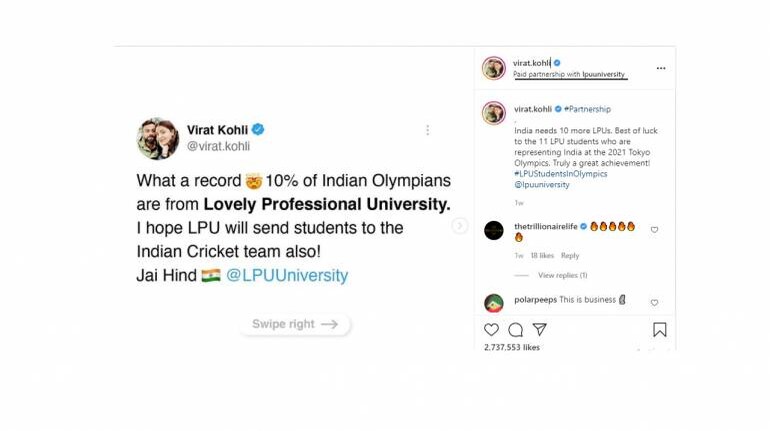
One such case is of cricketer Virat Kohli where he posted on social media on July 27 saying that 10 percent of Indian Olympians are from Lovely Professional University (LPU). And this post was devoid of any disclosure label like #ad, promo, sponsored that is required for any branded content.
ASCI had written to Kohli asking for clarification on the post whether there was any material connection between him and the brand, in this case LPU.
Kohli now has added a paid partnership disclosure to the LPU post.
Virat Kohli may be flouting ASCI's guidelines but Hrithik Roshan plays safe
This brings us to the point where we find out what actions ASCI takes against influencers flouting the guidelines.
"After we receive a complaint, ASCI writes to the advertiser and influencer asking them to provide evidence that the said post was not in violation of the ASCI guidelines and take appropriate corrective action. In most cases, the advertisers and influencers have voluntarily modified or withdrawn the post."
What if the content creator refutes the claims?Kapoor said that in cases where influencers have contested ASCI’s letter, the evidence and response is taken to the Consumer Complaints Committee (CCC) to assess whether there has been a violation, and the recommendation of the CCC is given to them, along with a timeline to implement the same.
What kind of evidence are influencers required to submit?If an influencer or brand claims that the content in question is not an advertisement or there is no material connection, the influencer has to submit to ASCI a declaration from the advertiser stating that there is no material connection between them and the influencer as on the date of the post, said Kapoor.
This declaration needs to be signed by a senior member of the advertiser’s organisation such as the marketing head, legal/compliance head, digital marketing head, she added.
What happens if influencers are unable to provide proof?In the event that the advertiser of the brand is difficult to trace in spite of reasonable efforts, or if the piece of communication features brands of multiple advertisers, then proof of purchase of featured products and brands, provided by the influencer, would be considered adequate evidence to refute material connection, said Kapoor.
She added that if such evidence or declaration is not forthcoming, then the ad will be considered in violation of the ASCI guidelines.
"And then a recommendation may be passed against such ads. Cases of non-compliant advertisers and influencers may be escalated to the government regulators for further action."
When it comes to non-compliance, Kapoor said that ASCI depends on consumers reporting violations on its WhatsApp number- 7710012345.
In addition, the ad regulator has tied up with the French firm Reech, which uses artificial intelligence to spot guideline violations in influencer posts.
"After detailed testing of the technology platform for the Indian market, we have set up specific monitoring parameters relevant to the country and the platform has now been deployed. This will allow us to monitor posts that even consumers may not have complained against," said Kapoor.
When it comes to guidelines for influencer advertising, India alone is not regulating paid content on social media.
Many other international markets have put in place such guidelines. For example, UK which has an Advertising Standards Authority (ASA) that monitors paid content. ASA last September found only 35 percent of ads were labelled properly and which were clearly identifiable.
While globally the influencer market is worth $1.75 billion, in India the influencer advertising has seen significant growth in the past 10 years and now is estimated at $75-150 million a year, according to AdLift, a digital marketing agency.
Discover the latest Business News, Sensex, and Nifty updates. Obtain Personal Finance insights, tax queries, and expert opinions on Moneycontrol or download the Moneycontrol App to stay updated!
Find the best of Al News in one place, specially curated for you every weekend.
Stay on top of the latest tech trends and biggest startup news.