


co-presented by
ASSOCIATE SPONSORS
co-presented by


ASSOCIATE SPONSORS



Urban air pollution is a challenge that you cannot ignore. Here are some proactive steps that can help you minimise the impact of pollution on your lungs and lead a healthier life despite the challenges of urban living.

Impacts of pollution: Long-term exposure to pollution harms both health and the environment. It can cause serious health issues like respiratory problems, heart disease, and cancer. Pollution also disrupts ecosystems and contributes to climate change.

How to keep your lungs healthy: Don't let air pollution take a toll on your lung health. Try these natural remedies to breathe easy and beat the harmful effects of air pollution in your city.

AQI Tracker: New Delhi records the highest air pollution levels among all major Indian cities.
AQI Tracker: New Delhi records the highest air pollution levels among all major Indian cities.

AQI Tracker: New Delhi records the highest air pollution levels among all major Indian cities.
According to the index, an AQI between zero and 50 is considered "good", 51 and 100 "satisfactory", 101 and 200 "moderate", 201 and 300 "poor", 301 and 400 "very poor", and 401 and 500 "severe".

The analysis found pollution led to chronic obstructive pulmonary disease, respiratory infections, lung cancer, heart disease, stroke, diabetes, neonatal disorders and cataracts.

The Commission for Air Quality Management in NCR and Adjoining Areas reviewed the progress of switching over of industries operating in Delhi to PNG during a meeting, which was attended by representatives of the city government, the GAIL and the Indraprastha Gas Limited (IGL).
According to the index, an AQI between zero and 50 is considered 'good', 51 and 100 'satisfactory', 101 and 200 'moderate', 201 and 300 'poor', 301 and 400 'very poor', and 401 and 500 'severe'.

The minimum temperature was 8.4 degrees Celsius, the India Meteorological Department said.

A bench headed by Chief Justice S A Bobde was told by Additional Solicitor General Aishwarya Bhati, appearing for the Centre, that the government is readying a comprehensive affidavit to be filed in the apex court in the matter.
Air pollution in the neighbouring cities of Ghaziabad (AQI 430), Greater Noida (404) and Noida (404) remained in the severe zone.
Air pollution in the neighbouring cities of Ghaziabad (AQI 446), Greater Noida (401) and Noida (406) also entered the "severe” zone.
The city’s air quality index (AQI) was 346 at 9 am. The 24-hour average AQI was 318 on Monday and 268 on Sunday.

The city’s air quality index (AQI) was 307. The 24-hour average AQI was 268 on Sunday. It was 231 on Saturday, 137 on Friday, 302 on Thursday and 413 on Wednesday.
The city’s air quality index (AQI), which was 302 at 4 pm on Thursday, improved to 131 by 9 am on Friday.

An AQI between zero and 50 is considered "good”, 51 and 100 "satisfactory”, 101 and 200 "moderate”, 201 and 300 "poor”, 301 and 400 "very poor”, and 401 and 500 "severe”.
According to the index, an AQI between zero and 50 is considered "good", 51 and 100 "satisfactory", 101 and 200 "moderate", 201 and 300 "poor", 301 and 400 "very poor", and 401 and 500 "severe".
The city recorded a 24-hour average air quality index (AQI) of 314. It was 344 on Wednesday and 476 on Tuesday. Delhi witnessed six "severe" air days on the trot from November 4 to November 9, according to Central Pollution Control Board data.
Government agencies and experts said calm wind was exacerbating the effect of stubble burning and a "quick recovery" is not possible unless the number of farm fires reduces drastically.
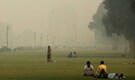
Through the Green Delhi application, people will be able to notify the government about burning waste, industrial pollution and construction dust in any area of the national capital.
The response from the Environment Secretary, R P Gupta came after the Supreme Court, which had raised concern over the worsening air quality in Delhi-NCR, was told by the Centre on Monday that it will bring a new legislation to curb pollution and submit a proposal before it in four days.


