
co-presented by
ASSOCIATE SPONSORS
co-presented by


ASSOCIATE SPONSORS




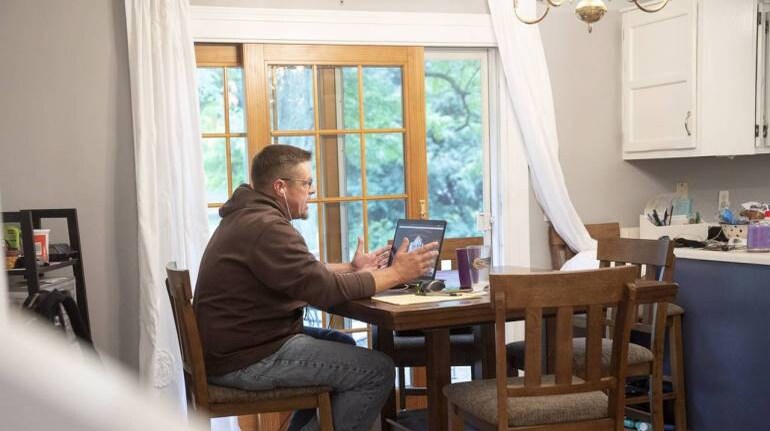
Employees who work entirely from home are less creative and less productive, according to a new working paper from the Stanford Institute for Economic Policy Research. Fully remote employees also receive less feedback and must spend more time coordinating. As a result, they work longer hours to keep up with their in-office peers.
But the researchers nevertheless predict we’ll see even more remote work in the future. That raises the question: If WFH has so many drawbacks, why can we expect more of it? And maybe more important: If we’ll be doing more of it, how can we mitigate its downsides?
The paper, by Jose Maria Barrero, Nicholas Bloom and Stephen J Davis, notes that the share of people working from home at least some of the time has doubled roughly every 15 years since about 1980; by 2019, about 5percent of workdays took place at home. That figure surged to 60percent in 2020 and has now plateaued at about 25percent. The authors say the change between 2019 and 2023 levels amounts to fast-forwarding the remote-work revolution by about 35 years.
They expect to see remote work decline slowly for the next couple of years as companies pressure workers to return before accelerating again for the next 20. In part, that will be the continuation of the long-term trend; and in part, it will be fueled by pandemic-era innovations. The number of patents mentioning terms like “telework” tripled after March 2020, and in the past, those kinds of advances have sent more workers remote.
The findings hold an important implication for corporate leaders: Exhorting employees to return to the office full time may be wasted energy. Fast internet connections have made at least some degree of remote work inevitable. Rather than trying to fight omnipresent technology, organisations might be better served by figuring out how to address challenges of fully remote work — disengagement, slower learning, even loneliness.
Fortunately, those downsides don’t always apply to what a lot of employees are doing now, which is hybrid work: alternating days in the office with days at home. In fact, hybrid work is associated with productivity gains. The debate that’s been raging since the COVID vaccines started going into arms is around how many days of face time matter.
But even if we could definitively answer that question, I’m not sure the answer would influence behavior as much as we assume. A lot of work will become virtual, whether we like it or not.
In fact, a lot of it already has. Some of the management problems that leaders have reported struggling with during the pandemic — meeting creep, employees who send a dozen emails instead of having a five-minute conversation, monitoring and giving feedback to workers in other locations and so on — have been around a long time. But they’ll become more common as technology sends more workers home.
That might mean rethinking some assumptions about how to manage remote staff.
For example, many managers have complained to me about the challenges of motivating their far-flung employees. A typical comment came from a senior executive who told me he feels as if he has two types of remote workers: lazy ones who do the bare minimum, and conscientious ones who do too much — or do the wrong things. But unlike other bosses who have tried to solve this problem by calling people back to the office, he has lighted a fire under the slowpokes by prodding them with a lot of short-term goals. And he now makes sure his sprinters are running in the right direction — lest they end up halfway down the wrong football field before he notices.
More fundamentally, managers could go back to the mid-century research of Frederick Herzberg and find that the same aspects that motivated employees in the pre-internet era probably still work today: achievement, recognition, interesting work and responsibility.
Or consider mentoring. One of the challenges facing remote workers, confirm Barrero, Bloom and Davis, is that they don’t have the same chances to learn as in-person staff members. A lot of on-the-job learning happens informally by overhearing colleagues working on the same types of problems. Early in my career, I learned a lot from listening to my bosses on the phone, interviewing sources or giving feedback to authors.
But maybe eavesdropping isn’t the best way to learn — or to teach. Maybe more knowledge can be transmitted when we’re intentional about doing so: taking the time to include junior colleagues on a call, walking them through the goals and debriefing afterward.
Loneliness might be a tougher problem to solve. Studies have long suggested that it’s important to have friends at work. It’s good for morale and engagement. And those sorts of human connections are vital for a good life — indeed, they’re the whole point, according to Marc Schulz, associate director of the decades-long Harvard Study of Adult Development.
It’s hard to forge those ties remotely; sharing memes on Slack just isn’t the same as sitting next to someone every day. At well-heeled companies, firms can bring employees together periodically to renew those bonds. But a remote-work future may well be a more isolated one.
That should be a reminder that although remote and hybrid work may have a lot of upsides, they won’t be unalloyed goods. And in that way, the changing nature of work isn’t so different from the other changes the internet has brought to our lives — the improvements always accompanied by new problems.
Sarah Green Carmichael is a Bloomberg Opinion editor. Views are personal and do not represent the stand of this publication.
Credit: Bloomberg
Discover the latest Business News, Sensex, and Nifty updates. Obtain Personal Finance insights, tax queries, and expert opinions on Moneycontrol or download the Moneycontrol App to stay updated!
Find the best of Al News in one place, specially curated for you every weekend.
Stay on top of the latest tech trends and biggest startup news.