India is one of the brightest spots in the global economy — the International Monetary Fund has just given us another pat on the back. Its World Economic Outlook Update predicts that while global growth will slow this year, growth in India will accelerate. The IMF forecasts India’s GDP growth to increase from 7.3% in 2018-19 to 7.5% in 2019-20.
Why is India expected to grow faster? The IMF report says, "India’s economy is poised to pick up in 2019, benefiting from lower oil prices and a slower pace of monetary tightening than previously expected, as inflation pressures ease."
Notice that the key to higher Indian growth is lower crude oil prices. It reduces inflation, allows the central bank to have a looser monetary policy, brings down interest rates, takes the pressure off the current account deficit and strengthens the currency. The reason why the IMF has increased its GDP growth projection from 7.4% to 7.5% in 2019-20 is lower oil prices.
By how much does it expect oil prices to be lower? The IMF has a benchmark based on the simple average prices of UK Brent, Dubai Fateh, and West Texas Intermediate crude oil. The average price of oil in US dollars a barrel for this benchmark was $68.58 in 2018; the assumed price, based on futures markets (as of November 27, 2018), is $58.95 in 2019 and $58.74 in 2020.
If oil prices pan out as predicted, there’s no doubt that growth in the Indian economy will get a boost. The question is: what is the IMF’s track record when it comes to predicting oil prices?
Cast your eyes on the accompanying chart. It shows the changes in oil prices forecast by the IMF’s World Economic Outlook publication and its updates between October 2017 and January 2019.
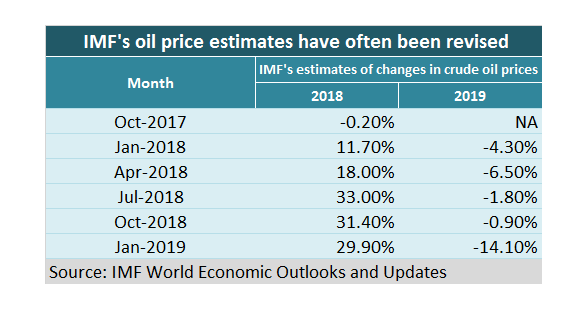
In October 2018, the World Economic Outlook thought that crude oil prices would decline by 0.2% in 2018. Come January 2018, however, it realised prices were headed higher and hastily revised its forecast for 2018, this time saying it would rise by 11.7%. In April, it revised it upwards to 18%. By July, with a relentless rise in crude, it panicked and jacked up its oil price growth estimate to 33%. By October last year, it lowered its estimate to 31.4%. And in January 2019, its latest WEO update says crude oil price growth in 2018 was 29.9%.
Clearly, the IMF has no special insight into the trajectory of crude oil prices — all it does is follow the market and the market changes frequently.
So yes, we should celebrate India’s resilience in the face of slowing global growth, but we need to take the IMF projections with a pinch of salt. And we need to keep a wary eye on oil prices.

Discover the latest Business News, Sensex, and Nifty updates. Obtain Personal Finance insights, tax queries, and expert opinions on Moneycontrol or download the Moneycontrol App to stay updated!
Find the best of Al News in one place, specially curated for you every weekend.
Stay on top of the latest tech trends and biggest startup news.