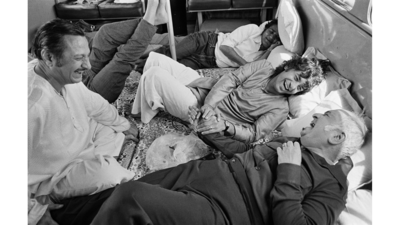
‘Ustad Zakir Hussain led me to the Green Room Gharana of photography’: artist Dayanita Singh
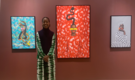
How to photograph a celebrity: Dayanita Singh first photographed feted Hindustani Classical musician Zakir Hussain when she was 18. Over the next 43 years, her archive of pictures of the Ustad – laughing, practising, teaching, sleeping, touring – grew into the 100s. For an upcoming photo exhibition in Delhi, Singh has culled 72 pictures that marked her initiation into what she now calls the ‘Green Room Gharana’ of photography.

Where to begin if you want to learn about Indian abstract art? A practitioner responds
When looking at an abstract work of art, ask yourself what it makes you feel rather than what it might represent, suggests artist Bappaditya Roy Chowdhury.
Board exams 2026: Scroll break or sketch break? The study reset your brain actually needs
Why the National Gallery of Modern Art (NGMA), Delhi, is promoting art-based study resets during exams, and how mindful viewing and active creation can trigger positive changes in mood and focus compared with passive consumption of content.
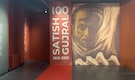
Satish Gujral retrospective at NGMA Delhi: From 1947 Partition paintings to neo-tantric art, how Gujral's legacy straddles multitudes
Satish Gujral 100: If you find it hard to pin down the art of Padma Vibhushan Satish Gujral (March 1925 - March 2020), a large retrospective exhibition at the National Gallery of Modern Art on India Gate C Hexagon can help to understand some of his ideas and experiments in drawing, painting, sculpture, murals and working with a variety of materials - some of them quite unconventional.
Business of photos: An archive of images from the 1970s - 1980s offers glimpses of Indian industry before liberalization
Photos don't just capture people and places; they freeze a moment in time. To those who know how to read them, photo archives can thus be fertile ground for research. Research on companies and promoters, of course. But also on processes and technologies. In the 1970s and 1980, Mahatta & Co shot images for MMTC, Maruti, handloom exports council, BHEL and Escorts, among other companies. Seeing photos from their archive now can be an exercise in nostalgia. But it can also an exercise in appreciating Indian industry before liberalization.
Exhibition at Delhi's Bikaner House unpacks how British Raj photographed the people of India, urges new readings
How the 1857 Revolt affected British colonizers: A photography project to understand, categorize and rule Indians better drove the British Raj to create an archive that is rich with information today about power structures in colonial India and pockets of resistance to them.
Fabric and feminism at India Art Fair 2026: East African photographer Thandiwe Muriu on embracing wax fabric and oral histories
At India Art Fair 2026: Nairobi-born photographer Thandiwe Muriu on coming to love East African wax textile prints, how women can perhaps come ‘to love ourselves more’, and coming to love her own Black hair and how it can do its own beautiful thing.
Reading ‘Chacha Chaudhry’ in a museum: The art - history - heritage quotient of comics, zines and posters
Museums have always been places for collecting, curating, contextualizing and displaying curiosities. A three-part exhibition in Delhi shows why comics, zines, posters and other ephemera must have a place in them.
Forget ChatGPT and Instagram, Indian artists are revisiting text and how it makes meaning
Even as social media and ChatGPT change the way we speak and write, artists are pulling text in different directions in their practice. Some examples from recent shows across Goa and New Delhi.
Madras Art Weekend: An art installation evokes Indian histories of trade and textile through indigo
India's long textile history is naturally recalled in an indigo-and-rice-paste-resist-dye installation at the Madras Art Weekend, opening across Chennai from December 3, 2025.
Delhi events: An art show that's all about Indian sculpture in the 20th century, in 40-plus works
'Sculpting the Century', an art exhibition at the Triveni Kala Sangam, is like a sampling menu of the biggest names in modern Indian sculpting in the 20th century - with some (expected and unexpected) lacunae.
Games People Play 02: Thukral & Tagra mark 20 years in Indian art with show featuring modified table tennis, multitasking game
As they complete 20 years of their art practice, artists Jiten Thukral and Sumir Tagra bring out games they have designed and modified over the years for visitors to play, see, hear.
'To work with leather today is to enter a space of ethical and conceptual responsibility': India Design ID Mumbai 2025 artist Meera
An artist presenting work at the India Design ID Mumbai, from September 26-28, explains why she works with leather and why she is more interested to evoke the ways in which our world responds to the laws of physics than depicting any one physical form through her work.
In photos: 48 Raja Ravi Varma prints with fabric and zari embellishments are on show in Australia
India-Australia cultural exchange: With a 'Maitri' grant from the Australian government and help from conservationists at the Museum of Art and Photography (MAP) in Bengaluru, an art gallery in Brisbane is showing Raja Ravi Varma's prints - embellished with fabric, zardozi and bundgi dots - till October 5.
‘Between the river and the ridge’: Peeling back layers of Delhi history, from the Mughal period to the rise of key cultural institutions at Mandi House
After Kolkata and Mumbai, DAG – formerly Delhi Art Gallery – brings its City As A Museum programme to the Capital; with visits to diverse corners from Rashtriyapati Bhavan to the Sunday Book Market at Daryaganj; an exhibition; and an immersive audio tour, among other events.
How to display art beyond hanging it on a wall, and more questions answered at the 2025 Delhi Contemporary Art Week
At Delhi Contemporary Art Week, a look at contextual ways to display the art pieces in your collection, an engagement with the materiality and ideas in contemporary sculpture, and an experience of how art itself can respond to its environment and reference its own source.
What you can't see on Maps: Revisiting an 1,850-km historic route to gold fields in Australia
The theme for Australia's National Reconciliation Week - from May 27 to June 3 - this year is Bridging Now to Next. The Australian High Commission in India is observing it with a show around indigenous Australian art.
‘Exotica to be collected’: Indian plants in East India Company paintings, and a rare plant that fanned Europe's orchid-mania
An ongoing art show at DAG Delhi and a new book by Trinity College literature professor Sarah Bilston revisit two ways in which the British sought to collect plants as well as knowledge about plants from colonized countries.
Zakir Hussain, thumri & fado: In its 10th year, Serendipity Arts Festival goes to Birmingham
In its 10th edition, Serendipity Arts Festival goes global and celebrates 10 years in 10 cities, starting with Birmingham, the UK. The four-day festival, from May 23-26, will showcase South Asian artistry to foster a cross-cultural dialogue.
Dreams, sex and living with art: Yesteryears actor and Lok Sabha MP Shatrughan Sinha's sons Luv, Kussh among 20 artists in 'Art of Confluence' show in Mumbai
6 artworks on show in 'The Art of Confluence' exhibition of digital art as well as traditional media, in south Mumbai. Exhibition on till Sunday, May 26.
Rishikesh art trail, from Beatles Ashram to the streets leading to Ram Jhula and Laxman Jhula
When in Rishikesh, you can't miss the public art along the routes to Ram Jhula and Lakshman Jhula. Also visit The Beatles Ashram, for some cool wall art capturing the vibe of the place. Plus, an art residency in the pilgrimage centre brings together artists from around the world.
Gulammohammed Sheikh retrospective at Kiran Nadar Museum of Art: People, places, histories
Gulammohammed Sheikh retrospective at KNMA Delhi may not be linear, but it captures six decades of the key Indian artist's thought and work across media.
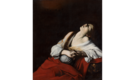
Must see: Attributed to Italian master Caravaggio, ‘Magdalene in Ecstasy’ is in Delhi
In 2014, art historian Mina Gregori said she had found 17th century painter Michelangelo Merisi da Caravaggio's 'Magdalene in Ecstasy' in a private collection. The Italian embassy in India and KNMA have now brought this work to Delhi for public viewing.
Himmat Shah (1933-2025) — Moulder of earth, Indus Valley-born artist leaves man from Moon at Delhi’s newest gallery
In the last show before Himmat Shah died on March 2, the inaugural 'Vocabulary of Vision' at the newly opened Black Cube Gallery, in Delhi's Hauz Khas, till March 23, brings together nine modern masters — including Gujarat's Lothal-born Shah — and 16 contemporary voices of Indian art.
There are no spelling mistakes here. These typos are intentional
Exclusive interview: Artist Shilpa Gupta on how borders divide but they also connect people, why points and moments of transition interest her, and how mobility and travel are integral to who we are as humans.