






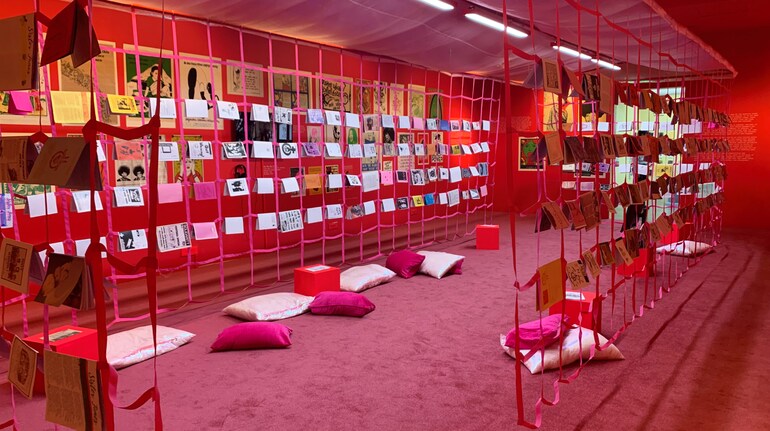
If you ever got flak for reading comics like Chacha Chaudhary and Tanashah, an ongoing exhibition at the Kiran Nadar Museum of Art (KNMA) in south Delhi might offer a kind of redemption. Titled ‘please touch gently’, the exhibition is all about comic books, zines, posters and other ephemera.
The title ‘please touch gently’ is “both an invitation and a provocation” to engage with the artefacts as opposed to seeing them from a distance as you typically would in a museum, says Akansha Rastogi, curator of the Young Artists of Our Times (YAOT) series at KNMA. ‘please touch gently’ is the fifth show in the YAOT series. (The lower case of the show title is deliberate, and is used by the curators in many places across the show.)
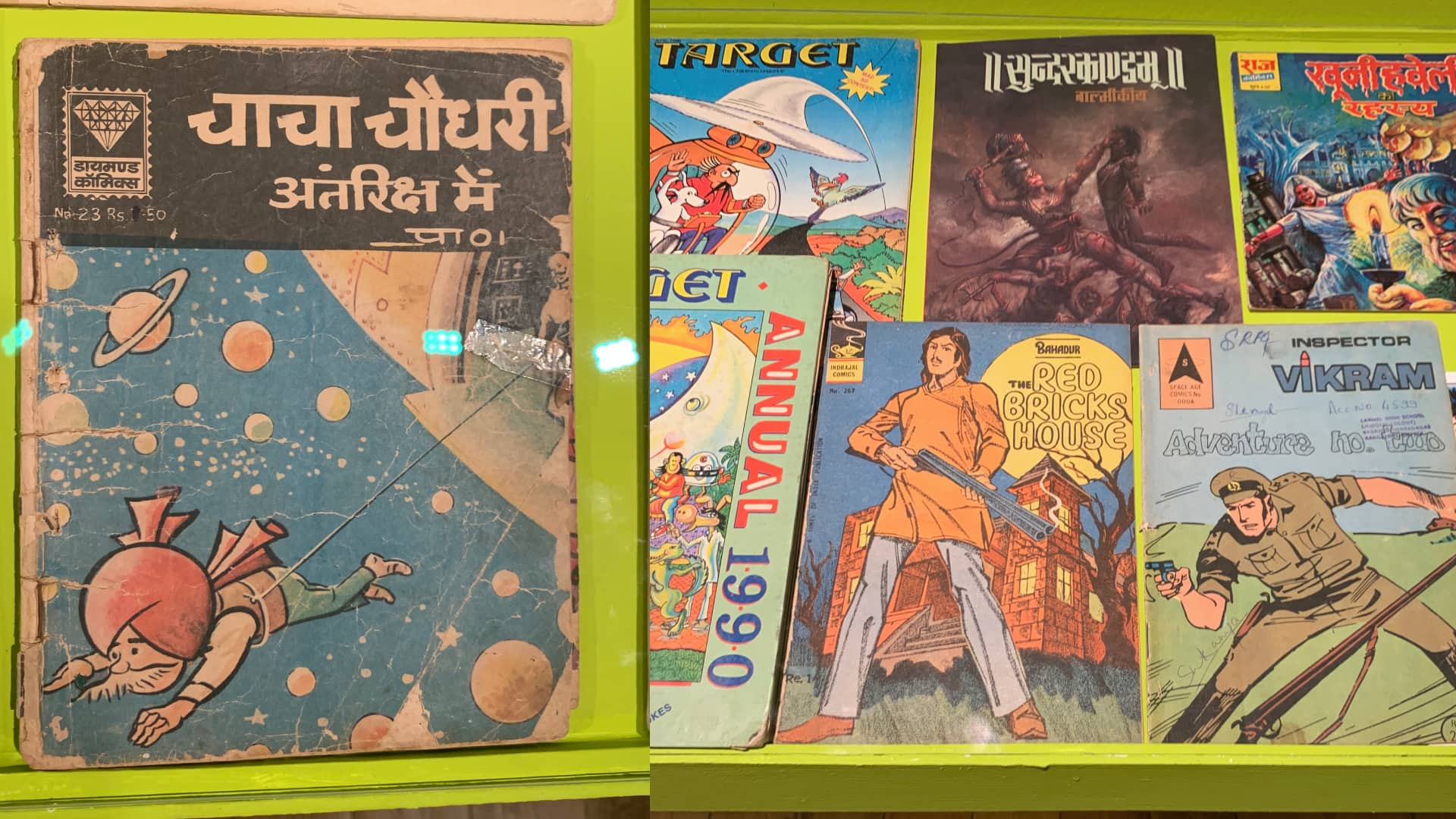 Indian comic books from the 1970s, '80s and '90s gave their readers new crime-fighting heroes and superheroes of Indian origin.
Within the show, there's a separate segment for comics, zines and posters, and each of the three segments has its own curator. The first section of ‘please touch gently (zines, comics, ephemera)’ is on comic books and graphic novels. Titled ‘We the People, Birds and Beasts, Deities and Demons…, it is curated by Bharath Murthy and tells a story of Indian comics. ‘Chacha Chaudhry’ by Pran to Satyajit Ray’s storyboards for ‘Pather Panchali’ are featured alongside Diamond Comics’ Film Chitrakatha with actual dialogue and still photos from Bollywood movies as well as cartoon strips by masters like Abu Abraham and south films director G. Aravindan. This section alone has works by dozens of practitioners and publications that were the stuff of popular culture in their time — and could easily be seen as the stuff of history and art history today.
(Readers of a certain vintage will remember ‘Billu’, ‘Pinki’, ‘Bahadur’ and the ‘Tanashah’ comics where Nagaraj and Super Commando Dhruva join forces to fight off the malevolent Hitler-inspired spirit; as well as Target magazine and Aravindan’s ‘Cheriya Manushyarum Valiya Lokavum’ [‘Small Men and the Big World’] cartoon strip). Indeed, the list of contributors to this segment is so long, an entire wall inside KNMA is devoted to listing them (see below).
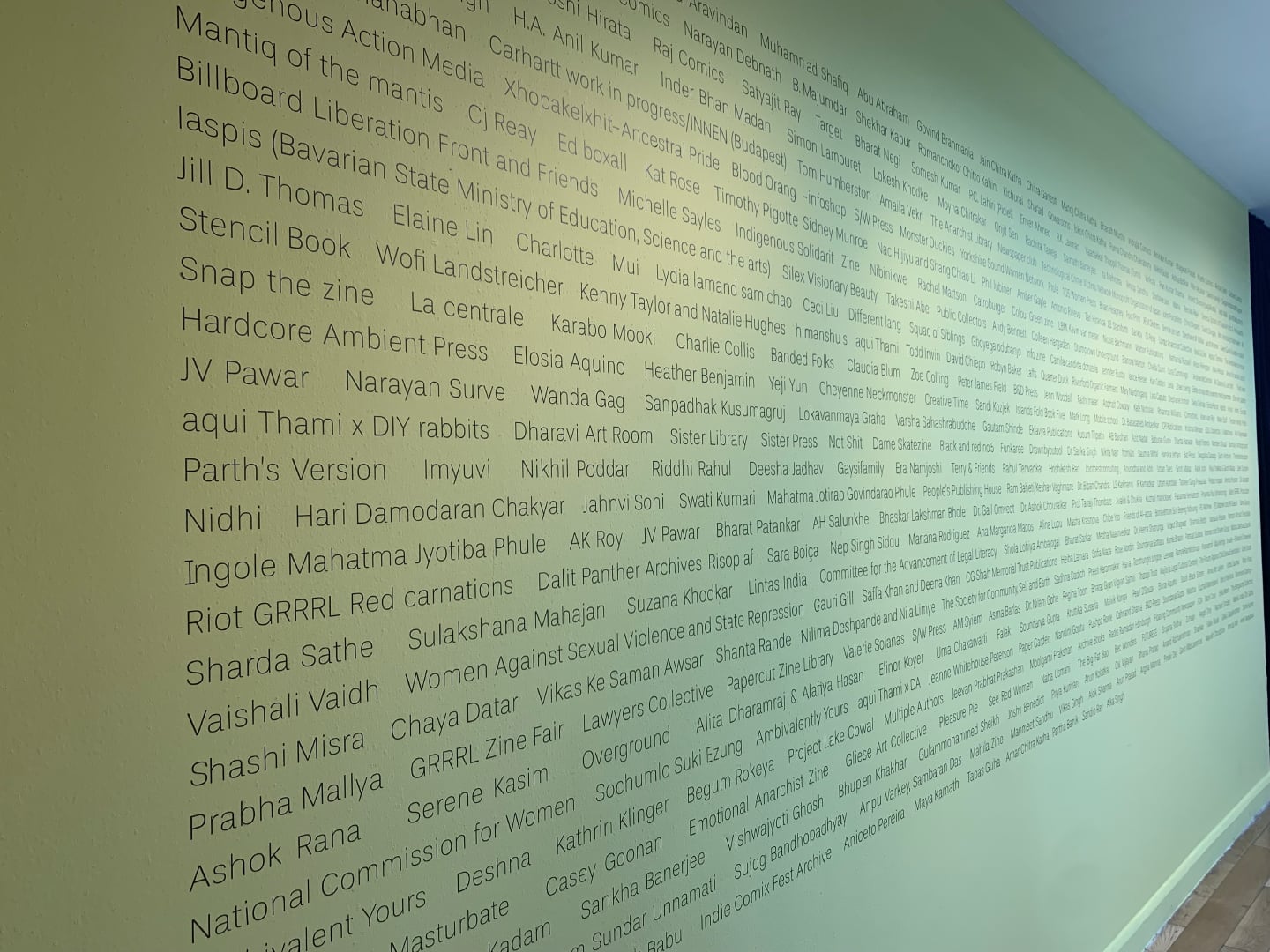 Credits for the comic books section, curated by Bharath Murthy, take up an entire wall at the exhibition.
The second segment comprising physical copies of zines printed over decades and from different parts of the world, is curated by himanshu s, who also runs Fluxus Chapel, an art community hub-cum-zine-shop, in Mumbai. This section is titled ‘disappearing is a good way to keep working — found words’.
The final section, titled DIY SIS!, is curated by aqui Thami, and contains “ephemera” or pieces that were created with the knowledge that they would likely last only a short while. In this section are posters from Zubaan as well as the See Red Women’s Workshop that operated in the UK between 1974 and 1990 but whose irreverent messages about equal pay remain relevant today. There are also zines and pamphlets; some of them created for a specific event or period and none of them expected to last decades, given that their subjects are always topical, their pov often subjective and their print runs typically small. These zines and pamphlets are produced using easily accessible printing technologies like photocopiers, or mimeographs before photocopies became ubiquitous.
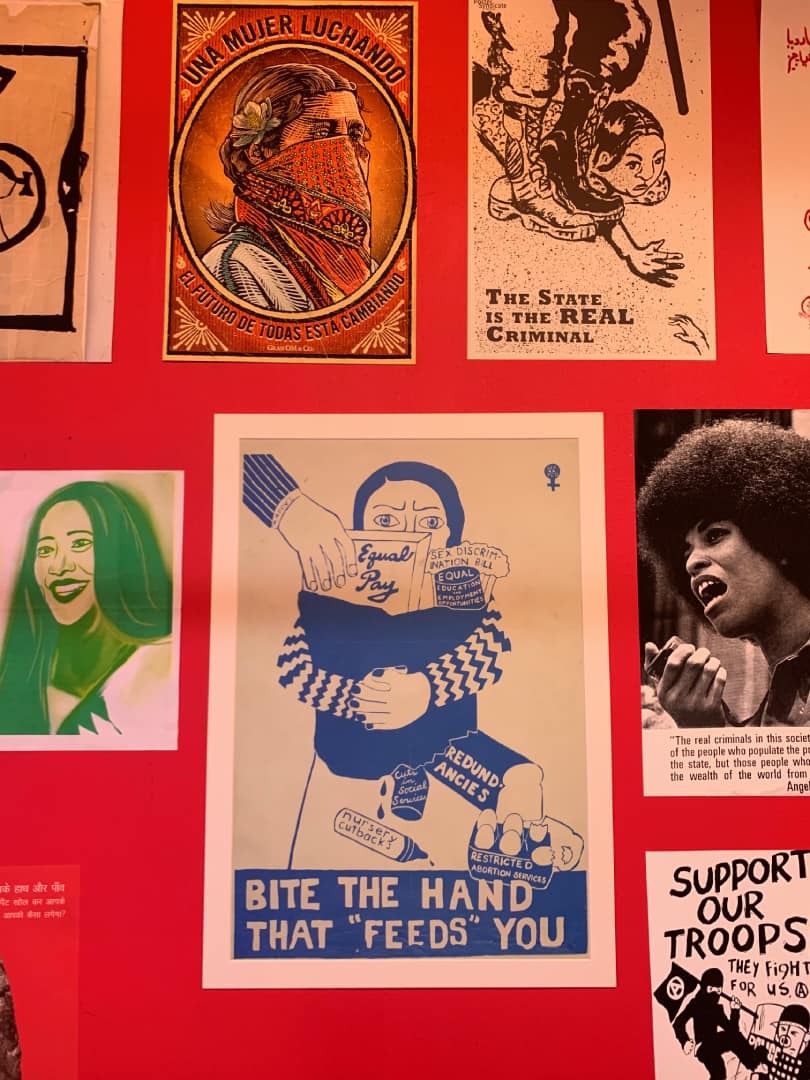 See Red Women's Collective posters in the ephemera segment of the show at KNMA.
Indian comics: Preoccupations, makers, timeline
As you enter the ‘please touch gently’ exhibition space at the KNMA, among the first things to catch your attention is a wall-full of excerpts from comics. Among them, towards the top, is a kind of legend. And though it is not marked as such, this infographic of sorts also offers a way to navigate the Indian comics landscape more broadly.
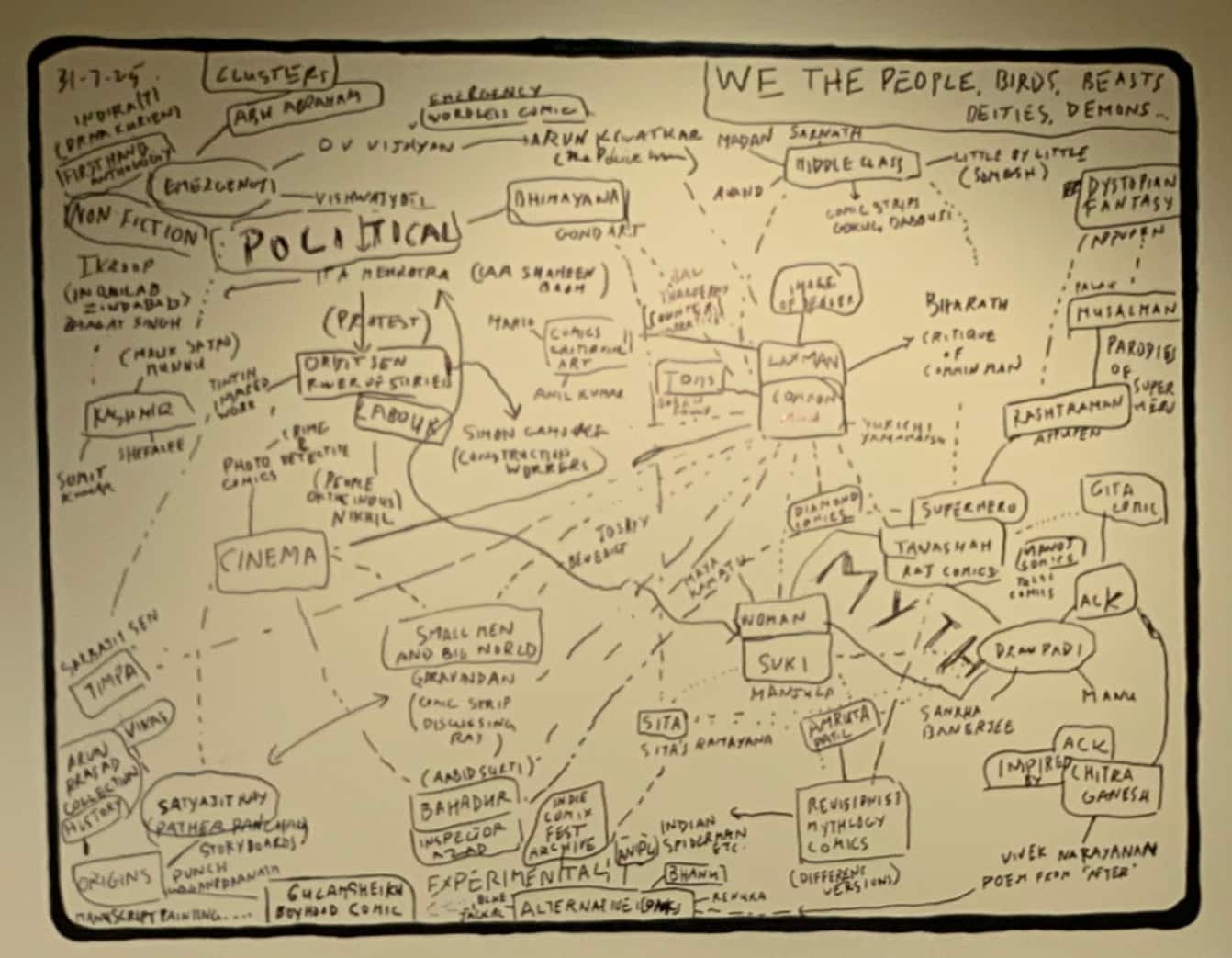 A legend, to navigate the show and the landscape of Indian comics and graphic novels.
Comics in this section of ‘please touch gently’ are split into broad buckets that reveal some of the preoccupations and approaches of Indian comics makers and readers. For example, there's a large segment devoted to mythology-based comics and graphic novels, including revisionist myths-based work. Within this bucket are examples from artist Chitra Ganesh's mythology-inspired art as well as graphic novels like 'Draupadi' which draw upon scripture to retell the stories from modern vantages. The birth and evolution of Indian superheroes like Super Commando Dhruva (Raj Comics) and Bahadur (Indrajal Comics) commandeer their own space, complete with larger-than-life cutouts and wall displays in addition to vitrines and shelves stacked with comics and graphic novels you can browse while there. There are political comics and comic strips, including Abu Abraham's work during the Emergency years and the 'MusalMan' satirical comics.
The overall feeling here is of being immersed in the comic books-and-graphic novels scene in India, from the 1960s to the present. There are examples from Indrajal Comics' 'Bahadur' comics where a kurta-and-jeans clad hero and his girlfriend Bela took down baddies in the 1970s and '80s. There are also examples of visual narratives for grownups here, like the 'Vérité' periodical and 'The Alcazar', a 2021 graphic novel about immigrant workers in Bengaluru — both produced and marketed by Comix India, of which Bharath Murthy is the founding editor and publisher.
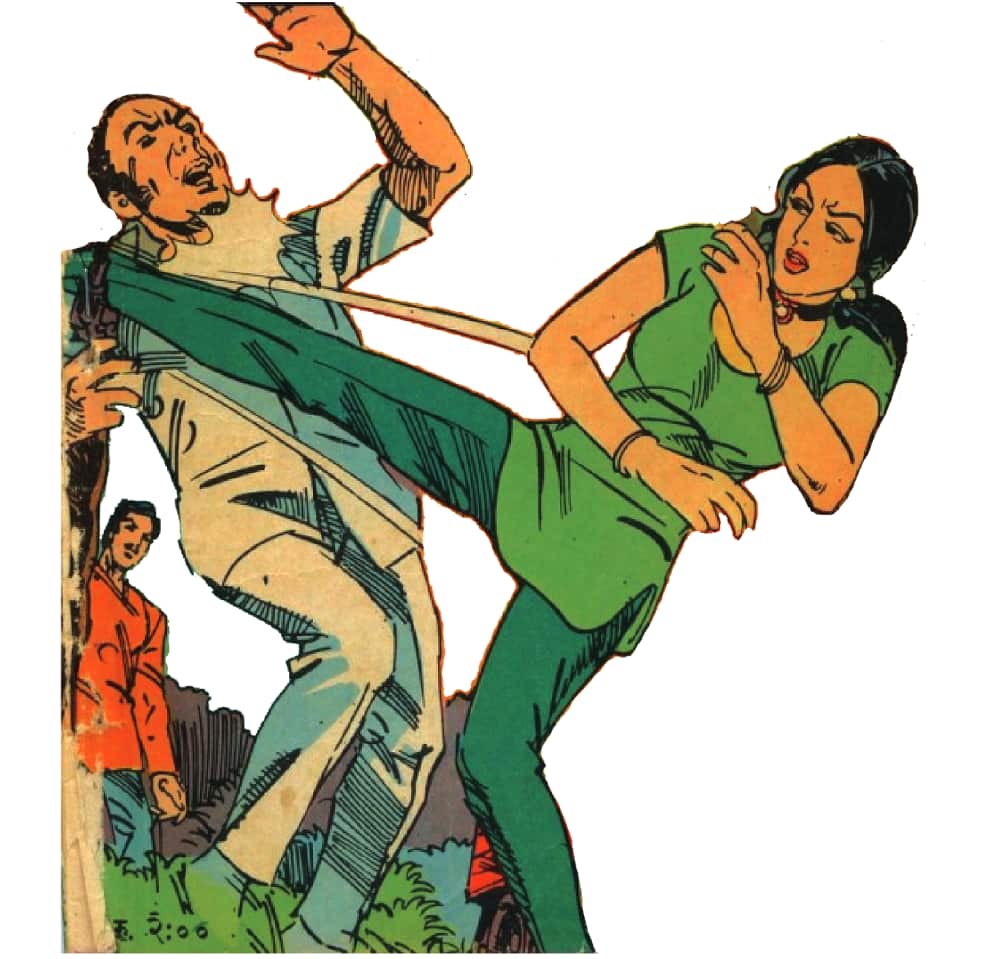 In Aabid Surti's 'Bahadur', the hero's girlfriend Bela knows martial arts. (Image courtesy KNMA, 2025)
Across ‘please touch gently’, you get the feeling of being in a zany library more than in a museum or art gallery. Zany, because of the reading materials, of course, but also because the cold shelves and table-chairs of typical libraries are replaced here by large reading rooms in bright yellows, blues and Rani pink. As Rastogi explained in a curatorial note: "The library-like exhibition space deep-dives into the larger visual and print cultures of zines and comics making in India, and brings together more than a thousand zine makers, comics artists and cartoonists, illustrators and makers, feminists and publishing houses, materials from small presses, home-made, low-cost works that create their own economies of circulation."
While 'please touch gently' has an overall design language, each segment has a predominant colour and vibe. There are spaces to sit and browse / read across the "rooms" — partitioned out of the large exhibition space. You could spend hours here, looking through comics and zines and posters and other content from different decades. Refreshingly, there is a preponderance of printed works here over multimedia and digital productions (though there are some video recordings of interviews with creators, too). There's also an engagement with modes of production, given that the kind of content showcased here has historically been reproduced and distributed at small scale, often made on low-cost paper using easily available technologies from mimeographs and photocopy machines to small printing presses in indie publishing houses.
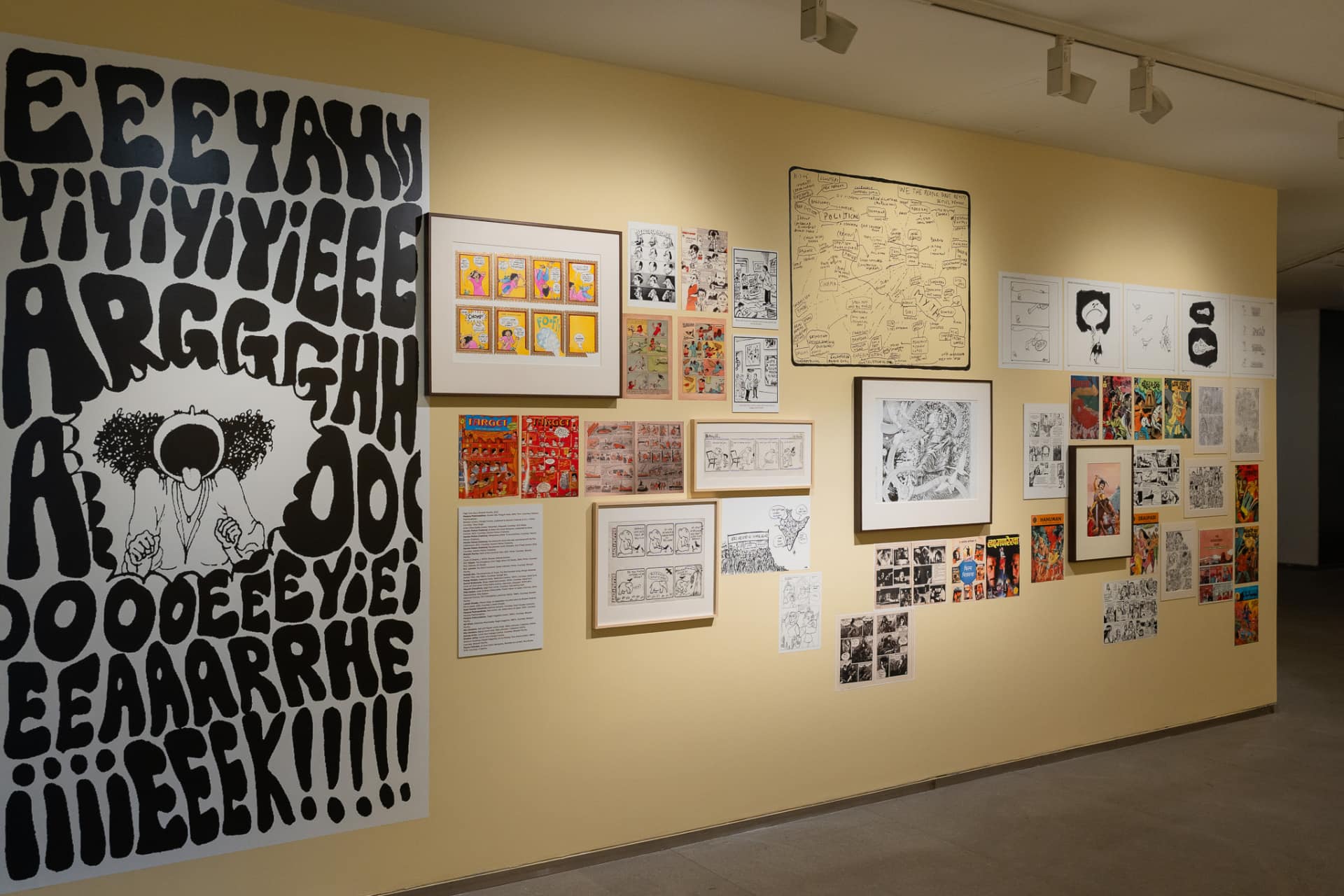 From ‘We The People, Bird, Beasts, Deities and Demons…’ (image courtesy KNMA)
Blue room: Zines as passports to the past
Technology has always been key to how people have broadcast their ideas and content. In the world before social media, there were amateur radio and magnetic tapes, of course. But there were also posters, pamphlets and zines — printed, photocopied, and distributed by the hundreds or a few thousand — that became mediums for user-generated content to be shared through much of the 20th century. Some of these pamphlets and zines became so popular that copies can still be found 40-50-60 years later. A selection of these are now part of ‘please touch gently (zines, comics, ephemera)’ at KNMA.
Indeed, the second segment of 'please touch gently' is all about zines — typically thin, cheaply produced booklets that were often A4-sized low-GSM papers stapled in the middle, distributed by hand, with "print runs" in the few hundreds or thousands. Curated by himanshu s, who also runs the Fluxus Chapel indie space for zines and books in Bandra, Mumbai, the section contains some zines that are like portals to the past.
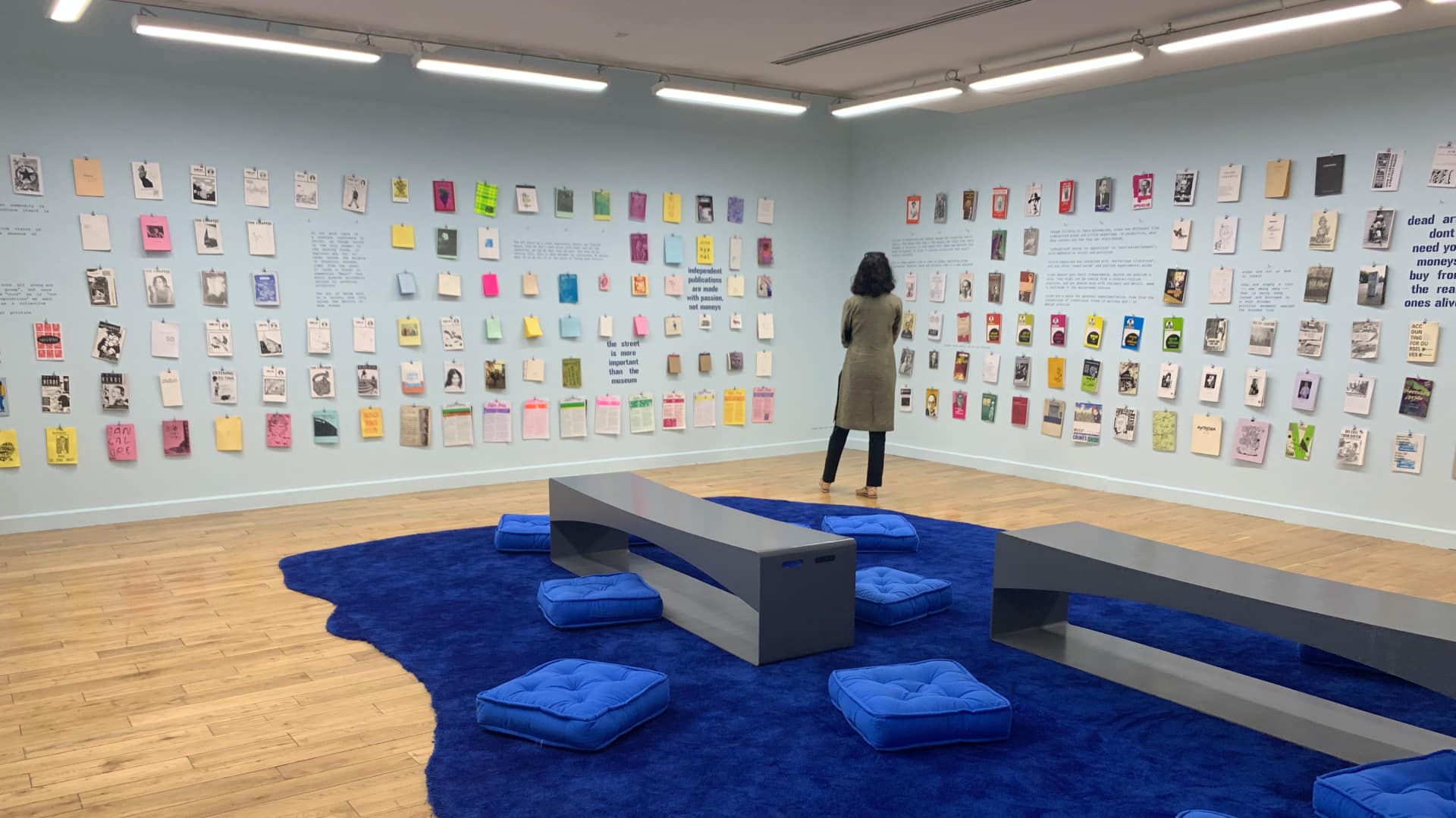 Zines are strung up with paperclips inside 'The Blue Room' of 'please touch gently'. Visitors are encouraged to take down the ones they want to read, and then return them to the same spot after reading.
Consider the example of Valerie Solanas’ SCUM Manifesto.
Solanas was an aspiring playwright whose claim to fame was that she had done a bit-part in a 1960s film by Andy Warhol, the famous American artist. Solanas, a radical feminist, had started SCUM — Society For Cutting Up Men — to challenge men's hold over every sphere of life. In 1966-67, she wrote the ‘SCUM Manifesto’, a complete write-off of men as “incomplete female(s)” and deficient in every way — including as sex partners. In 1967, she printed and distributed some 2,000 mimeographs in 1967 — mimeographs were a precursor of the modern-day photocopy, where a master copy or stencil had to be made and mounted on an ink drum to make more copies.
It is ironic — a bit tragic — that the manifesto (printed as a zine) and Solanas got a lot of attention only after Solanas tried to murder Warhol in 1968 — she shot him twice at ‘The Factory’, as Warhol's New York City studio was called, because she suspected Warhol was trying to steal her unpublished play. The bullets hit Warhol's stomach, liver, spleen and lungs, forcing him to wear a surgical corset for life. That's when the S.C.U.M. Manifesto was picked up by a mainstream publisher. A copy of it is available online now. Its outpouring of vitriol may have been read as a stinging — if hyperbolic and irreverent — appraisal arising from the lived experience of many ambitious women, if it were not for the attempted murder. Sample this paragraph, reproduced from the online version:
“Completely egocentric, unable to relate, empathize or identify, and filled with a vast, pervasive, diffuse sexuality, the male is psychically passive. He hates his passivity, so he projects it onto women, defines the male as active, then sets out to prove that he is (“prove he’s a Man”).... Since he’s attempting to prove an error, he must “prove” it again and again.”
But that's just one example. The zines here straddle many spectrums, from the deeply personal to the very political. From casual to urgent. From text-heavy, to art-based. Depending on how much time you have on your hands, and what you're interested in, each zine is a rabbit hole, taking you down into explorations of a people, a place, a period, a political stand, a punching bag, a pastime, a history, a focused or broader examination of the human condition and the times we've lived through...
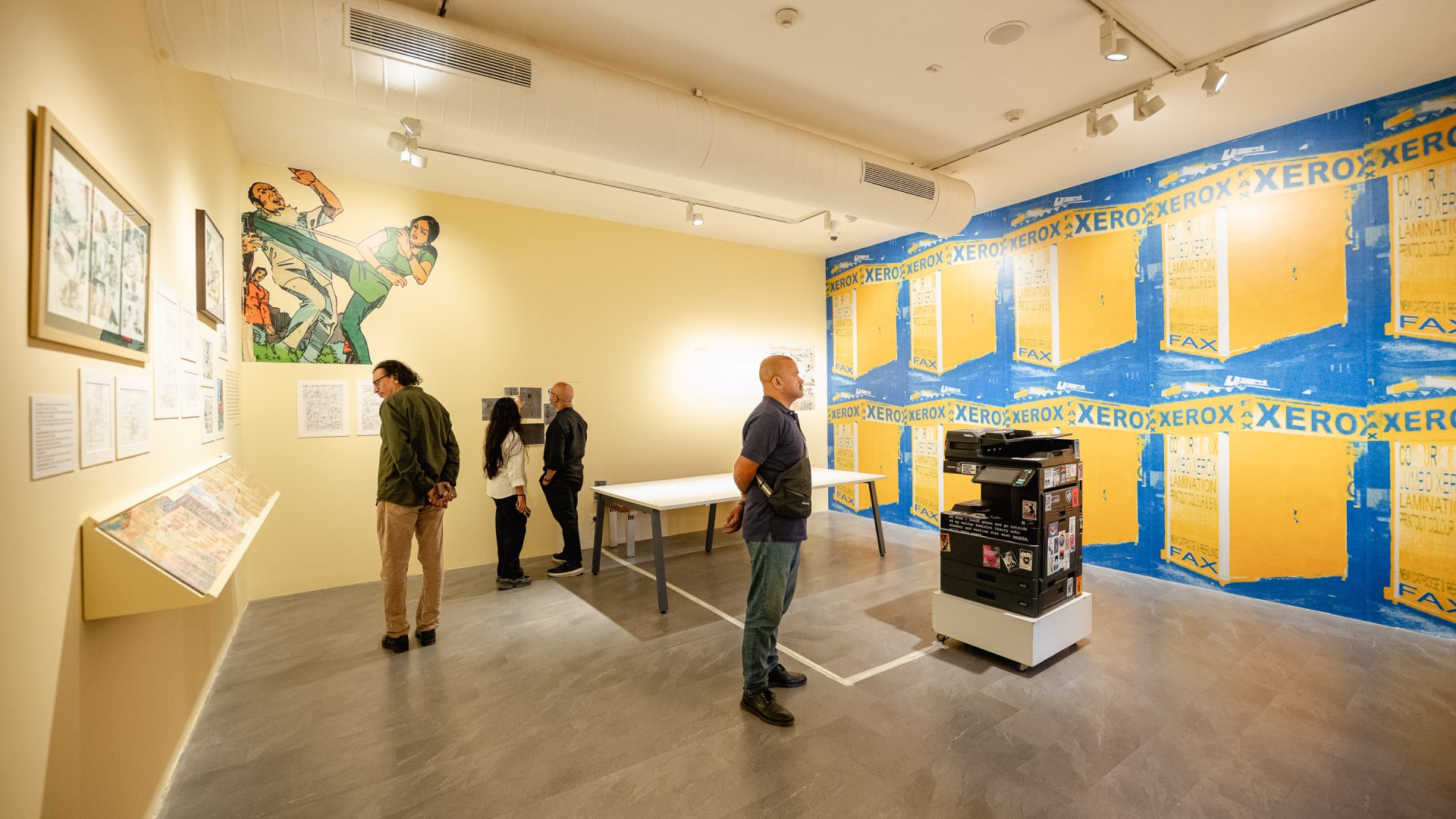 Technologies like photocopiers, and mimeographs before them, made the production of counterculture zines, posters and even comics possible. These, too, are celebrated in ‘please touch gently (zines, comics, ephemera)’. (Image courtesy KNMA)
DIY Sis! Gender equality, equal pay and DEI
There's a preponderance of zines and posters in the final segment of the show, DIY SIS! The content here speaks to gender parity. Posters from Zubaan in India and the See Red Women's Collective in the UK, paint a picture of a shared global experience of inequality. It's a sobering thought that most of these concerns - equal pay for equal work, gender equality in the home and at work, for instance - continue to be as persistent and urgent today as they were decades ago.
Just behind this room, curated aqui Thami, is another room devoted to celebrating the modes of production and reproduction that enabled creators to make and distribute this content in the first place. The show is perhaps among the best contexts to understand how photocopiers changed the world - and made sharing of "user-generated content" possible in the world before social media.
But is it art?
If you put comic books and graphic novels in a museum, do they become art? The question is one among many that comic-books maker, publisher and curator Bharath Murthy asks in the catalogue accompanying his segment of the exhibition — ‘We The People, Bird, Beasts, Deities and Demons…’ — at KNMA.
To take this query further, you could ask if it is high art if the graphic narrative is created by a famous film director, say, G. Aravindan or Satyajit Ray. Or if it achieves cult status, as Aravindan's 'Small Men and Big World' and Ray’s ‘Pather Panchali’ drawings did? Or perhaps if it became the stuff of sharp social commentary in newspaper comic strips by RK Laxman and Abu Abraham, and passed into the histories of India and of Indian comics? What if it were a one-off illustrated story by an openly gay artist — think ‘Phoren Soap’ by Bhupen Khakhar? Where would you slot it if it were a segment in, say, ‘Tinkle’ or ‘Target’ magazine? Or blow-ups of ‘Amar Chitra Katha’ comics about morals and mythologies for young Indians?
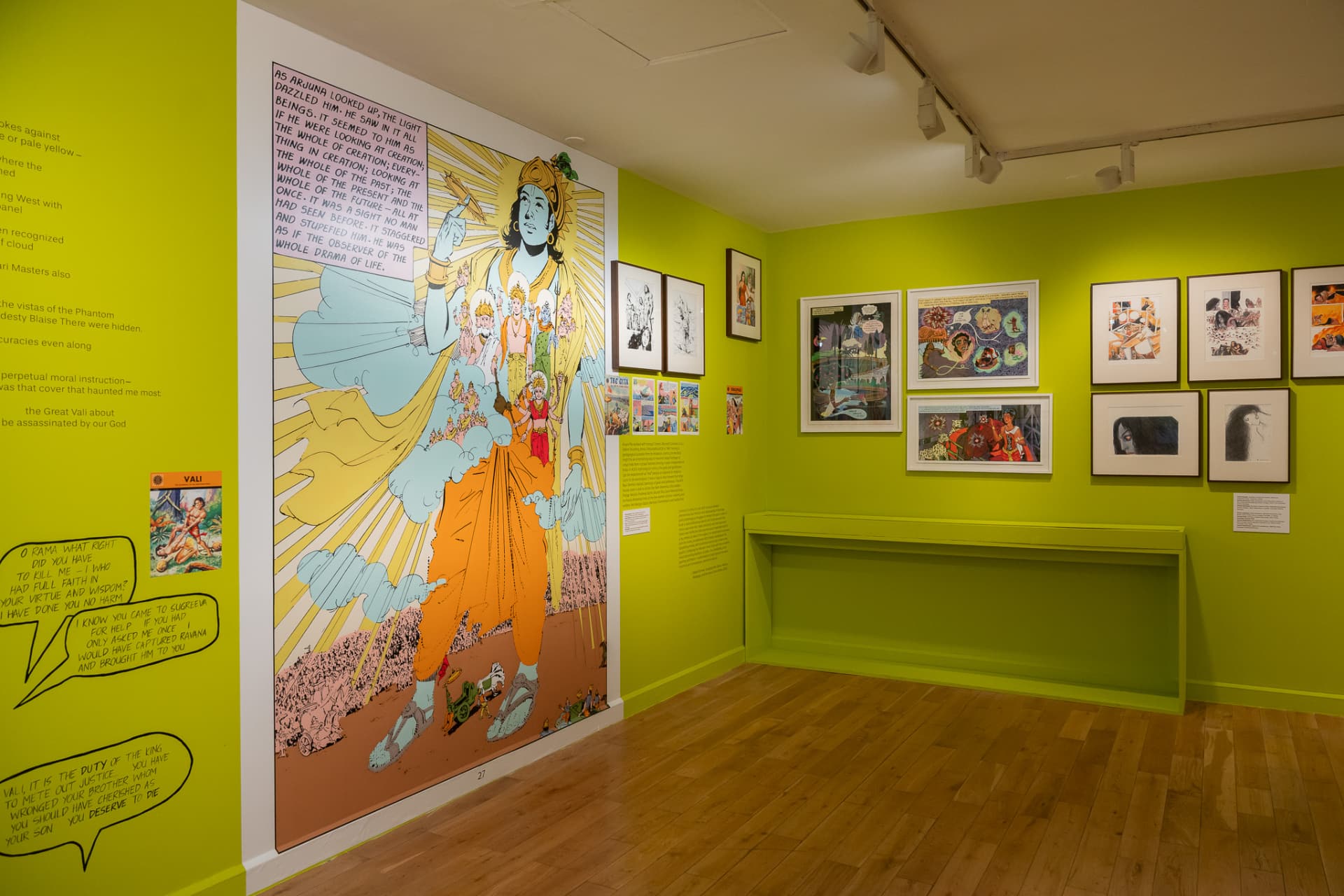 ‘please touch gently’ is on till January 10. (Image courtesy KNMA)
Murthy has stacked all of these examples in ‘We The People, Birds, Beasts…’ and posited more questions in his catalogue: “How does one make sense of Indian comics today?... What kind of stories can be told of this quite unruly, indisciplined medium?” How, even, to build an archive of comic books and comic-book art when creators themselves have historically treated it as ephemeral — sometimes not even preserving the artwork after the edition goes to print.
While Murthy doesn’t present any easy answers to these questions, the exhibition itself is an attempt at archiving, curating, and narrativizing a loose history of these printed materials. The broad sweep — in terms of time, form, original format of publication — makes multiple readings possible. For example, those looking for the rise of the Indian superhero in Indian comics could come away with examples of humans with an extraordinary sense of purpose in Bahadur and Super Commando Dhruva but also superhumans like Nagraj. Those looking to get a sense of the stories India wanted to tell its young people from roughly the 1960s onwards, could find models in the Indrajal Comics as much as the Amar Chitra Katha stories. Those looking for engagements of a filmy, mythological or anthropological nature, might find a surprising range of ways in which Indians have used the comic-book style — grids and bubbles — to tell all manner of stories. (Don’t miss a Japanese retelling of the 1979 film ‘Noorie’ on display here; it’s on loan from artist Chitra Ganesh.)
This extensive engagement with comic books leads — spatially in this show — to other rooms, and other printed materials. Similarly, the zines and ephemera offer different modes of engagement with art. They offer perspectives, and worldviews that may or may not have shaped our own. In the end, it boils down to an engagement with interesting ideas presented well. What else is contemporary art?

Discover the latest Business News, Sensex, and Nifty updates. Obtain Personal Finance insights, tax queries, and expert opinions on Moneycontrol or download the Moneycontrol App to stay updated!
Find the best of Al News in one place, specially curated for you every weekend.
Stay on top of the latest tech trends and biggest startup news.




