It’s impossible to miss the focus on feminism and fabrics at India Art Fair 2026. For, among the first few large outdoor projects you see upon entering this year’s fair at Okhla NSIC in Delhi, is an art quilt by feted American artist Judy Chicago. Just over six years ago, in January 2020, before the Covid lockdowns shuttered half the world indoors, Judy Chicago had collaborated with Christian Dior creative director Maria Grazia Chiuri for Dior’s Spring-Summer 2020 Haute Couture show in Paris. As part of the engagement, the artist had created 21 banners asking the question: “What if women ruled the world?” Mumbai-headquartered Chanakya School of Craft had embroidered the banners posing questions like “would God be female?”, and “would there be violence if women ruled the world?”
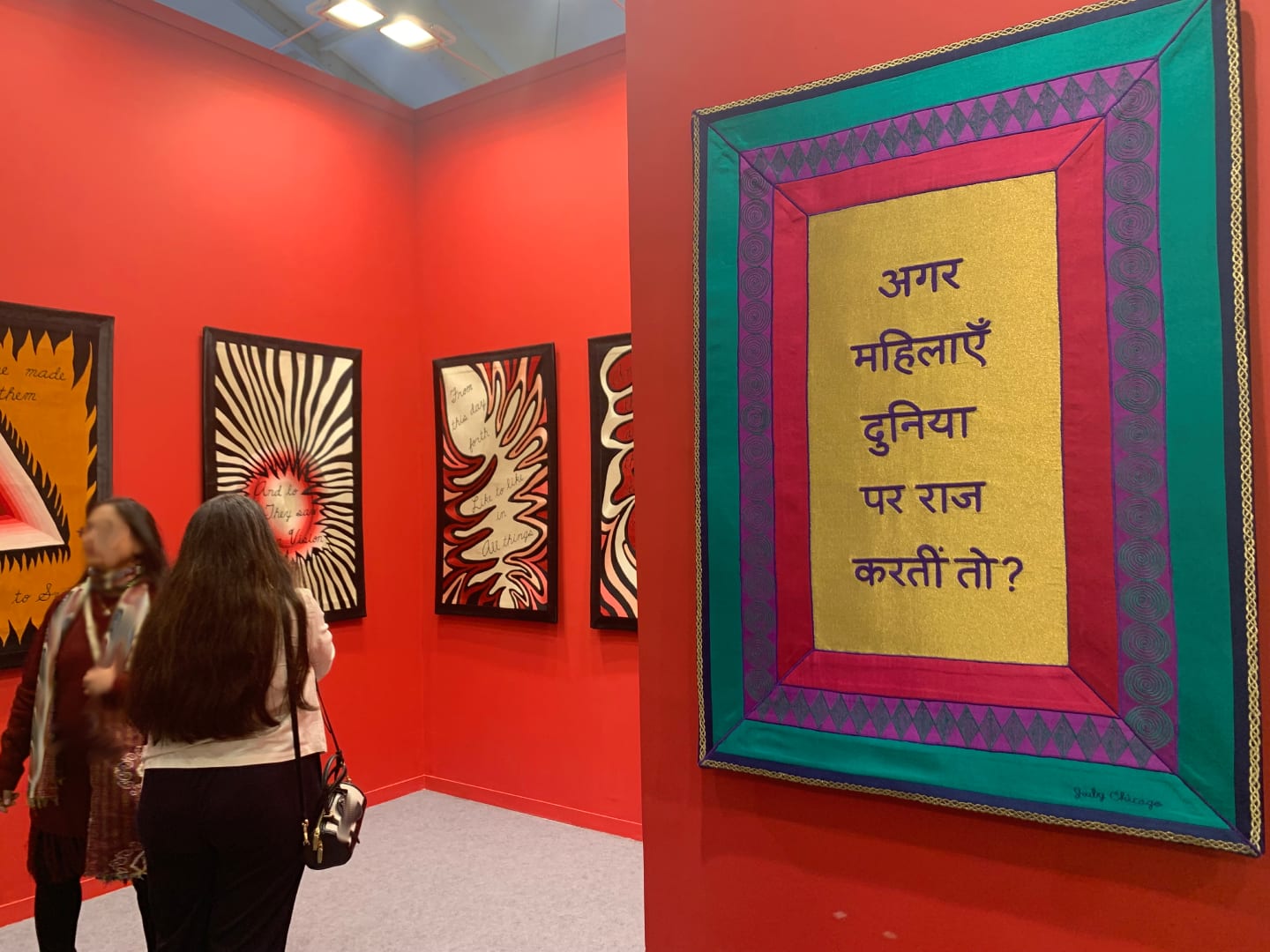 Judy Chicago's 'What if Women Ruled the World?' has garnered responses in 22 languages, according to DMINTI'S Sam Hillmer, who was at the India Art Fair 2026 in Delhi.
New York-based art-tech company DMINTI has since continued the work, opening it up to the world for the responses. DMINTI has now brought one of 11 such art quilts by Chicago to India — a first. The quilt, and the project at large, invite viewers to record their own responses to provocations like: Would men and women be gentle, if women ruled the world? Would there be equal parenting, if women ruled the world? And, would men and women be strong?
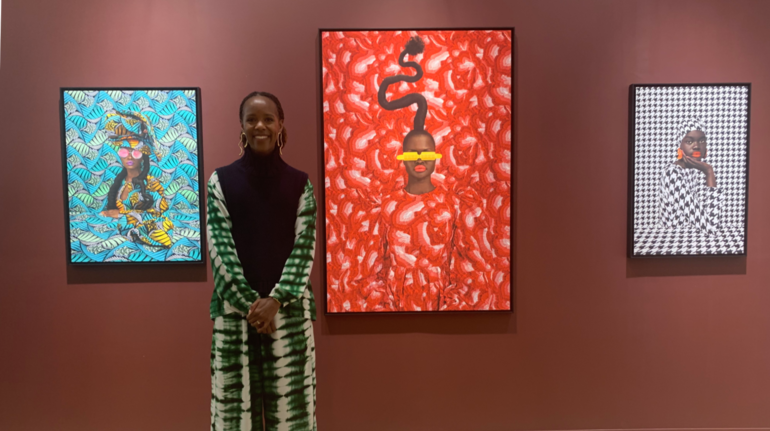
But, of course, this is just at the beginning of the art fair that is on in Delhi till February 8. Farther inside, in the international galleries section, just after the famous Carpenters Workshop Gallery (which this year is also presenting a work by Indian artist duo Thukral and Tagra), in booth F04, is Paris-based 193 Gallery, showing photographs by Nairobi, Kenya-born photographer Thandiwe Muriu.
A self-taught artist, Muriu switched from a career in advertising to art around 2020. In her photographs in booth F04, we see pops of neon and models dressed in large-printed textiles that are unmistakably African, their hair teased into buns and do’s that say something about who they are and where they come from — if you know how to read the signals.
It’s easy to get pulled in by the bursts of colour here — the accessories the models wear are fashioned out of bright blue knives, eye-popping-yellow hair rollers, among other things. Once inside, you begin to notice more detail — the models in the photos look glamorous, but the pictures also tell the story of a textile that the artist thought she’d never wear until she was an “old auntie”.
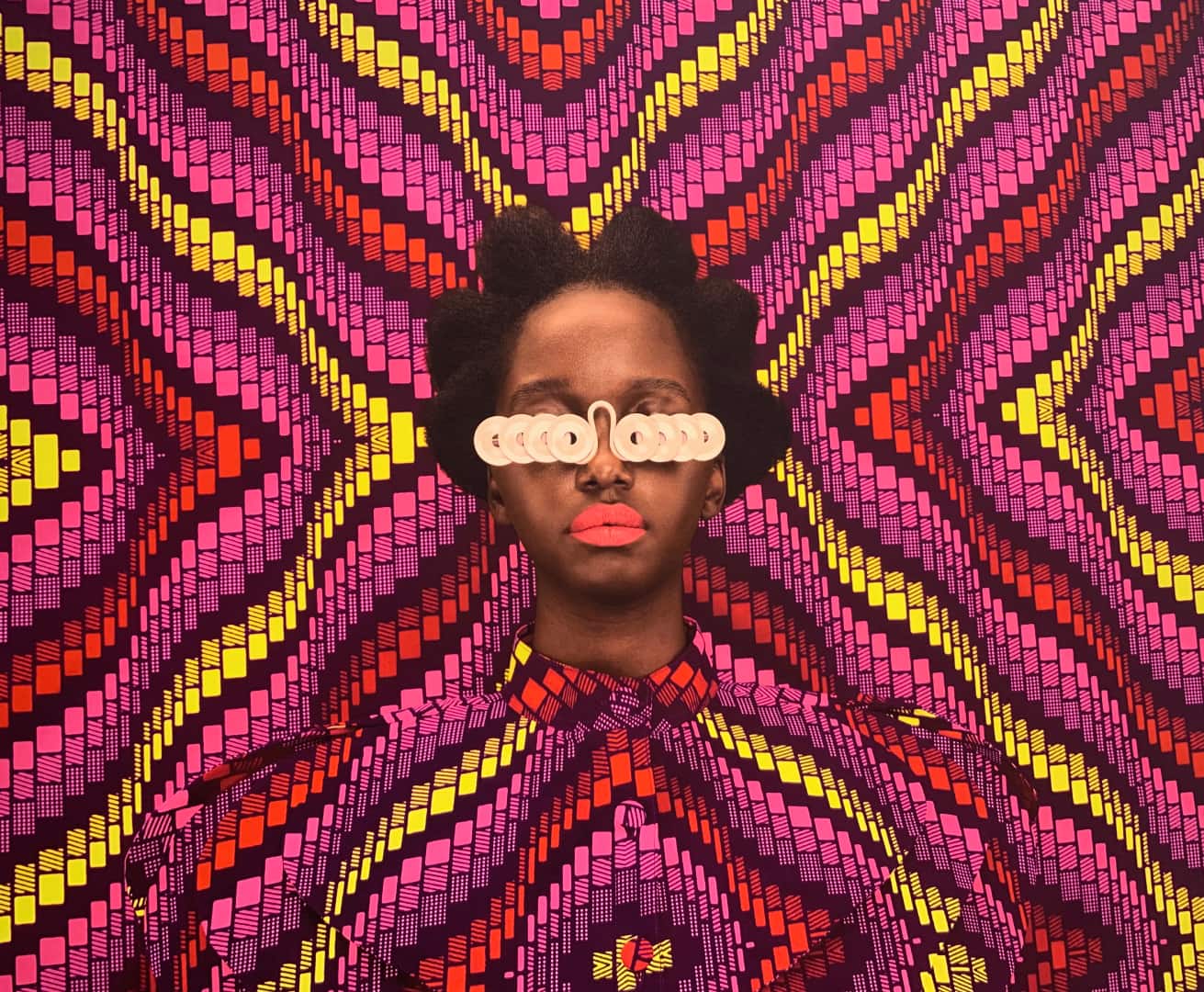 Detail from a photo by Thandiwe Muriu, in the 193 Gallery booth at the India Art Fair 2026.
In a brief interview at the fair, Muriu explained how she came to the realization that she was participating in culture without understanding it, how this became a provocation for her work with Kanga and wax textiles from Kenya, how textiles can be cultural maps, and why African proverbs like “diamond does not lose beauty due to lack of admiration” resonated with her for this work. Edited excerpts:
Tell us about your love affair with textiles.
Interestingly enough, I didn’t always love textiles. I viewed these particular textiles that I work with, as something that I would wear when I was an old auntie. It sounds a little silly now. But the more I began to research as an artist, the more I realized that I was participating in culture without understanding it. And that’s where my love for textiles began. Because I realized that coming from an oral culture, our history isn’t in books, it’s in stories, it’s in songs, it’s also in textiles. And to understand my community, our practices, even as I, maybe sometimes, criticize them or question them, I must understand our textiles. And so what began as a love for the patterns and the colours, soon quickly developed into a deep desire to understand the language and symbolism of textiles and their place in discussions and narratives today.
And so in the work that you see, I use the wax textile as a canvas to question, to celebrate, and to redefine what womanhood should and could be. My background, of course, is: I live and work in Kenya. And my journey in becoming a photographer has raised a lot of questions for me around being a modern woman in a very conservative context. And as I began to think of how to express that in images, I really wanted to use a wax textile because it’s almost a universal symbol of Africanness. And that’s a big part of my perspective as a woman — it’s grounded in my Africanness, even if the questions I’m asking are universal.
How are you responding to this idea of Africanness being associated with this textile in your work — is it a celebration or does it give you pause?
I’m embracing it. This is a textile we live with. The wax textile, at least in Kenya, is what you pull out when you want to look your best. So, if you have a wedding, if you have a really important meeting, if you have a political speech, you wear the wax textile. Maybe a little bit, as a woman, we all want to look our best. And so even as I question this notion, this idea of belonging, identity, womanhood, why not do it with a fabric that expresses women at their best?
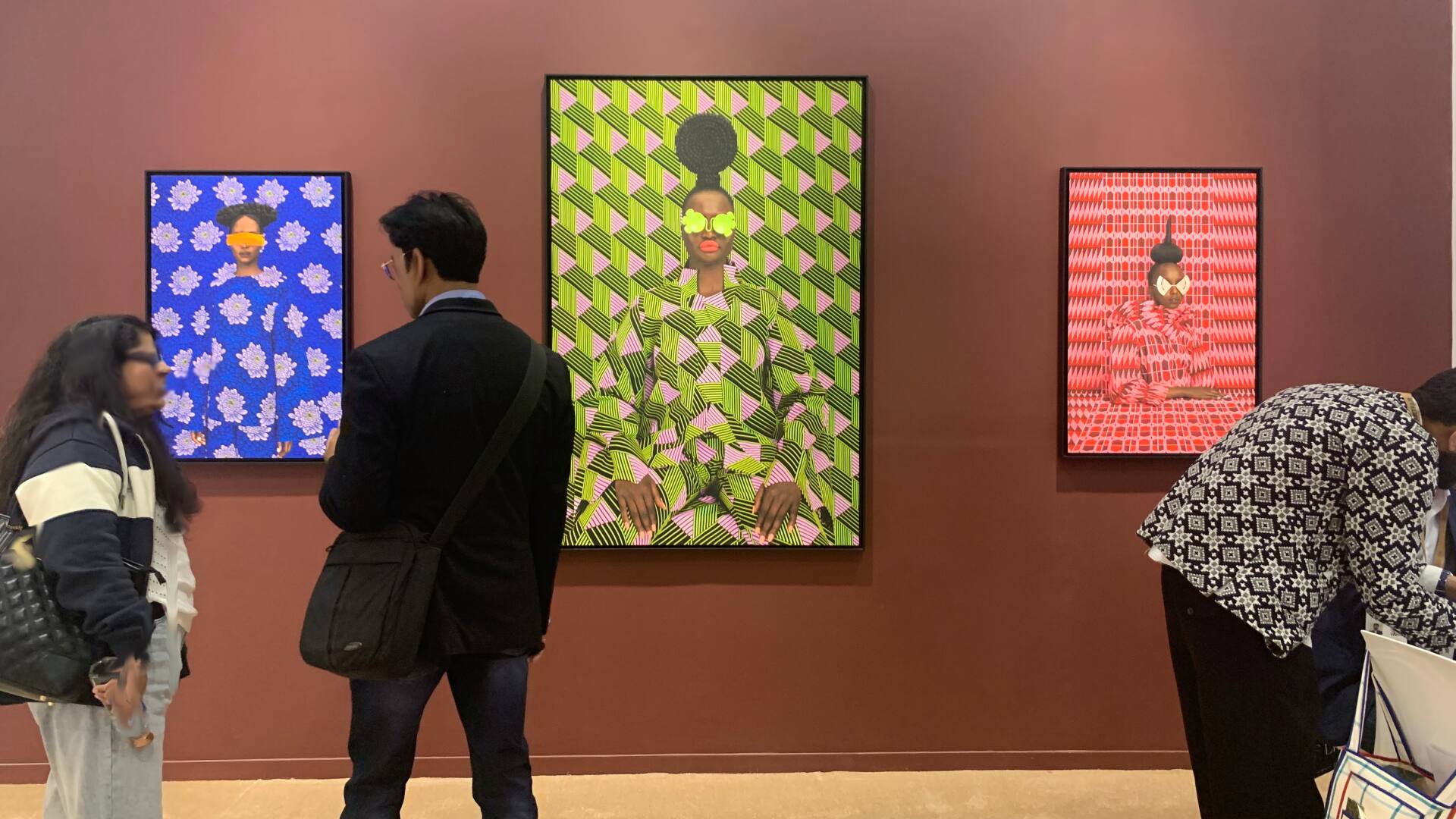 Culturally, the hairdos in these photos by Thandiwe Muriu carry a lot of information - about a woman's age, marital status, and the place and community she belongs to.
Tell us about the hairdos and the accessories. The models are wearing some very elaborate buns and plaits here.
Hair, of course, is a very big part of being a woman. It says a lot about a woman. If you look at history in Africa... in African history, hair would be a communication device. It could tell you the age of the woman. Is she married? Is she not? Is she in grief? There’s many communities that would cut their hair when they lost somebody close to them. So it’s a language by itself. Even today in modern times, it’s a language. It’s how we say, I’m feeling a little bit edgy. I’m feeling a bit more feminine; I want soft curls. There’s a saying that when a woman changes her hair, something big is going to happen in her life.
It’s still a language even today. And in my work, it is a way to archive history. I take inspiration from traditional images of historical hairstyles. Because the language of hair has really changed across the continent. Due to colonisation and other reasons, our relationship with our hair is complicated. And one of the things I realised in my journey of womanhood and learning to love myself, was that I really didn’t like my hair. Whenever I looked at what I consider beautiful hair, it was long and glossy and it fell and moved beautifully. And my hair is short and it stands up. And it just doesn’t do that. And so doing the hair in my images was a way to fall in love with my hair again on a very personal level. But on a wider level, it’s also a way to record the history of what hair used to be, and celebrate the beauty of African hair that doesn’t fall down, that isn’t silky, but it can do its own incredible things. And so I think in the images, you can just see the creativity around what hair could be. It’s also a language of womanhood. It’s just the joy of expressing an individual identity through hair.
The accessories in my image are more fun. Every accessory you see is actually made from mostly domestic objects. And I make them myself in my studio. So I will sit down at my desk and try, and make them, and test them on myself with a mirror.
Are those lemon squeezers in the accessory here?
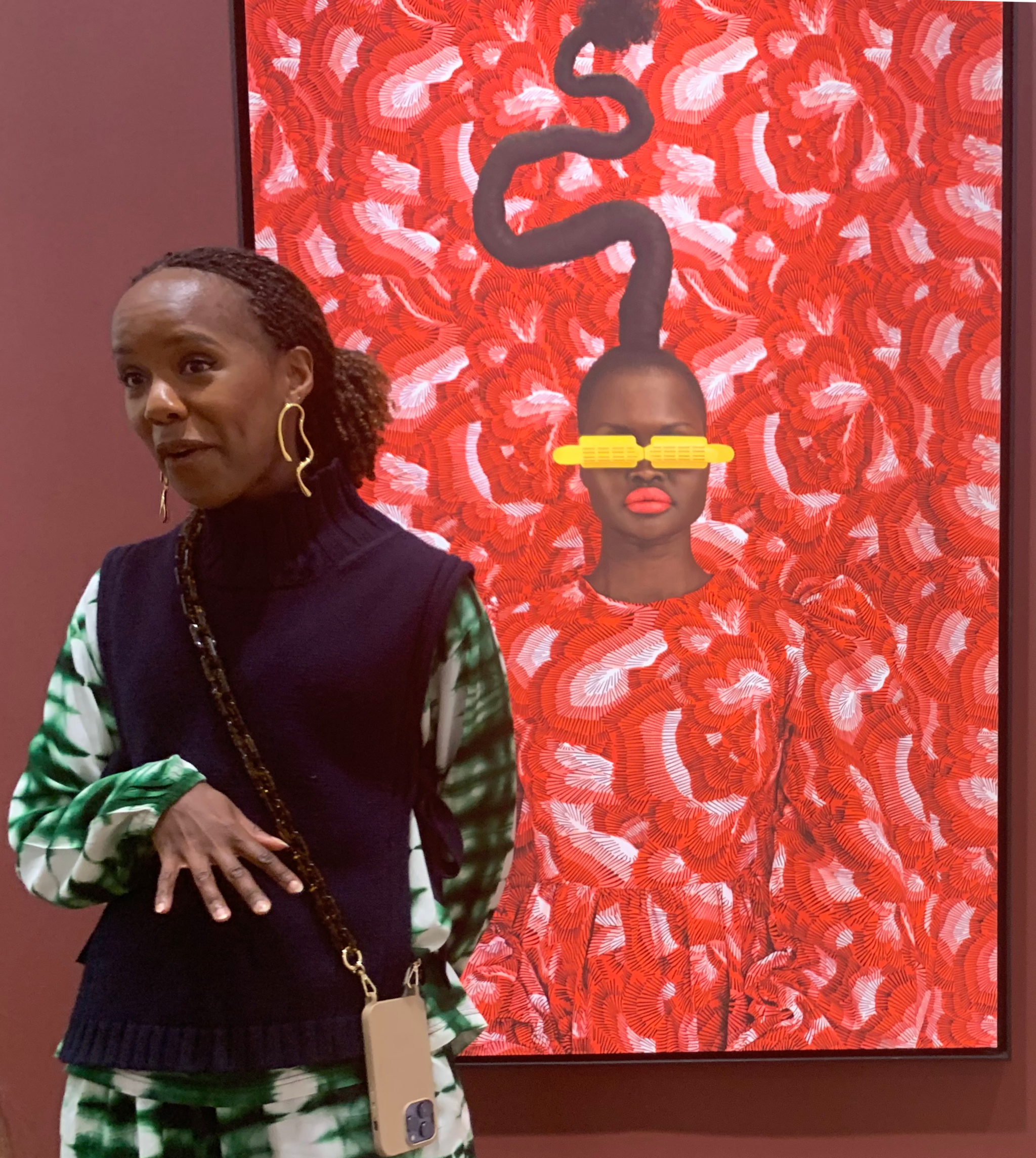 Thandiwe Muriu fashions her accessories from everyday objects.
Those are hair rollers. Those are plastic knives (points to the respective photos). That is a comb. That’s a protractor from a mathematical set. I’ve done spoons. I have done safety pins. Anything you can think of, I’m game to try and make it an accessory.
Part of that is a cultural practice. Where I come from, there’s a lot of poverty. A lot has been said about the difficult side of poverty. But one of the interesting things is people get very creative when they can’t go and buy something to solve a problem they may have. I call it creative recycling, and it’s a lifestyle. You see creative recycling all over Nairobi.
On a more personal level, it’s also a challenge to women. Because, remember, my work is about womanhood and the confidence of simply being yourself. And when we look at this image, if you saw this (the blue accessory over the eyes) on a table, you could see it’s just knives. To you, this looks like plastic knives, and that’s the end of its usefulness and its beauty. But I see it, and turn it into this accessory. Many times it’s a perspective issue; many times when women speak about themselves, when they struggle with the notion of identity, so often we think we are the problem — the woman is the problem. But it’s a woman’s perspective of herself that’s a problem. There’s nothing wrong with the woman herself. And I think this transformation is a reminder of that. All I’ve done here is given you a change of perspective on what a life could be. And perhaps as women to love ourselves more, all we need is a change of perspective.
Tell us about this work — I’m told this is inspired by your family?
Yes, this piece is inspired by my grandmother. Before I get there, one of the things I love about this piece is, this still the wax textile.
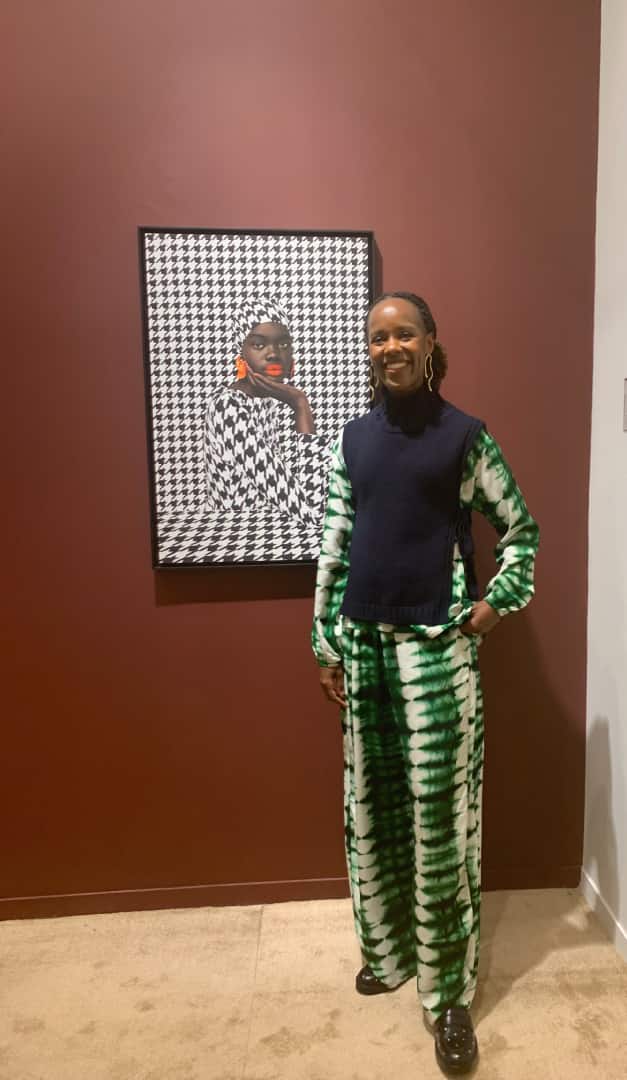 Thandiwe Muriu at the India Art Fair 2026.
And this is also a very international design now.
Yes, it’s the houndstooth print. One of the rules for this project is I only work with wax textile. But this is an incredible way to show cultural exchange through textiles. So it is an African textile, or it is a wax textile. But at the same time, it’s a very English print. And I love the blending of both worlds and the idea that textiles are cultural maps.
So, this image is inspired by my grandmother, who always wears a headscarf because she belongs to this organization called the Women’s Guild. And every Sunday, she goes to church with this blue headscarf. When I was making this work, I was really reflecting on her. The choice to put a headscarf, instead of doing the hair, was inspired by the idea of my grandmother and her and her sense of fashion on a Sunday.
Of course, people like Nobel laureate Abdulrazak Gurnah have written about the East African coast. But it’s a part of the world that most people outside of Africa don’t know much about. Is that something you try to address in your practice?
A big part of what I think my role as an artist is, is to create the opportunity for dialogue. My job isn’t to answer questions, it’s just to present them and for us to have a conversation. I think that’s how art has impact. So in sharing about a region that maybe people don’t know a lot about, it’s really exciting because it just gives an opportunity for questions and cultural exchange, which is always a good thing for everybody.
There’s a famous saying that goes: until the lion has its own storyteller, the hunter will have the best stories. And I think it’s really important as artists, as writers, as creatives, we tell our own stories in our own voice. Because there’s a very unique perspective that we have. And historically, our stories have been told for us. So, I’m very excited to see more and more people telling their stories, their way and from their point of understanding.
Speaking of proverbs — each of the photos in the show here is accompanied by an African proverb? There’s only one that’s printed on the wall at the art fair — Wood already touched by fire is not hard to set alight. What are some of the others?
Each work has an African proverb. And that’s because I come from an oral culture. And so even as I question culture, I ask questions about belonging in a culture, I’m not the first person to do that. It’s been done for thousands of years. It’s just been done with words. And I felt very compelled, as I did this work, to pay homage to the people who’ve gone before me and done that. So each work gets an African proverb. It comes with some writing that kind of explains what the piece is about. Because each piece is a reflection on different elements of womanhood. Some of my favourites are: A diamond does not lose beauty due to lack of admiration. Or, a beautiful thing is never perfect. And I think some of those can be very powerful reminders to women.

Discover the latest Business News, Sensex, and Nifty updates. Obtain Personal Finance insights, tax queries, and expert opinions on Moneycontrol or download the Moneycontrol App to stay updated!
Find the best of Al News in one place, specially curated for you every weekend.
Stay on top of the latest tech trends and biggest startup news.