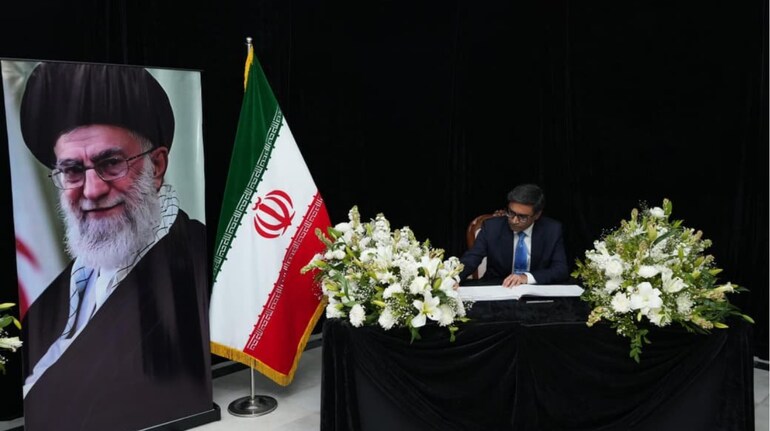

A brief diplomatic visit by India’s top bureaucrat has suddenly turned into a political conversation.
Foreign Secretary Vikram Misri on Thursday visited the Iranian embassy in New Delhi and signed a condolence book opened after the death of Iran’s Supreme Leader Ayatollah Ali Khamenei, who was killed in a US-Israel strike during the rapidly escalating West Asia conflict.
The act lasted only a few minutes.
But in the middle of a geopolitical crisis that has already rattled oil markets, shipping routes and global diplomacy, the gesture has raised an important question in India: why did New Delhi make the move now?
The answer lies at the intersection of diplomatic protocol, domestic politics and India’s delicate balancing act in West Asia.
The trigger
Iran began a three-day national mourning period after Khamenei’s death, with embassies around the world opening condolence registers for foreign dignitaries.
Misri’s visit to the Iranian mission in New Delhi followed that protocol. During the meeting, he conveyed condolences to Iran’s ambassador Mohammad Fathali on behalf of the Indian government.
In diplomatic terms, the act is routine.
When a sitting head of state dies, whether through natural causes or conflict, embassies traditionally open condolence books. Senior officials from other countries sign them as a gesture of respect toward the nation and its people.
Such gestures are typically directed at the state, not necessarily an endorsement of the leader’s politics or legacy.
Yet the current context has made the move far more sensitive.
The strike that killed Iran’s top leadership
Khamenei’s death has already become one of the most consequential moments in the ongoing West Asia crisis.
The Iranian leader was reportedly killed in a joint US-Israel strike targeting the leadership structure of Iran’s regime, in what analysts have described as a “decapitation strike”.
The attack eliminated several senior figures within the Iranian establishment and dramatically escalated tensions across the region.
Iran has since warned of retaliation.
Shipping through the Strait of Hormuz, one of the world’s most critical oil chokepoints, has come under pressure.
Global markets have reacted sharply to the uncertainty.
For India, which imports the majority of its energy and maintains strategic ties across the region, the crisis is far from distant.
Why Iran matters to India
India’s relationship with Iran goes beyond diplomacy.
Tehran remains an important partner in regional connectivity and strategic access to Central Asia, particularly through the Chabahar port project, which India has helped develop to bypass Pakistan and reach Afghanistan and beyond.
Historically, India has tried to maintain working ties with both sides of the region’s complex geopolitical divide, including Iran, Israel and the Gulf states.
That balancing act has become harder as tensions escalate.
Even symbolic actions can carry diplomatic weight.
The political controversy at home
The condolence gesture also landed in the middle of a domestic political debate.
In recent days, opposition leaders criticised the government for what they described as India’s silence following Khamenei’s killing, arguing that New Delhi should have taken a clearer moral position.
The ruling BJP countered those claims, with several leaders highlighting Iran’s past geopolitical positions and criticising Khamenei’s leadership.
The result was a sharp political exchange over whether India should condemn the strike or remain neutral.
Against that backdrop, the foreign secretary signing the condolence book immediately raised another question: was the government subtly recalibrating its stance?
The government’s position: Protocol, not politics
According to CNN-News18, government sources have suggested that the visit should not be interpreted as a policy shift.
Instead, officials describe it as standard diplomatic courtesy, something India would extend to any country following the death of a national leader.
In foreign policy, government actions often operate separately from domestic political messaging. Diplomatic protocol tends to follow established practices regardless of political debate.
The condolence visit, therefore, may reflect New Delhi’s attempt to maintain formal diplomatic continuity while avoiding taking sides in an escalating regional conflict.
The bigger diplomatic tightrope
India’s foreign policy in West Asia has long relied on careful balancing.
The country has deep strategic ties with Israel, including defence cooperation and technology partnerships. At the same time, India maintains historic and economic links with Iran and close relationships with Gulf states that host millions of Indian workers.
The current conflict is putting that balancing strategy under strain.
In such moments, diplomacy often moves through subtle signals rather than dramatic statements.
Discover the latest Business News, Sensex, and Nifty updates. Obtain Personal Finance insights, tax queries, and expert opinions on Moneycontrol or download the Moneycontrol App to stay updated!
Find the best of Al News in one place, specially curated for you every weekend.
Stay on top of the latest tech trends and biggest startup news.