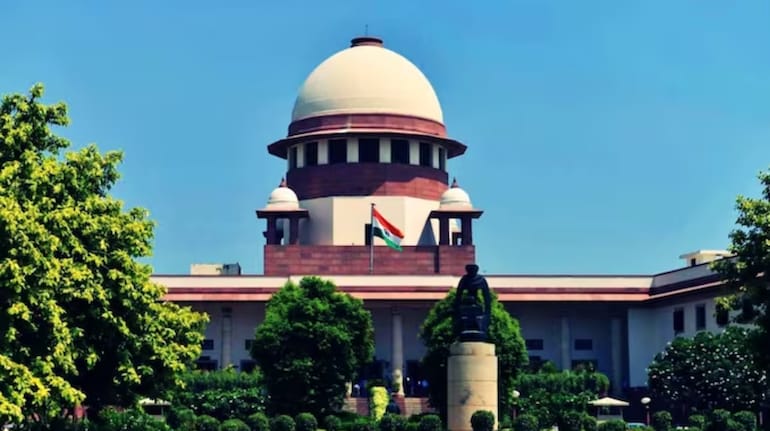
The Supreme Court on Tuesday refused to interfere with the Delhi High Court’s order upholding the removal of Army officer Samuel Kamalesan, a Christian by faith, who had objected to entering the innermost area of a temple during regimental religious activities.
A bench of Chief Justice Surya Kant and Justice Joymalya Bagchi observed that his actions reflected a serious breach of discipline within the forces, reported LiveLaw.
“What kind of message he has been sending...he should have been thrown out for this only...grossest kind of indiscipline by an army official,” Justice Kant, who assumed officed as CJI on November 24, remarked while dismissing the plea.
Kamalesan had argued that compelling him to step into the sanctum during rituals went against his religious beliefs protected under Article 25, although he said that he routinely accompanied his soldiers to both the mandir and the gurdwara for weekly parades.
His counsel, Senior Advocate Gopal Sankaranarayanan, insisted that the officer had been terminated solely due to one instance involving refusal to enter the “sanctum sanctorum,” adding that the petitioner had earlier participated in activities at places “where there were ‘sarva dharma sthals’.”
The bench, however, questioned the officer’s behaviour. “Is this sort of cantankerous conduct permissible in a disciplined force?” CJI Kant asked, noting that the regiment also had a gurdwara since Sikh personnel were part of the unit.
According to the Chief Justice, “Gurudwara is one of the most secular places,” and the officer’s reluctance suggested he was “insulting the other religions.”
Justice Bagchi observed that the pastor’s opinion which said that entering such a place would not violate Christian doctrine was significant. Sankaranarayanan countered that this pastoral opinion related only to visits to a Sarva Dharma Sthal, not specifically to a temple.
The counsel argued that Kamalesan’s objection was limited to being asked to “carry out the worship,” stating, “I cannot be forced to worship a deity. Constitution permits that much freedom.”
He argued that one superior officer had escalated the matter unnecessarily and insisted that once the commanding officer changed, the petitioner’s Annual Confidential Report (ACR) returned to normal.
Yet the bench pointed out that the petitioner had also declined entry to what was described as a ‘sarva dharma sthal,’ despite the pastor confirming that such entry did not conflict with his faith.
Justice Bagchi pointed out to the counsel that “Article 25 is protection for essential religious features, not every religious sentiment,” and stressed that as a leader of troops, the officer had to respect “the collective faith of the majority that you are commanding.”
When Sankaranarayanan cited the Christian commandment against worshipping another god, he reiterated that mere entry into the premises was not the problem; the concern arose only when participation in rituals was expected.
The Chief Justice nevertheless remarked, “Leaders have to lead by example". Justice Bagchi said that once the pastor had counselled him, the officer should not rely on a “private understanding” of his faith “in uniform.”
With the bench unwilling to interfere, the petitioner sought a reduced penalty on proportionality grounds, but this too was rejected.
The CJI said that although Kamalesan might have excelled in several aspects, the Army’s secular character and its strict disciplinary standards could not be compromised. “You have failed to respect the sentiments of your own soldiers,” the Chief Justice observed.
The counsel told the bench "this will send a wrong message" to which CJI Kant said, "this will send a strong message," while dismissing the matter, LiveLaw reported.
Kamalesan, commissioned in March 2017 in the 3rd Cavalry Regiment -- comprising Sikh, Jat, and Rajput troops -- served as Troop Leader of a Sikh squadron.
He stated before the High Court that the regiment had a mandir and a gurdwara but not a Sarv Dharm Sthal or church. The respondents asserted that he repeatedly avoided regimental religious parades despite extensive attempts to counsel him.
The Chief of Army Staff, after reviewing the entire record, found his continuation in service undesirable.
The High Court, while upholding his dismissal, noted that though regiments may bear religious or regional nomenclature, the forces operate on a secular ethos.
It observed that to civilians the penalty might appear severe, but military discipline requires a different standard. The court concluded that his refusal impacted troop cohesion and eroded the camaraderie crucial in combat environments, and thus the termination -- along with denial of pension and gratuity -- was justified.
Discover the latest Business News, Sensex, and Nifty updates. Obtain Personal Finance insights, tax queries, and expert opinions on Moneycontrol or download the Moneycontrol App to stay updated!
Find the best of Al News in one place, specially curated for you every weekend.
Stay on top of the latest tech trends and biggest startup news.