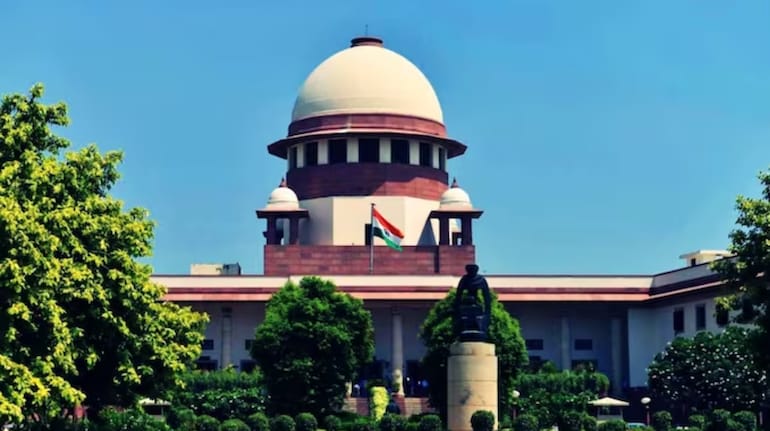
During Wednesday’s hearing on challenges to the Special Intensive Revision (SIR) of electoral rolls, the Supreme Court asked if individuals who have entered India from neighbouring nations possessing Aadhaar cards for welfare purposes be also be allowed to vote.
According to a report by The Indian Express, Chief Justice of India Surya Kant, sitting with Justice Joymalya Bagchi, said that the Aadhaar system exists under a specific statute and only for designated purposes.
Aadhaar, CJI Kant said, is valid “to the extent that it acknowledges the benefits or privileges based upon it.”
The bench imagined a situation involving people “who intrude from a different country” and work in India as labourers or rickshaw-pullers.
According to the CJI, offering Aadhaar-based welfare to such individuals aligns with “our constitutional ethos” and “constitutional morality." However, he questioned whether such 'benefit' transform them into voters.
“Does it mean that because he has been given this benefit, he must now be made a voter also?” he asked.
This exchange came after Senior Advocate Kapil Sibal, representing Kerala and West Bengal, complained that people holding Aadhaar cards were still being removed from voter rolls.
A person, Sibal argued, makes a “self-declaration, I am a citizen. I live here. There is an Aadhaar card that I have.” If the state intended to delete such an elector, he said, “take it away, take it away through a process.”
The CJI referenced the Bihar SIR to underline that very few objections were recorded. The bench, he said, had been “eagerly, desperately looking for those instances” where legitimate citizens were wrongly excluded.
The court also remarked that widespread media coverage meant even those in remote areas were aware of the exercise. “Sometimes we should give full credit to the media also,” he noted.
Sibal questioned the burden placed on ordinary electors and criticised the extensive authority granted to Booth Level Officers. Software, he argued, can detect duplicate voters.
Justice Bagchi countered that although digital tools help, they cannot identify dead voters. Removing deceased names matters politically, he said, because “if the power gradient is for party A, all the dead voters will vote for party A.”
Addressing concerns about flawed surveys, Justice Bagchi said this is exactly why draft rolls are issued and why lists of “dead and the shifted persons” should be publicly posted in panchayats and online.
As for deadlines, the bench clarified it could extend them if necessary. With enumeration forms due December 4 and draft rolls scheduled for December 9, the CJI remarked, “So what?” and said that the court retained authority to intervene.
Senior Advocate Rakesh Dwivedi, for the Election Commission of India (ECI), opposed postponements, insisting that “99 per cent of voters” had received forms and half had already been digitised, with both the ECI and the Kerala SEC coordinating smoothly.
Given Kerala’s imminent local body polls, Sibal requested priority, and the bench agreed, listing that matter for December 2.

Discover the latest Business News, Sensex, and Nifty updates. Obtain Personal Finance insights, tax queries, and expert opinions on Moneycontrol or download the Moneycontrol App to stay updated!
Find the best of Al News in one place, specially curated for you every weekend.
Stay on top of the latest tech trends and biggest startup news.