




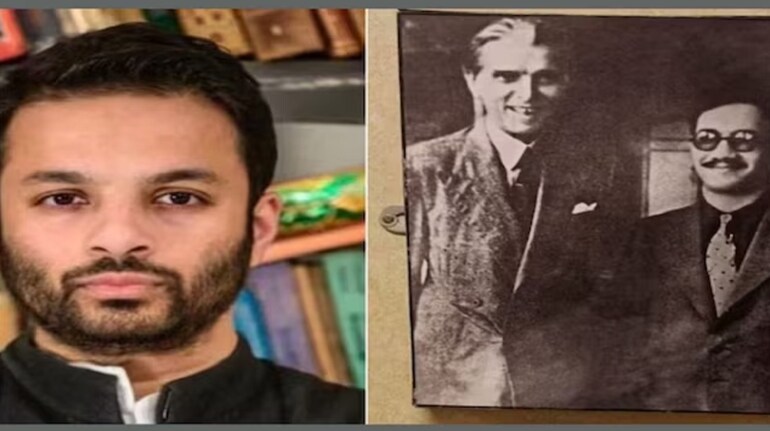
On Wednesday, the Supreme Court granted interim bail to Ali Khan Mahmudabad, who teaches political science at Ashoka University. However, the court also made it clear that it considers this teacher’s behaviour and comments to be completely unreasonable and provocative, which is not expected from an educated person.
For this reason, the Supreme Court neither stopped the investigation process nor cancelled the FIR. On the contrary, the court ordered the formation of an SIT, so that this case could be investigated speedily. Haryana police arrested Ali Khan on the complaint of the state women’s commission. The controversy started over a Facebook post by Ali Khan Mahmudabad, who teaches political science at the country’s most upmarket and elite Ashoka University, in connection with which the women’s commission had issued a notice to him, asking for his appearance. But Ali Khan did not agree to come forward and instead issued a public statement questioning the commission’s jurisdiction and motives. Enraged by this, the commission lodged an FIR against him. A political leader too lodged a complaint.
On the basis of these complaints, Haryana police arrested Ali Khan. Later, a local court sent him to judicial custody. After this, a petition for bail was filed in the Supreme Court on behalf of Ali Khan, and the lawyer was Kapil Sibal. The Supreme Court granted interim bail to Ali Khan but expressed deep displeasure over his intentions and actions.
In fact, Ali Khan Mahmudabad had raised the issues of mob lynching, etc, in his social media post while taking a dig at Colonel Sofiya Qureshi, who gave a media briefing during Operation Sindoor, and instead of discussing the Pakistan-sponsored terrorist attack in Pahalgam, he tried to divert the debate to some other direction. It seemed as if India’s strict action against Pakistan was not tolerable to Ali Khan, or he did not like India’s attempt to give a strong symbolic reply through Colonel Qureshi to the fundamentalist rulers and military officers of Pakistan who propound the two-nation theory.
The Supreme Court termed this attitude of Ali Khan as “dog whistling", i.e., an act under which you try to provoke people and communities through gestures and try to polarise them. The Supreme Court clearly said that when the country was trying to teach Pakistan a lesson under Operation Sindoor after the terrorist attack in Pahalgam in which 26 people lost their lives, Ali Khan Mahmudabad tried to take the debate in another direction through his post, which cannot be justified in the name of freedom of speech in such an environment.
The question arises as to why Ali Khan Mahmudabad did this. The answer is that Ali Khan not only teaches political science but also does politics himself, is very active in it, and has been associated with the Samajwadi Party. Most of his social media posts are related to politics, that too focusing on issues related to Muslim interests, attacking the ruling BJP and the Sangh Parivar. Under the guise of being a liberal, Ali Khan Mahmudabad seems to be doing politics of Muslim identity.
In fact, Ali Khan has inherited this kind of politics, particularly from his grandfather. Very few people would be aware that the Pakistan which came into existence as a country for Muslims with the two-nation theory through jihadi, communal thinking, was birthed by Ali Khan’s own grandfather Mohammad Amir Ahmed Khan, who is recorded in the history books as the Raja of Mahmudabad.
This was the same Raja Mahmudabad who nurtured the politics of the Muslim League, opening his treasury to strengthen it. Mahmudabad was a very prosperous talukdari in the then United Provinces, and currently it is a part of Sitapur district of Uttar Pradesh and is also an assembly constituency.
Raja Mahmudabad formally played the role of treasurer of the Muslim League. Raja Mahmudabad was a close associate of Pakistan’s founder, Muhammad Ali Jinnah, and was deeply involved in the conspiracy to create Pakistan by dividing India. It would also be interesting to note that the founder vice chancellor of Aligarh Muslim University, from which the poisonous tree called Pakistan got the most enrichment, water, and ideological support, was Raja Mahmudabad’s father, Mohammad Ali Mohammad Khan, the then king of Mahmudabad.
In terms of communal extremism, Raja Mahmudabad Mohammad Amir Ahmed Khan was two steps ahead of Muhammad Ali Jinnah. The situation was such that while Jinnah kept saying that people of all communities could live together here after the formation of Pakistan, Raja Mahmudabad was intent on creating Pakistan as an Islamic state in 1939 itself. A glimpse of this is clearly seen in the letter that Raja Mahmudabad had written to one of his friends and historian Mohibul Hasan.
He had written in the letter: “When we speak of democracy in Islam it is not democracy in the government but in the cultural and social aspects of life. Islam is totalitarian—there is no denying about it. It is the Koran that we should turn to. It is the dictatorship of the Koranic laws that we want—and that we will have—but not through non-violence and Gandhian truth."
This letter gives an idea of how violent, jihadi and communal the thoughts of Raja Mahmudabad were. Keep in mind that when this letter was written, Jinnah was not that radical and had scolded Raja Mahmudabad for writing such a letter. Jinnah was also worried that if such ideas about what the future Pakistan would be like came out, then his Pakistan project might be in danger.
Even though Jinnah wanted to keep his real intentions hidden, Raja Mahmudabad had no such problems. That is why he also played an important role in the formation of the Muslim National Guards. This organisation not only left no stone unturned in killing Hindus and Sikhs on a communal basis before the partition of India, but also during and after that loot, murder and rape were its agenda, and it did not hesitate to use swords and guns.
However, when it was decided that Pakistan would come into existence, Raja Mahmudabad thought of saving his properties. After all, he had real estate worth hundreds of crores not only in Lucknow and its surrounding areas, but also in Mahmudabad and many parts of the country. Even though Muslims influenced by their communal thinking were flocking to their dream country, Pakistan, leaving behind their permanent properties, both Jinnah and Raja Mahmudabad were worried about their palaces and the rest of their permanent properties that would remain in India.
It is well known that even after becoming the Governor General of Pakistan, Jinnah kept pleading to retain his right over his palatial house in Mumbai, kept writing letters to Jawaharlal Nehru, kept dreaming of collecting the rent of the house, and kept dreaming of visiting there from time to time. But very few people know what trick Raja Mahmudabad played to save his property worth crores and how he played it.
Famous historian Ishtiaq Ahmed has revealed this in his article written for the newspaper Friday Times, published from Pakistan. He has said that when Jinnah came to Karachi from Mumbai on August 7, 1947, to take over the reins of his dream country, Pakistan, which was taking shape a week later, Raja Mahmudabad also came to Pakistan like him.
But as on August 14, 1947, when Pakistan was officially, artificially, coming into existence as a separate country for Muslims, Raja Mahmudabad had mysteriously left Quetta a day before in a Dakota plane for the Iranian city of Zahedan. Raja Mahmudabad himself was a Shia, and he had gone to Shia-dominated Iran as part of a well-thought-out strategy to create a special excuse. Ishtiaq Ahmed realised this when he wrote an article on the fundamentalist aspect of the Pakistan movement in 2002 and as soon as this article was published, he received an email from one of Raja Mahmudabad’s grandsons with a request to write an article in which it should be strongly put forward that Raja Mahmudabad had left Quetta and gone to Iran on August 13 itself, and hence he was not a citizen of Pakistan. The intention was to prove that since Raja Mahmudabad was not in Pakistan on the day it came into existence, his Indian citizenship should continue.
The effort was to ensure that his sons and grandsons achieve what Raja Mahmudabad could not in his lifetime. The focus was on the property of the Mahmudabad estate. On the one hand, getting Pakistan, and on the other hand, not losing their property in India, was the dream of Raja Mahmudabad and his heirs.
But this intention of Raja Mahmudabad and his heirs could not succeed. First, their dream country itself lost its steam, that too within just a decade. Raja Mahmudabad had thought that after the success of the Pakistan project, he would rule there comfortably. But in Punjabi-dominated Pakistan, with the death of Jinnah, the clout of all those who were most intent on creating Pakistan vanished. The Punjabis gave them a clear signal that there was no place for the dominance of Muhajirs in Pakistan; only the sons of the soil would rule here. All the Muslims who migrated to Pakistan were declared Muhajirs (refugees) with the establishment of Pakistan.
Raja Mahmudabad and all the special and not-so-special people like him who had played big gambles to turn the dream of Pakistan into reality, even not shying away from shedding blood and doing communal politics, were reduced to second-class citizens. The truth is that the entire power of the Muslim League came from the then United Provinces, Bihar, and Central Provinces, where Muslims voted heavily for this party; at that time, the Congress used to be a Hindu party for them. Most of the big leaders of the Muslim League were from these areas.
But after the formation of Pakistan, the situation became such that all these Muslim League leaders became strangers in the country of their dreams. Pakistan was formed, but the power there remained with the leaders of the Punjab province of Pakistan; all the others remained under their thumb. The same trend has been going on to date, as Punjabi Shehbaz Sharif is ruling Pakistan as the Prime Minister, while Punjabi Mullah General Asim Munir is the head of Pakistan’s army. With the formation of Pakistan, the Punjabis drove the Muhajirs straight to Karachi, ahead of which there was only the Arabian Sea. This was the reason that, as a party fighting for the rights of the Muhajirs, the centre of MQM’s movement later became Karachi, and gradually its influence ended in Karachi as well.
As far as Raja Mahmudabad’s activities after the creation of Pakistan are concerned, after initially staying in Iran, he went to Iraq. He was accompanied by his wife, Rani Kaniz Abid, and his three-year-old son Mohammad Amir Mohammad Khan, who later came to be known as Suleman Mian. Raja Mahmudabad spent a lot of time in Karbala, a city important for the Shias. The reason was never clear. Whether it was to repent for the partition that caused the bloodshed of millions of people or to strengthen his Islamic roots, only Raja Mahmudabad knows.
According to a report in the Pakistani newspaper Dawn, which was founded by Jinnah and which was funded by Raja Mahmudabad, after spending some time in Iraq, Raja Mahmudabad also came to Lucknow for a short time, but he did not like it there, and from 1947 to 1957 he mostly stayed in Iraq. In between, he kept coming to his dream country, Pakistan, or to India, to take care of his properties.
In 1950, Rani Kaniz also moved to Iraq with her two daughters and seven-year-old son Suleman Mian. For the next three years, Suleman Mian studied in Iraq, where he kept acquiring knowledge of Arabic, Persian and other things. After this, Rani returned to Lucknow with her children, but Raja Mahmudabad finally reached Pakistan in 1957. There, he handed over his Indian passport, with which he had moved to many countries, to the then Indian High Commissioner CC Desai. After this, he formally accepted Pakistani citizenship, a full ten years after Pakistan was formed.
This was not a unique case. This was the condition of most of the leaders who played an important role in the creation of Pakistan. All of them felt that they would serve their community by creating Pakistan as an Islamic nation, and then go to secular India and enjoy themselves. Zulfiqar Ali Bhutto, son of Shahnawaz Bhutto, one of the big leaders of the Muslim League, who himself formed the Pakistan Peoples Party and later became the Prime Minister of the country, surrendered his Indian passport in 1967. Imagine, the same Bhutto who boasted of fighting a thousand-year war with India, was a close aide of General Ayub Khan, dreamt of victory against India in the 1965 war, shamelessly held an Indian passport till 1967. There were many such people who were ready to sacrifice their lives for India’s enemies and Pakistan, who led it, and who themselves roamed around with Indian passports. Raja Mahmudabad and Bhutto were the more famous names.
After the 1965 war, the Indian government implemented the Enemy Property Act in 1968, under which the properties of those people were confiscated who were either in Pakistan or whose children were sitting on their properties in India. The effect of the order was that all immovable property in India belonging to or held by or managed on behalf of Pakistani nationals stood vested in the Custodian of Enemy Property in India with immediate effect. Since the Raja of Mahmudabad was a national of Pakistan, his property also vested in the Custodian. First, the Enemy Property Ordinance, 1968, was promulgated, which was later on replaced by the Enemy Property Act on July 6, 1968. Enemy Property vested in the Custodian under the Defence of India Rules, 1962, continued to be vested in the Custodian under this Act.
On the one hand, morality demanded that such people not even look towards India after fighting for their dream country and then achieving it, and on the other hand, the stubbornness to retain that property at all costs due to greed, with complete shamelessness, continued.
But destiny has its own game. The Pakistan for which they did everything, shed blood and sweat, divided India, and there was no place for such people in that Pakistan. With a broken heart, Raja Mahmudabad left Pakistan and started living in London. He gave strength and satisfaction to his religious sentiments by building a mosque there, and departed from this world with a broken heart on October 14, 1973.
After the death of Raja Mahmudabad, his son Suleman Mian kept fighting a legal battle from 1974 to gain possession of the property of Mahmudabad, which was confiscated during the tenure of the Congress-led central government. This battle went on for a long time, and in 2005, the Supreme Court gave a decision in his favour. At the time when this decision of the Supreme Court came, there was a Congress-led UPA government at the Centre, and it was alleged that the government was not able to present its case strongly. Jinnah or his close associate Raja Mahmudabad used to call Congress a Hindu party before the formation of Pakistan, but the form, colour and attitude of that Congress had also changed by then. By the time the Supreme Court verdict came, instead of protecting Hindu interests, it had become a Congress party that staked everything on the Muslim vote bank. Not only this, Raja Mahmudabad’s son Suleman Miyan had also become a Congress MLA from the same Mahmudabad twice, in the years 1985 and 1989.
After the Supreme Court verdict, there was an uproar, and the UPA government had to bring an ordinance. Suleman Miyan’s dream of regaining the property of the once Mahmudabad princely state could not turn into reality. Raja Mahmudabad’s property once also included Lucknow’s Butler Palace, which is under the control of the government today.
With the dream of acquiring properties worth crores of rupees in his heart, Suleman Miyan passed away on October 4, 2023. There was no possibility of his dream being fulfilled, because the NDA government, which came to power in 2014 under the leadership of Narendra Modi, made the Enemy Property Act even more stringent in 2017, under which it was said that not only the enemy but even his heirs cannot claim rights over the property confiscated under this Act, even if they are living in India instead of Pakistan. UPA did not try to make the amendment after the lapse of the ordinance, fearing Muslim backlash. That’s why the Modi government made the necessary changes in the Act to thwart any attempt to claim the properties by the heirs of the people declared as enemies.
Suleman Miyan is no more, but his sons still lament, remembering the prosperity of their ancestors. One of the two sons of Suleman Miyan, Ali Khan, still adds Mahmudabad to his name, to keep himself connected to that history, which was once the most prosperous talukdari, princely state of Awadh, and whose then ruler, Raja Mahmudabad, while doing Muslim League politics, created Pakistan, dividing India. In the same tradition, if Ali Khan plays the Muslim card in a subtle manner, and if he criticises the Indian government instead of the Pakistani government and army, then where is the surprise? The good thing is that the Supreme Court has exposed the real mentality of Ali Khan Mahmudabad by referring to “dog whistling" in its comments. Till now, the section that supports and does politics of the Muslim vote bank was calling Ali Khan a liberal and raising its voice in his support, instead of criticising his absurd comments, calling it freedom of expression and creating a perception as if democracy had ended in India.
Discover the latest Business News, Sensex, and Nifty updates. Obtain Personal Finance insights, tax queries, and expert opinions on Moneycontrol or download the Moneycontrol App to stay updated!
Find the best of Al News in one place, specially curated for you every weekend.
Stay on top of the latest tech trends and biggest startup news.




