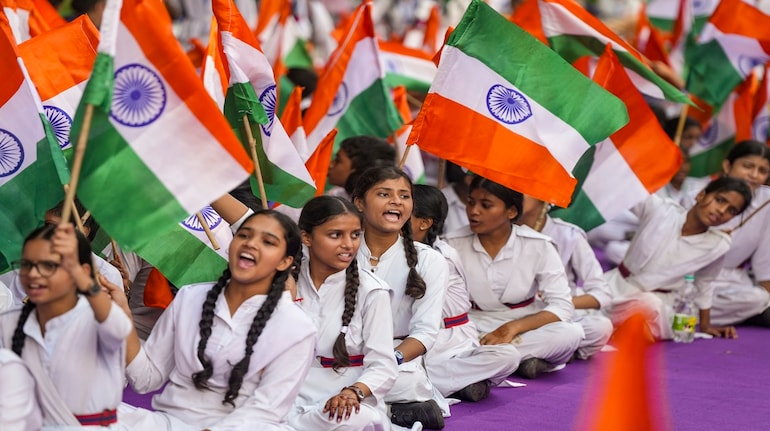

The Union Home Ministry, on January 28, issued fresh guidelines mandating that all six stanzas of Vande Mataram be sung or played at designated government functions and in schools across the country. The rules also state that when both are performed at the same event, the national song must precede the national anthem, Jana Gana Mana.
Those present are required to stand to attention during the rendition, though the ministry has clarified that this does not apply to cinema halls when the song is played as part of a film or documentary.
Until now, Vande Mataram has not had a clearly defined national protocol, unlike the national anthem, which has long been governed by formal rules.
Why all six stanzas, and why now
At the heart of the new guidelines is the decision to restore the full, six-stanza version of Vande Mataram for official use.
According to the Centre, the move is intended to standardise respect for the national song and remove what they describe as an artificial distinction between "acceptable" and "excluded" verses. The government has argued that the song should be treated as a single, complete composition, as originally written by Bankim Chandra Chatterjee, rather than a selectively edited text.
The timing is significant.
The guidelines come amid the Narendra Modi government’s year-long programme marking 150 years of Vande Mataram and follow an extended parliamentary debate in which the ruling party had questioned why a national symbol continued to be used in a truncated form decades after Independence.
Prime Minister Narendra Modi has repeatedly described the omission of the four stanzas as a historical wrong.
During the Winter Session of Parliament in December 2025, he said the song had been "divided" for political reasons, arguing that restoring the full version was necessary to reclaim its original spirit. "Vande Mataram was divided first, and then the country was divided," PM Modi had stated during the debate.
The government has also pointed out that, unlike Jana Gana Mana, Vande Mataram never had a formally codified version or duration, leading to inconsistent practices across states and institutions.
The new rules seek to end that ambiguity.
The deletion pre-Independece: Why four stanzas were dropped in 1937
The decision to limit official use to the first two stanzas dates back to 1937, when the Congress Working Committee debated concerns raised by Muslim leaders about the later verses, which contain references to Hindu deities such as Durga, Lakshmi, and Saraswati.
It has been found from archives that former Prime Minister Jawaharlal Nehru, in his correspondence from that period, had acknowledged that while some opposition to the song was "manufactured by communalists", there was also "some substance" to concerns about the religious imagery.
Eventually, the Congress had resolved that only the first two stanzas, which celebrate the motherland without religious references, would be used in a national context.
Years later, after India became independent, those two stanzas were adopted as the national song in January 1950, while Jana Gana Mana was designated the national anthem.
The current-day political debate
The BJP has long argued that the 1937 decision amounted to a compromise on a national symbol, and says continuing with a truncated version reinforces what it sees as a legacy of appeasement.
The Congress and other opposition parties, however, maintain that the original decision was guided by inclusivity and an effort to ensure that national symbols remained accessible to all communities. They have accused the government of politicising Vande Mataram and selectively interpreting historical debates.
Under the Home Ministry’s order, Vande Mataram will be played or sung at:
>> Government and state functions
>> Civilian award ceremonies, including the Padma awards
>> Events attended by the President and Governors
>> School assemblies and educational programmes
The ministry has, however, clarified that standing is not mandatory in cinema halls when the song is played during films or documentaries, as this could disrupt viewing.
Why this matters now
By formally mandating all six stanzas, the Centre has given Vande Mataram its most detailed official status to date, bringing it closer to the ceremonial framework of the national anthem.
The decision has also reopened a decades-old debate over history, identity and national symbolism, ensuring that the song, first written in the 19th century, remains a live political and cultural issue in 21st-century India.

Discover the latest Business News, Sensex, and Nifty updates. Obtain Personal Finance insights, tax queries, and expert opinions on Moneycontrol or download the Moneycontrol App to stay updated!
Find the best of Al News in one place, specially curated for you every weekend.
Stay on top of the latest tech trends and biggest startup news.