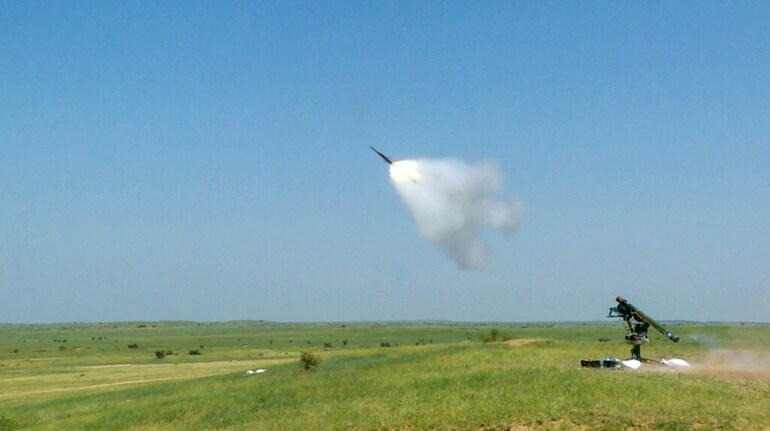
Amid heightened tensions with Pakistan following the Pahalgam terror attack, India is accelerating efforts to strengthen its tactical air defence capabilities. The Indian Army is in the process of acquiring the Very Short Range Air Defence System (VSHORADS), also referred to as VSHORADS – New Generation (NG), to plug critical gaps in its air defence grid. These man-portable air defence systems (MANPADS), featuring Russian-origin Igla-S missiles, are designed to neutralize low-flying threats such as helicopters, UAVs, and low-speed aircraft, especially in forward areas and mountainous terrains.
The Ministry of Defence, in coordination with the Indian Army, has issued a Request for Proposal (RFP) to procure 48 launchers, 48 night vision sights, 85 missiles, and one missile text station for the VSHORADS (NG), as part of a Rs 260 crore contract signed under emergency procurement powers.
"The new supplies of the Igla-S air defence missiles have been received by the Indian Army a couple of weeks ago and are being provided to the forward formations for taking care of the threat from enemy fighter aircraft, choppers and drones on the borders," defence sources told news agency ANI.
What is VSHORADS?The VSHORADS is a shoulder-fired air defence system designed for quick deployment and engagement of aerial threats at short ranges. The new-generation VSHORADS (NG) is an upgraded variant intended to replace older systems like the Strela and provide the Indian Armed Forces with a technologically advanced edge.
VSHORADS systems typically have a range of around 6–8 km and are most effective below altitudes of 4.5 km. Their portable nature and operational flexibility make them vital for troops stationed in high-altitude regions, forward posts, and mobile units.
Russian-Origin Igla-S: Core of India’s VSHORADSAt the core of India’s VSHORADS capability lies the Igla-S missile, a Russian-developed MANPADS that India has begun acquiring under emergency procurement.
The Igla-S is a successor to the older Igla-M system and features significant upgrades:
Range and Altitude: It can engage aerial targets up to 6 km away and at altitudes of up to 3.5 km.
Seeker Technology: It uses a multi-spectral optical seeker, making it highly resistant to flares and countermeasures.
Warhead: Equipped with a high-explosive fragmentation warhead that can destroy or severely damage aircraft with a single hit.
All-Weather, Day-Night Capability: Its advanced infrared homing capability allows it to operate in various combat environments and weather conditions.
Portability: At under 20 kg (including launcher and missile), it is highly mobile and can be rapidly deployed by infantry units.
DRDO's Indigenous VSHORADS: Another PillarIn parallel, the Defence Research and Development Organisation (DRDO) has been developing an indigenous VSHORADS system, which successfully completed flight tests in 2023. While not yet inducted, the DRDO system adds a layer of strategic independence and long-term domestic capability to complement imports like the Igla-S.
Why This Matters NowThe VSHORADS acquisition comes at a time of heightened border security concerns and increased threats from both Pakistan and China. The use of drones for surveillance and potential offensive operations has increased along India's borders, particularly in Jammu & Kashmir and Punjab. Pakistan’s rapid missile testing — such as the recent test-firing of Fatah-series and Abdali missiles — adds urgency to India’s defensive posture.
Moreover, the VSHORADS system is critical in mountainous areas like Ladakh and the Northeast, where fixed air defence systems may be hard to deploy, and mobile aerial threats pose a real-time danger.
Discover the latest Business News, Sensex, and Nifty updates. Obtain Personal Finance insights, tax queries, and expert opinions on Moneycontrol or download the Moneycontrol App to stay updated!
Find the best of Al News in one place, specially curated for you every weekend.
Stay on top of the latest tech trends and biggest startup news.