






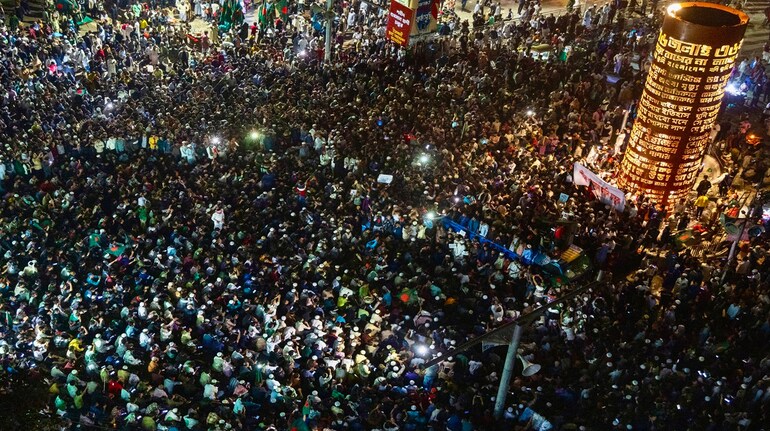

Bangladesh has been on edge in recent days following the killing of a prominent student leader, setting off protests, mob violence and diplomatic tensions with India at a sensitive moment ahead of the country’s February 2026 national elections.
Security assessments indicate that the unrest is unfolding amid heightened narrative-driven mobilisation, with Pakistan’s Inter-Services Intelligence (ISI) playing a behind-the-scenes role by amplifying instability rather than overtly directing it.
Sheikh Hasina sentenced to death
A Bangladeshi court sentenced former prime minister Sheikh Hasina to death for her alleged role in the deadly violence during the 2024 student-led uprising. India responded by saying it “remains committed to peace, democracy, inclusion and stability in Bangladesh”, while Dhaka sought her extradition, referring to her as a fugitive.
Sharif Osman Hadi shot dead
Sharif Osman Hadi, a prominent student leader associated with Inqilab Mancha, was shot by masked gunmen while leaving a mosque in Dhaka. He later died while undergoing treatment at a hospital in Singapore. Hadi had emerged as a key figure during last year’s pro-democracy movement that led to Sheikh Hasina stepping down and fleeing the country.
Fresh protests after Hadi’s death
Hadi’s death triggered widespread unrest across Bangladesh. Protesters took to the streets, vandalising and torching property, including media offices such as Prothom Alo and The Daily Star. According to Reuters, several areas remained tense, prompting the deployment of additional security forces.
Another NCP leader shot in Khulna days after Usman Hadi killing
Days after the killing of Inqilab Manch spokesperson Sharif Osman Hadi, unidentified gunmen shot a senior leader of the student-led National Citizen Party in Khulna, deepening concerns over the deteriorating security situation.
Muhammad Motaleb Sikdar, a central organiser of the NCP’s labour wing, Jatiya Sramik Shakti, was shot in the head while preparing for a divisional labour rally in the city, Bangladeshi media reported.
Saif Nawaz, an organiser of the NCP’s Khulna metropolitan unit, said Sikdar is the party’s Khulna divisional convener and a key figure in its labour organisation. He was reportedly involved in mobilisation efforts for the upcoming rally when the attack occurred.
Hindu worker lynched amid unrest
Amid the violence, Dipu Chandra Das, a Hindu worker, was lynched by a mob along the Dhaka-Mymensingh highway. His body was tied to a tree and set on fire. While initial reports linked the killing to an alleged religious insult, police and family members later said a workplace dispute was the trigger.
ISI role under scrutiny
Security and intelligence assessments indicate that Pakistan’s Inter-Services Intelligence is exploiting the volatile situation through narrative-driven mobilisation ahead of Bangladesh’s general elections, reported CNN News18. Rather than leading the unrest openly, ISI is believed to be operating through Islamist networks linked to Jamaat-e-Islami and student and madrasa groups, keeping local actors visibly in front while amplifying agitation from behind the scenes.
Officials say Pakistan-linked digital networks and funding channels are amplifying violent imagery and anti-India messaging on social media, portraying New Delhi as a backer of the ousted Sheikh Hasina government. Several influential handles driving protest narratives are reportedly operating from Pakistani territory.
Controversial NCP remarks on India
Tensions escalated after National Citizen Party leader Hasnat Abdullah claimed Bangladesh could shelter separatist forces from India and sever the country’s seven northeastern states from the rest of India. The remarks drew strong reactions in New Delhi.
Protest march towards Indian High Commission
Police stopped protesters attempting to march towards the Indian High Commission in Dhaka, demanding the return of Sheikh Hasina and others who fled after last year’s uprising. India later summoned Bangladesh’s high commissioner, citing concerns over the deteriorating security environment and potential threats to its mission.
Protests spread to India, visa services hit
The unrest spilled over into India, with protests reported outside Bangladeshi diplomatic and visa offices in New Delhi, Siliguri and Tripura. In response, Bangladesh suspended visa services at multiple centres, citing security concerns.
India, Bangladesh trade diplomatic barbs
India expressed concern over what it described as the “horrendous killing” of the Hindu man and said it was closely monitoring developments in Bangladesh. Bangladesh, in turn, summoned the Indian envoy, raising concerns over the security of its missions in India.
Bangladesh summons Indian envoy
Bangladesh’s foreign ministry summoned the Indian envoy over the security of Bangladeshi diplomatic missions in India. The incidents cited for the summons included vandalism at the Bangladesh Visa Centre in West Bengal’s Siliguri and a protest outside the Bangladesh High Commission in New Delhi. Dhaka stated that it had raised concerns about the safety of its missions amid rising protests linked to the ongoing unrest.
Discover the latest Business News, Sensex, and Nifty updates. Obtain Personal Finance insights, tax queries, and expert opinions on Moneycontrol or download the Moneycontrol App to stay updated!
Find the best of Al News in one place, specially curated for you every weekend.
Stay on top of the latest tech trends and biggest startup news.





