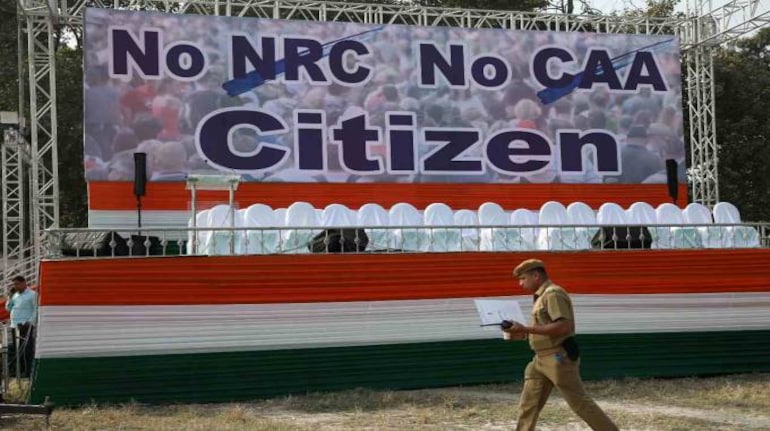
It took a massive agitation spanning over six long years to highlight the threats posed by the unabated influx of Bangladeshi migrants to Assam’s ethnic demography. Thirty-five years have passed since then, but the issue is still alive and kicking as successive ruling parties chose to play their own brand of politics over the years, undermining the importance of the matter.
A year after the final version of the National Register of Citizens (NRC) was published in the northeastern state, the authorities concerned have not yet issued 'rejection slips' to the 1.9 million people excluded from the list, significant numbers of whom are suspected to be illegal Hindu settlers from Bangladesh. This has fuelled fears among the state’s indigenous groups that the ruling Bharatiya Janata Party (BJP) is trying to protect the Bengali-speaking Hindus for electoral gains.
First published in 1951, the process to update the NRC was initiated to detect illegal immigrants irrespective of their religion on the basis of March 25, 1971 cut-off date. The Supreme Court-monitored exercise found 31 million people eligible for inclusion in the final list published on August 31 last year and rejected 1.9 million applicants as they failed to submit adequate proof of their citizenship.
Those excluded from the list were supposed to be issued rejection slips earlier this year, but the state NRC authorities claim the process got delayed because of the nationwide lockdown triggered by the COVID-19 pandemic. A rejection slip will show the reason for exclusion of an applicant from the list.
The delay in issuing the rejection slips could also be due to the fact that the Registrar General of India is yet to notify the final publication of the NRC.
Nonetheless, indigenous groups such as the influential All Assam Students’ Union (AASU) and the Asom Sangrami Mancha (ASM) have now slammed the ruling BJP, saying it made a mockery of the NRC, and deliberately complicated the NRC process in order to protect the interest of illegal migrants.
Rejection or inclusion?There is apprehension that the majority of people excluded from the NRC would eventually make it to the list as the officials involved in the process had allegedly cited weaker grounds for their exclusion. And the chances are that a Foreigners’ Tribunal (FT) would strike down such a rejection order, making it easier for the applicant to get his/her name included in the citizens’ register.
An FT is a quasi-judicial body that has the power to determine if a person is an Indian citizen or a foreigner according to the provisions of the Foreigners Act 1946, and the Foreigners (Tribunal) Order 1964. At present, there are 100 FTs in Assam to handle the NRC rejection cases.
There were plans to set up 200 more tribunals across the state to expedite the hearings in the NRC rejection cases, and accordingly, 221 new members were appointed by the Assam government last year. However, questions are now being raised about its intention after the BJP-led government failed to issue appointment letters to 1,600 people selected as support staff. Nobody knows how long it will take to settle the appeals with the COVID-19 pandemic now giving the ruling dispensation another excuse to delay the process.
NRC – the backstoryThe demand to update the NRC was first raised by the AASU in 1980, amid the six-year anti-foreigner movement, better known as Assam Agitation. On February 2 that year, AASU leaders met the then Prime Minister Indira Gandhi demanding that all illegal immigrants be detected and deported on the basis of 1951 NRC. However, the student body finally settled for the March 25, 1971 cut-off date during the signing of the 1985 Assam Accord that brought an end to the agitation.
Since then, successive regimes at the Centre have never taken it seriously. In 2010, the Congress-led United Progressive Alliance government decided to run a pilot project in Chhaygaon in Kamrup district and Barpeta, but abandoned it after violence broke out in Barpeta. Four persons were killed in clashes between police and activists of the All Assam Minority Students’ Union who opposed the move to update the citizens’ register.
The NRC issue received a fresh impetus after the Registrar General of India issued a notification on December 5, 2013, and subsequently, the Supreme Court started monitoring the process. The BJP that came to power at the Centre in 2014 claimed credit for this, and some of its top leaders even talked about the possibility of a nationwide NRC, a move seen as anti-Muslim by the Opposition and rights organisations.
However, the final version of the NRC in Assam had put the BJP in a fix when it found that only 1.9 million people were excluded from the list, many of whom are suspected to be Bengali-speaking Hindus, its potential votebank. While the saffron party started questioning the whole exercise, the AASU and the Assam Public Works (APW) urged the apex court for re-examination of the final draft, which they alleged was “not prepared” according to the court’s directives. APW is a primary petitioner in the NRC case in the Supreme Court.
The AASU has also accused the BJP government of trying to violate the provisions of the Assam Accord by imposing the Citizenship Amendment Act 2019 that grants Indian citizenship to persecuted minorities, including Hindus, from Bangladesh, Pakistan and Afghanistan who entered the country on or before December 31, 2014.
Jayanta Kalita is a senior journalist and author based in Delhi. He writes on issues related to India’s Northeast. The views are personal.Discover the latest Business News, Sensex, and Nifty updates. Obtain Personal Finance insights, tax queries, and expert opinions on Moneycontrol or download the Moneycontrol App to stay updated!
Find the best of Al News in one place, specially curated for you every weekend.
Stay on top of the latest tech trends and biggest startup news.