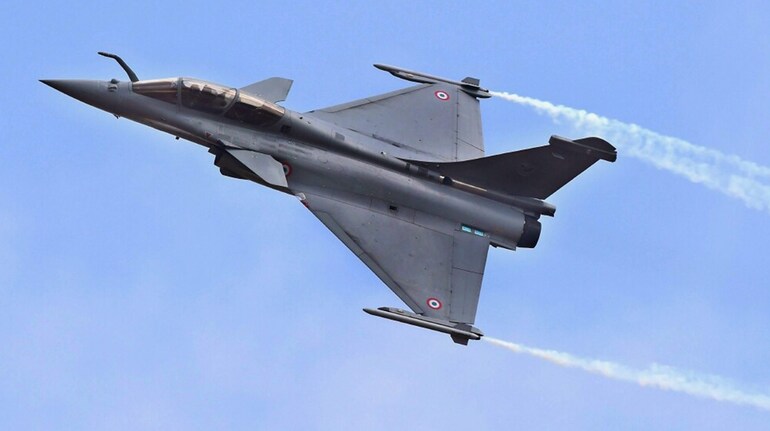

French President Emmanuel Macron is in India on a three-day state visit, where he is set to meet Prime Minister Narendra Modi and hold wide-ranging talks under the India–France Strategic Partnership.
A key item on the agenda is a proposed government-to-government deal worth nearly 40 billion USD, under which India plans to acquire 114 Dassault Rafale fighter jets over the coming months.
The potential agreement comes at a time when the Indian Air Force is grappling with falling squadron strength. The IAF currently operates 29 fighter squadrons against a sanctioned strength of 42, even as regional rivals Pakistan and China continue to expand their air power.
Pakistan fields roughly 25 fighter squadrons, while China has more than 60 and is adding new fourth and fifth-generation aircraft at a rapid pace.
India already operates 36 Rafales inducted under the 2016 deal, while the Indian Navy recently signed a contract for 26 naval variants for deployment on the aircraft carrier INS Vikrant.
Classified as a 4.5-generation multirole fighter, the Rafale is currently the most advanced combat aircraft in India’s arsenal.
India-specific enhancements on the Rafale include the long-range Meteor beyond-visual-range missile, advanced electronic warfare suites, improved radar and secure communication systems. Its Thales RBE2 AESA radar and frontal stealth features provide superior situational awareness and survivability.
The aircraft can also deploy precision weapons such as the SCALP cruise missile and HAMMER smart bombs, enabling deep-strike missions with high accuracy.
Pakistan’s fighter fleet: How it compares to India's air power
F-16: Capable but restricted
Pakistan’s F-16 Fighting Falcon fleet, acquired from the United States, remains one of its most capable platforms in air-to-air combat. However, these jets operate under strict end-use monitoring agreements that limit their employment primarily to counter-terrorism and defensive roles. With an estimated fleet of around 70–75 aircraft, maintenance costs and dependency on US oversight often affect availability.
While the F-16 is effective in dogfights and carries AMRAAM missiles, analysts note it lacks the Rafale’s advanced electronic warfare depth and long-range engagement advantage.
JF-17 Thunder: Backbone but lighter class
The JF-17 Thunder, jointly developed by Pakistan and China, forms the numerical backbone of the Pakistan Air Force. It is a lightweight, single-engine multirole jet designed for affordability and quick production. The latest Block 3 variant introduces AESA radar and upgraded avionics, yet it still trails the Rafale in range, payload capacity, engine redundancy and survivability in heavily contested airspace.
J-10c: Modern but battle-tested questions remain
Pakistan has also inducted the Chinese Chengdu J-10C, a 4.5-generation medium-weight multirole aircraft produced by Chengdu Aircraft Corporation. The jet features modern avionics, delta-canard design and advanced missiles, placing it technologically closer to the Rafale than the JF-17.
However, its combat record remains limited compared to the Rafale, which has seen operational deployments across multiple theatres globally. Defence observers note that while the J-10C narrows the technology gap on paper, the Rafale’s twin-engine reliability, mature weapons integration and electronic warfare ecosystem still provide India a qualitative edge.
If the 114-jet Rafale deal is finalised, it would significantly boost India’s squadron strength and reinforce its qualitative superiority in the region.
While Pakistan’s mix of F-16s, JF-17s and J-10Cs provides numerical balance and modernisation, the Rafale’s combination of advanced sensors, long-range strike capability, electronic warfare dominance and operational flexibility continues to position it as one of the most formidable fighters in South Asia’s evolving air power equation.
Discover the latest Business News, Sensex, and Nifty updates. Obtain Personal Finance insights, tax queries, and expert opinions on Moneycontrol or download the Moneycontrol App to stay updated!
Find the best of Al News in one place, specially curated for you every weekend.
Stay on top of the latest tech trends and biggest startup news.