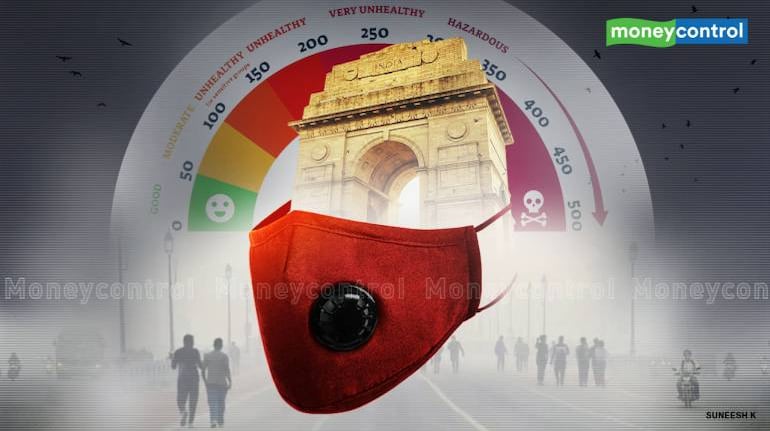
Finally, after all crisis-management efforts failed, it was left to the 'weather gods' to rescue a choked Delhi-NCR from one of the longest air emergency spells in recent times. There is, however, no reason to cheer yet as it is only the beginning of winter, which coincides with the annual pollution season.
The rain and wind rescued Delhi this time, but favourable weather conditions may not be present all the time and only coordinated, long-term and year-long efforts involving all stakeholders can help address the annual air pollution emergency, say experts.
So, what happened? A thick blanket of smog had enveloped Delhi and nearby areas for nine days, from November 1 to 9, leaving Delhi-NCR residents gasping for breath – and forcing the authorities to enforce the highest restrictions in the rule books in a bid to control the air emergency.
 Steps to tackle Delhi AQI crisisGas chamber
October was breathable but the smokey story began around October 28 when Delhi's average air quality index (AQI) entered the ‘very poor’ category and slowly climbed up. On November 2, it neared the ‘severe’ category, resting at 392 at ‘very poor’. On November 3, the AQI crossed the ‘severe’ mark for the first time this season, recording 468 in the 4 pm daily bulletin.
From there, the AQI stayed put at ‘severe’ till November 8, barring one day on November 7, when it marginally came down to 375 in the ‘very poor’ category. On two days, November 3 and 5, the AQI crossed the severe-plus mark, recording 468 and 454, respectively.
An AQI between zero and 50 is considered ‘good’, 51-100 ‘satisfactory’, 101-200 ‘moderate’, 201-300 ‘poor’, 301-400 ‘very poor’, and 401-500 ‘severe’.
At many monitoring stations such as Anand Vihar – one of Delhi's notorious pollution hotspots – the AQI breached the 500 mark. The story was somewhat similar in the surrounding region, with a thick blanket of smog making breathing almost an impossible task.
The Commission for Air Quality Management reacted quickly, first invoking the stage 3 graded action plan (Grap) and then Grap 4, when the AQI crossed the 450-mark.
Grap is a set of emergency plans implemented in four stages. Stage 1 is implemented when the AQI is 'poor', stage 2 in the ‘very poor’ phase, and stage 3 when the AQI is between 401 and 450. Stage 4, which entails the highest restrictions, is invoked when the AQI crosses 450.
Apart from the Grap 4 measures, the Delhi government shut schools, banned app-based cabs registered in other states, stopped diesel trucks from entering the city, etc. It even mulled introducing the odd-even road rationing scheme and is considering cloud-seeding to induce artificial rain.
It finally rained relief late November 9 night and on November 10, when rain and winds blew away the smog and brought down the AQI from an alarming 437 on November 9 to a ‘poor’ 279 on November 10 and 220 on November 11.
Similar spells of seven consecutive days of ‘severe’ or near severe AQI in November were reported in 2016, 2017 and 2019 and six days in 2018, 2020 and 2021 – mostly in the first half of the month, when stubble burning peaks.
 Delhi AQI had come down to 220 by November 11. (Photo by Azim Islam via Pexels)Why Delhi-NCR choked
A host of factors such as stubble burning – which lasts for about two months – bio-mass burning for fuel, and heating, industrial and automobile emission, dust, brick kilns and firecrackers during Diwali, etc., generally cause a spike in pollution in winter when the wind is calmer, making it harder for the pollutants to disperse.
Due to its typical climatology and geographical location, Delhi gets a significant share of external pollution, which varies from season to season.
According to SAFAR, a national air quality initiative of the ministry of earth sciences, the external share in Delhi’s PM2.5 pollution in November-December may vary between 30-40 percent on average or even more on some typical episodes.
Stubble burning was one of the key causes for the spike this month. From September 15 to November 11, 36,604 paddy residue burning cases were reported from Punjab, Haryana, UP, Delhi, MP, Rajasthan. Punjab's share in this period was 23,730, Haryana 1,703, UP 1,568, Delhi 4, MP 8,379 and Rajasthan 1,220, Indian Agricultural Research Institute data shows.
A chunk of these fires was reported in November alone. From November 1 to 9, Punjab reported 16,595 fires, and Haryana 597. In October, Punjab recorded 7,779 fires against Haryana's 1,477.

It is generally the smoke from Punjab and Haryana that affects Delhi the most when the wind blows from the north-northwesterly direction.
Stubble fires peaked in Punjab on November 5 with 3,230 cases, November 6 (2,060) and November 8 (2,003). In Haryana, stubble fires peaked on November 5 with 109 cases and November 6 (65).
A sizeable number of fires is reported in these two states in April and May too but the windy conditions in these two months lead to fast dispersal of the smoke.
Taking note of the rising crop fires, the Supreme Court directed Punjab, UP, Haryana and Rajasthan to do whatever it takes to stop crop-burning.
 An airshed is a geographical area sharing a common and discrete air mass because of climate, topography or meteorology. (Photo by Zabala Trusido via Pexels)Stop-gap plans won't work
Experts say emergency measures are temporary and only pointed, consistent and years-long efforts that go beyond state jurisdictions will bear fruit as air pollution knows no boundaries.
Gufran Beig, chair professor, National Institute of Advanced Studies Bangalore, and founder project director, SAFAR, explains that in a normal case scenario, local sources contribute around 70 percent to pollution during winters. “So if you can check those sources, air pollution can be controlled.”
But in the last few days, stubble burning contributed around 30-40 percent to Delhi's air pollution, plus there were 20-25 percent pollutants from other sources in surrounding areas depending on the time and day. So Delhi was left with less than 50 percent of local pollutants, Beig said.
“In such a scenario, when a large number of pollutants are from outside, stop-gap arrangements such as odd-even or water sprinkling locally within Delhi won't be very effective,” he said.
Simi Mehta, CEO and editorial director, Impact and Policy Research Institute, said the thick blanket of smog was back to choke the residents of Delhi-NCR, and yet again, politicians were back with photo-ops of marathon meetings, indulging in a blame game over stubble fires, and introducing drastic measures like shutting down schools, and mulling others like odd-even norms, etc.
“Each year, Delhi-NCR reels under a severe air pollution crisis and each year, the crisis becomes more catastrophic than before. This year was not catastrophic. It was the dawn of an apocalypse,” she said.
Mehta says unless concerted action is taken to control stubble burning without engaging in vote-bank politics and ensure medium-short and long-term plans to control vehicular and industrial pollution, stray solutions will make all efforts futile.
Action beyond boundariesMost of the action or brouhaha is generally limited to Delhi or its immediate surroundings and all norms go for a toss in other parts of the northern plains. And this is where the problem is, the experts say – advocating for a regional action plan.
According to Anumita Roychowdhury, executive director, research and advocacy, Centre for Science and Environment, a rapid build-up of pollution, when meteorology turns adverse, is possible only if the local and regional pollution is consistently high. She calls for round-the-year aggressive action for deeper emission cuts from key sources of pollution not only locally but from across the region.
“Aligned and coordinated action across all four states in NCR is needed to ensure clean energy transition in all key sectors, zero emissions for vehicles, a massive shift to public transport and mass transit systems to reduce private vehicles on roads, and complete material recovery from all waste streams,” Roychowdhury says.
Among other steps, Roychowdhury says binding clean air targets based on more stringent national ambient air quality standards can catalyze pollution-abatement strategies such as clean and affordable renewable energy in industries, small businesses, power plants, and households. Compact cities, she says, can reduce distances and cut energy-intensive travel.
Beig says there are two ways to take decisive steps that can make a difference. One is long-term, science-based planning. Two, for immediate relief, these temporary steps should not be limited to within the city and must be extended to the airshed region.
For example, banning a few BS 3 cars or the odd-oven restrictions will not be of much help if polluting motorbikes or badly maintained cabs ply freely. Or barring app-based taxis from other states in Delhi as these will still be plying outside the borders. Similarly sprinkling some water inside Delhi's boundaries to contain dust will be fruitless if a construction site or factory just across the border flouts all norms.
“An airshed approach and action plan, which extends to 100 km from the city's periphery, is the only way to tackle this issue,” Beig says.
Airshed-level approachAn airshed is a geographical area sharing a common and discrete air mass because of climate, topography or meteorology, where pollution in one part may affect another.
In a paper on ‘Regulating air quality at an airshed level in India’, produced by the Initiative on Climate, Energy and Environment at the Centre for Policy Research, environmental lawyer Shibani Ghosh and co-authors Bhargav Krishna and Abinaya Sekar outline the importance of airshed planning.
The west-central Indo-Gangetic plains comprising Punjab (India and Pakistan), Haryana, parts of Rajasthan, Chandigarh, Delhi, and Uttar Pradesh is one such airshed.
Bihar, Bengal, Jharkhand, and Bangladesh form another. Odisha-Chhattisgarh and Eastern Gujarat-Western Maharashtra are two other airsheds.
“A coordinated effort across a region supporting consistent and uniform measures against similar pollution sources is likely to lead to greater gains,” states the paper shared with Moneycontrol.
The present regulatory set-up focuses on point sources and the jurisdictional mandate of regulatory bodies aligns with state or city boundaries and that needs to change. To effectively regulate pollution and reduce pollution exposure, this regulatory architecture needs to adopt an airshed-level approach. And that is the need of the hour, the paper states.
Discover the latest Business News, Sensex, and Nifty updates. Obtain Personal Finance insights, tax queries, and expert opinions on Moneycontrol or download the Moneycontrol App to stay updated!
Find the best of Al News in one place, specially curated for you every weekend.
Stay on top of the latest tech trends and biggest startup news.