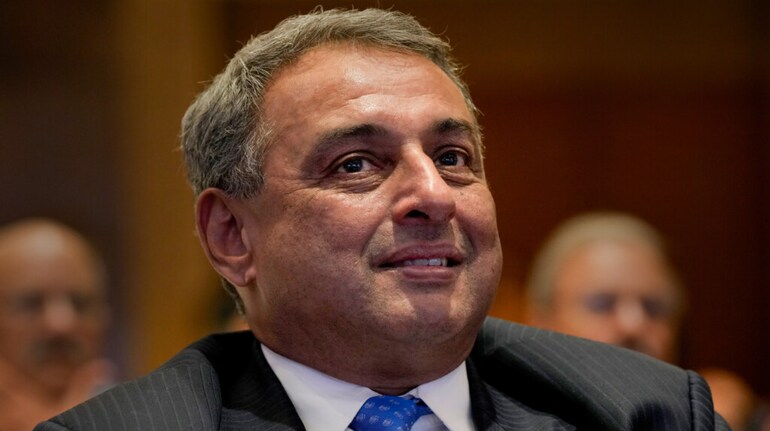

Metals major Tata Steel, which has a large exposure to European markets through its manufacturing operations in the Netherlands, said in an interaction with Moneycontrol that the free trade agreement (FTA) between India and the European Union will help improve sentiment in multiple sectors in India. The deal also helps Tata Steel protect its European market through the exclusion of the EU's Carbon Border Adjustment Mechanism (CBAM) from the FTA.
"From our point of view, the fact that the CBAM stays as it is, helps us in Europe because CBAM is actually an equalization tax. It's not so much a trade issue as a carbon tax issue. I think the whole philosophy of CBAM is if any steel producer in Europe is paying a carbon tax, any steel supplier into Europe should pay the same carbon tax," said T.V. Narendran, CEO and managing director of Tata Steel, during the interaction.
Steel producers in India with ambitions to tap the European markets were disappointed when the CBAM regime was kept outside the purview of the FTA , even as most steelmakers have been reducing exports to the trade bloc over the past few years, due to competition from steelmakers in China, Vietnam, and elsewhere, as well as in anticipation of the CBAM regime.
More than 60 percent of India's steel exports are to the European Union. Due to the CBAM, steelmakers exporting to the EU face varying tariffs based on the "intensity" of carbon emissions (carbon dioxide emissions per tonne), while India's duty-free steel export quota to the EU has also been reduced, effective from July 2026.
While the EU has termed CBAM as one of its levers to bring about a carbon-neutral continent, sector analysts have widely interpreted the regime as a protectionist measure intended to support Europe's long-struggling steel industry, with supply consistently outpacing demand.
The European Steel Association (ESA) projected a slight decline (0.2 percent) in consumption for 2025 in the EU, while steel demand is expected to grow by around 3 percent in 2026. Analysts say that incremental growth in EU steel demand is expected to be aided by defence spending, increased industrial activity, and measures such as CBAM which would impact imports of steel. In the January to August period of 2025, the ESA noted that steel imports to EU from India plunged by 45 percent.
While Tata Steel's Indian operations have limited exposure to the United States market, the recent "trade agreement" between the countries, in which the US has agreed to reduce tariffs from 50% to 18%, on some goods, may stand to benefit some of its customers, Narendran added.
The company does not export steel from its Indian operations to the United States, with Indian steel still subject to a 50 percent "national security" tariff under Section 232 of the Trade Expansion Act in the US. Tata Steel has been aiming to service the US market from its United Kingdom operations instead, which has a significantly lower tariff burden.
However, group chief financual officer Koushik Chatterjee said the tariff situation for steel exports to the US remains unchanged under the EU–US arrangement, with temporary exclusions having expired and no clarity on timelines for any relief.
"So there are two parts to it. One was there were certain exclusions to Section 232 which actually lasted till September 25. Post September 25, because exclusions, our effective tariff was lower than 50%, but post September 25 those exclusions moved away. So we are just now, or rather the EU is just now at about 50% for the steel that they exported to the US. So it’s actually gotten increased," Chatterjee said.
Discover the latest Business News, Sensex, and Nifty updates. Obtain Personal Finance insights, tax queries, and expert opinions on Moneycontrol or download the Moneycontrol App to stay updated!
Find the best of Al News in one place, specially curated for you every weekend.
Stay on top of the latest tech trends and biggest startup news.