
At 7:18 pm on a weekday evening, Rakesh Kumar stands outside a dark store in Gurugram’s Sector 40, helmet clipped to his bike as his phone buzzes with a new order. He moves to the designated pickup window, scans the QR code assigned to the order and confirms the handover on his app. Without pausing, he lifts the sealed grocery bag and pulls into traffic.
There is no countdown clock on his screen. No message telling him how fast he needs to deliver.
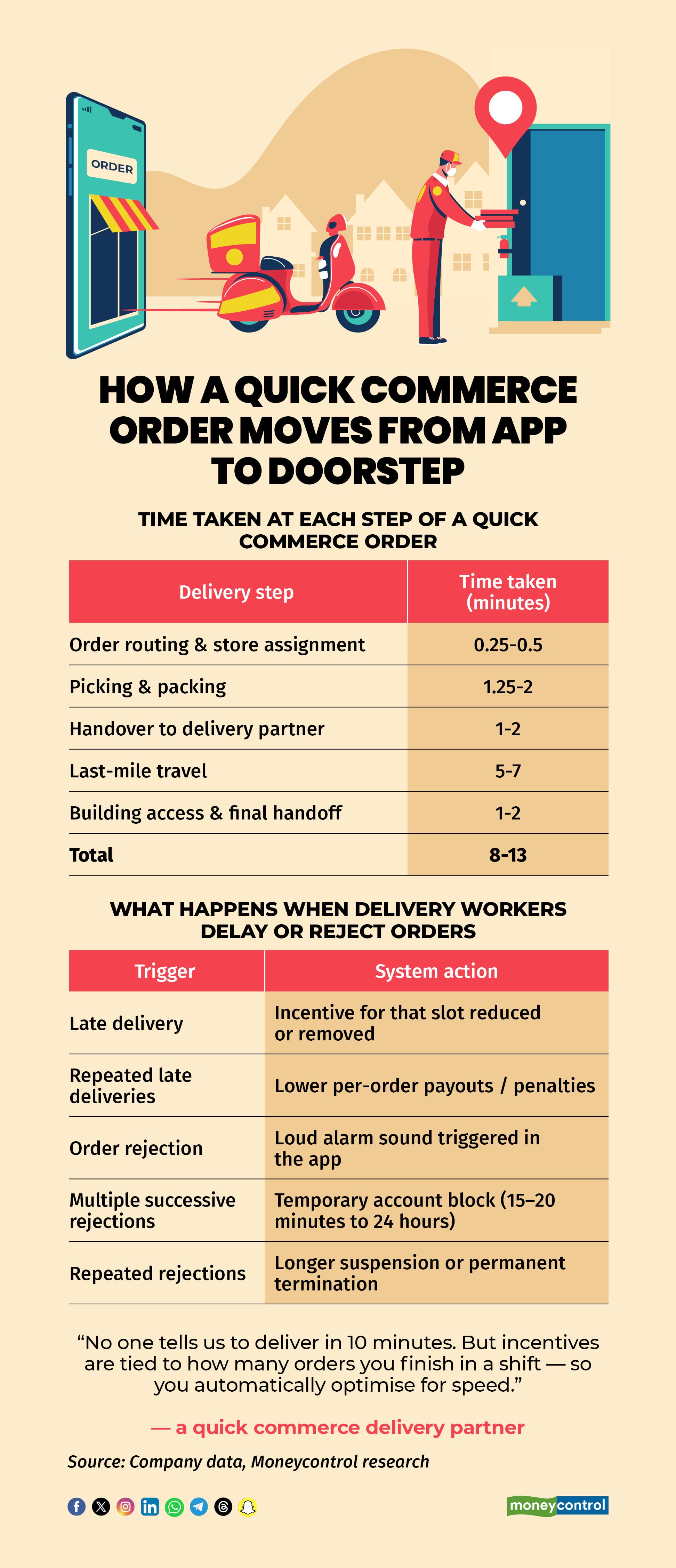
“No one tells us to deliver in 10 minutes,” Kumar, a delivery partner with Zepto, told Moneycontrol. “But incentives are linked to how many orders you finish in a shift. If you’re quick, you hit those slabs. If you’re slow, you don’t. You automatically optimise for speed that way.”
The experience Kumar describes is not unique to one platform. It runs through quick commerce players such as Blinkit, Instamart, Tata’s BigBasket, Flipkart Minutes and Amazon Now, which have built their businesses around moving groceries through dense urban neighbourhoods in minutes.
Industry executives said median delivery times across platforms typically range between eight and fifteen minutes, depending on dark store density, demand, product availability and basket size. Pinning down an exact median is difficult, they added, because delivery times fluctuate constantly — sometimes even day to day — based on traffic conditions and order volumes.
Blinkit, Zepto and Instamart did not respond to queries sent by Moneycontrol.
Why speed is under the spotlight
Speed is built into quick commerce long before a delivery partner starts riding. Dark stores are placed close to residential clusters, orders are routed automatically, and picking and packing are optimised to minimise time spent inside the store. Once an order is handed over, the rest of the system moves just as tightly — from navigation to handoff.
It is this tightly choreographed setup that has come under closer attention after coordinated protests by delivery partners on New Year’s Eve, one of the busiest nights of the year for food delivery and quick commerce platforms. Workers across cities raised concerns around payouts, penalties and working conditions during peak demand, drawing attention to how delivery timelines and incentives operate together.
Weeks later, the government asked quick commerce companies to remove explicit “10-minute delivery” claims from advertising and marketing, citing road safety concerns. Platforms complied with the advisory, but have not publicly outlined whether the move has led to any operational changes.
To understand how deliveries actually function on the ground, Moneycontrol traced the full journey of a quick commerce order — from the moment a customer places it to the final handover at the doorstep.
Before a customer places an order
Speed in quick commerce is engineered well before an order is placed.
Dark stores — compact fulfilment hubs embedded within residential neighbourhoods — are stocked daily, often multiple times a day. Fast-moving essentials such as milk, bread and vegetables are replenished once or twice a day, while packaged groceries typically arrive early in the morning. Slower-moving categories are stocked less frequently.
When a customer places an order, backend systems automatically route it to the nearest dark store that has the full basket in stock and sufficient staff capacity.
This decision typically happens within seconds.
Inside the store, discretion is minimised. Every shelf is digitally mapped, and pickers follow system-generated routes rather than deciding where to go next. Larger or scattered orders may be split between two pickers approaching from opposite ends of the store to reduce walking time.
A senior industry executive familiar with dark-store operations said the combined picking and packing process for most grocery orders is designed to take well under two minutes.
“On average, most orders are picked and packed in under 75 seconds,” the executive said, adding that delivery partners are often assigned even before packing is complete.
The handover to delivery partners
Once an order is sealed, it is placed at a designated pickup point — a rack or a window mapped digitally in the system.
The rider experience varies slightly by platform. Blinkit delivery workers said they are required to scan a QR code at the store to begin receiving orders, while Zepto riders only need to log into the app. Once an order is assigned, riders wait near the store until packing is complete, collect the order from the assigned location and confirm pickup.
Only after pickup do riders open navigation.
Platforms use their own mapping systems, delivery workers said, factoring in traffic patterns and, in some cases, weather conditions. If congestion builds up mid-route, the app reroutes automatically.
Riders are not shown explicit delivery-time targets, but can see how many orders they complete over the course of a shift.
Why last-mile delivery is kept short
Quick commerce platforms tightly control delivery radii — typically one to two kilometres in dense urban neighbourhoods, and rarely beyond three kilometres. Because of this, actual riding time is often shorter than the in-store picking and packing process.
Industry executives say last-mile travel is usually designed to stay under five minutes, allowing most orders to be delivered within an eight-to-12-minute window under normal conditions.
This operational design supported the industry’s earlier “10-minute delivery” positioning, even though companies have since stepped back from using that language publicly.
The emphasis on speed, however, remains unchanged. “Even if you remove the ‘10-minute’ messaging, the positioning still remains fast delivery,” said Satish Meena, founder of ecommerce consultancy Datum Intelligence.
Consumer behaviour now reinforces that model, Meena added. “Initially, speed was more platform-led,” he said. “But customers are now used to getting groceries quickly. You can’t suddenly move them to 30-minute deliveries — expectations have already been set.”
How incentives fit into the workflow
Delivery workers say earnings consist of a base payout per order, layered with incentives linked to order volumes, acceptance rates and peak-hour slabs.
“Base pay is fixed, but incentives depend on how many orders you complete within a shift,” a Blinkit delivery worker told Moneycontrol. “If you don’t hit those slabs, your earnings are lower.”
Delays can directly affect those payouts. Workers said late deliveries — particularly during peak slots — can lead to incentives being reduced or removed, and repeated delays may attract penalties reflected in lower order payouts.
“If you’re late, the incentive for that block can get cut,” the delivery partner quoted above said. “Sometimes they reduce the payout for that order.”
Workers also said repeatedly declining orders can trigger system-level restrictions. Riders described receiving alerts if they turn down orders. Declining too many orders may also result in their accounts being temporarily blocked — typically for 15–20 minutes, and in some cases for several hours or a full day. Persistent refusals, workers said, can lead to longer suspensions or permanent account termination, and on some platforms, a small portion of earnings may be deducted.
“If you keep rejecting orders, the app starts warning you,” said another delivery worker. “After that, they block you for some time. In extreme cases, the ID can get terminated.”
Meena noted that while platforms may not show riders countdown clocks, incentive structures tied to completing more orders within fixed shifts continue to shape how delivery work plays out on the ground.
“The pressure doesn’t come from a timer on the app,” he said. “It comes from how earnings are structured over a shift.”
What has changed — and what hasn’t
For delivery partners on the ground, however, the recent policy shift has barely registered.
Several riders Moneycontrol spoke with said they were unaware that the government had asked platforms to remove “10-minute delivery” claims from advertising. None reported any changes in payouts, incentives or how orders are assigned since the advisory.
“No one told us anything about this,” said a delivery partner for Instamart. “The app works the same way. Orders come, incentives are the same, and you try to finish as many deliveries as you can in a shift.”
Workers said they were never explicitly instructed to deliver within 10 minutes, but added that earnings beyond base pay continue to depend on completing a higher number of orders, particularly during peak hours. In practice, they said, that structure continues to shape how they plan routes, accept orders and pace their work.
For riders, as a result, the mechanics of the job appear unchanged, even as the language around delivery speed has evolved.


Discover the latest Business News, Sensex, and Nifty updates. Obtain Personal Finance insights, tax queries, and expert opinions on Moneycontrol or download the Moneycontrol App to stay updated!
Find the best of Al News in one place, specially curated for you every weekend.
Stay on top of the latest tech trends and biggest startup news.