







On December 31, one of the busiest nights of the year for food delivery and quick commerce platforms, gig workers across the country called for coordinated protests to press long-standing demands around pay structures, incentives and social security. While their efforts were thwarted, and most delivery operations held steady through the night, the strike calls pushed the economics of gig work into the spotlight, triggering an unusually intense public debate.
According to several delivery workers, platform executives and staffing firms Moneycontrol spoke with, delivery work today offers competitive cash earnings at the entry level — particularly in large cities — often matching or exceeding starting pay in several formal-sector roles. However, earnings growth is driven primarily by longer working hours and higher order volumes, with limited scope for upward mobility within the model.
What delivery workers earn — the broad picture
As per data from staffing platform TeamLease Services, a full-time delivery partner in a metro city can earn a gross monthly income of up to Rs 30,000, depending on the platform, location, hours worked and incentives earned.
“On average, a full-time delivery partner in a metro city earns a gross monthly income of Rs 20,000 to Rs 30,000, and in some cases even more,” said Balasubramanian A, Senior Vice President, TeamLease Services. “The wages are a function of the platform, location or locality, hours worked and incentives earned.”
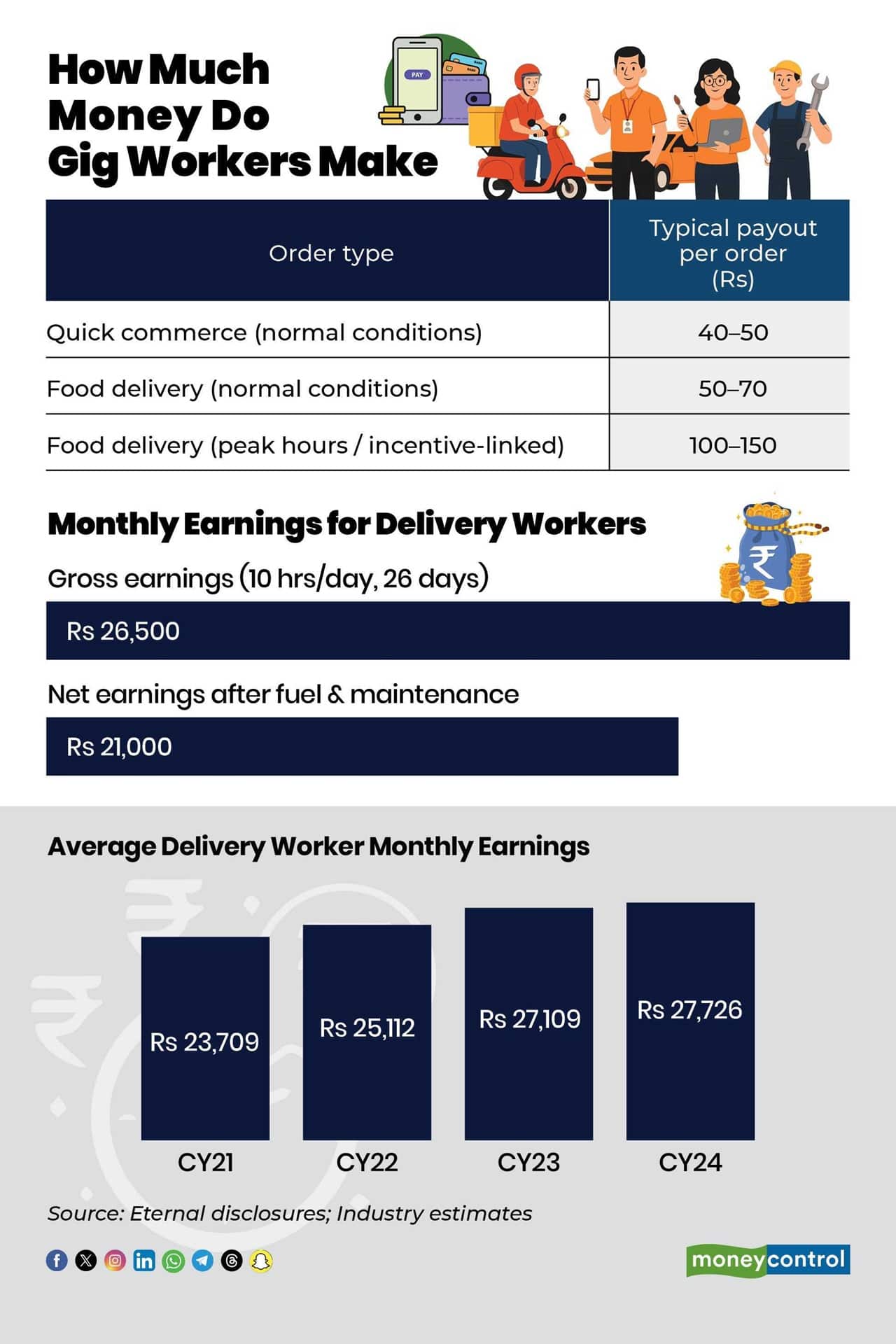
This broadly aligns with what Eternal founder and CEO Deepinder Goyal has said about delivery earnings on Zomato. In recent posts on social media platform X, he pointed to platform data showing that while most partners work only intermittently, those logging in around 10 hours a day for 26 days a month can gross about Rs 26,500. After accounting for fuel and maintenance costs of roughly 20 percent, net monthly earnings work out to around Rs 21,000, in line with estimates for full-time riders in large cities.
Though take-home earnings can vary after deducting fuel, mobile data and vehicle maintenance costs, TeamLease data shows that sectors such as retail typically offer starting take-home pay of Rs 15,000–20,000 a month for freshers, while entry-level roles in BFSI pay around Rs 18,000–22,000.
However, unlike formal-sector roles that offer increments and role progression over time, delivery earnings tend to plateau, with limited upward mobility beyond higher utilisation.
How pay works on the ground
Conversations with delivery workers broadly align with these estimates, while offering clarity on how payouts are structured in practice.
Delivery partners can opt for full-time schedules, usually structured around eight-hour shifts, or part-time, flexible log-ins. Once logged in, orders are assigned by the app rather than chosen by workers.
While riders can decline orders, frequent rejections can lead to penalties or reduced order allocation, limiting how selective they can be.
“You can reject one or two orders, but if you keep doing it, the app just stops sending work (for that particular individual),” said a Delhi-based rider who works for Zomato.
At a basic level, delivery earnings are built in two layers: a base pay per order, and incentives layered on top.
The base pay for an order — typically covering deliveries within a fixed radius of up to five kilometres — usually falls in the Rs 20–50 range, depending on the platform, city and category. For longer distances, riders earn an additional Rs 8–10 per kilometre beyond the base distance.
A significant share of daily income comes from the incentive layer, which is linked to the number of orders completed in a day, with common slabs at 10, 20 or 25 orders. Payouts are highest during peak hours, typically between 7 pm and 10 pm, when platforms push to maximise rider availability.
The higher the number of deliveries, the more the pay.
“The system pushes you to stay logged in longer and chase the next slab,” said a delivery partner working with Swiggy. “If you stop short of the target, the day’s earnings drop sharply.”
Taken together, this structure results in all-in per-order earnings of Rs 40–50 for quick commerce orders and Rs 50–70 for food delivery orders under normal conditions, as per delivery workers.
During high-demand periods, incentive payouts can spike sharply. This New Year’s Eve, for instance, Zomato offered riders Rs 120–150 per order during peak hours, according to multiple delivery partners.
In addition to incentives, riders may earn surge payouts during periods of high demand or adverse weather, such as rain. Tips form a smaller component of income — industry data shows that around 5 percent of orders receive tips, which are passed on fully to delivery partners.
Overall, daily earnings are shaped less by individual order payouts and more by time spent logged in, hitting incentive thresholds, and working peak hours — a structure that can lift income on busy days but makes earnings uneven.
What platform data shows
Platform disclosures broadly support these earnings. Following the New Year's Eve strikes, Eternal CEO Deepinder Goyal, in a string of posts on X, revealed that the average earnings per hour for Zomato delivery partners in 2025 stood at Rs 102, excluding tips, up almost 11 percent from Rs 92 the previous year. The figure is calculated across all logged-in time, including waiting periods, making it a blended average rather than peak-hour pay.
"Most delivery partners work for a few hours and only a few days in a month. But if someone were to work for 10 hours/day, 26 days/month, this translates to ~Rs 26,500/month in gross earnings. After accounting for fuel and maintenance (~20 percent), the net earnings for the partner are ~Rs 21,000/month," Goyal said.
Longer-term data suggests earnings growth has moderated. According to Eternal’s Q3 FY25 shareholder letter, average monthly earnings for delivery partners who logged in at least eight hours a day and 26 days a month rose to Rs 27,726 in calendar year 2024, excluding fuel costs. While this marked an increase from Rs 23,709 in CY21, earnings have remained largely flat since Rs 27,109 in CY23, even as order volumes have increased.
Platform data also shows that most delivery partners do not work full-time. On Zomato, the average delivery partner logged in for just 38 days in the year, underlining the flexible nature of gig participation.
"Only 2.3 percent of partners worked more than 250 days in the year. Demanding full-time employee benefits like PF, or guaranteed salaries for gig roles doesn’t align with what the model is built for,” Goyal noted.
Scale — and where the friction lies
The debate over delivery pay is amplified by the size of the workforce involved. In the September quarter (Q2FY26), Eternal reported about 5.55 lakh monthly active delivery partners on its food delivery business and around 3.39 lakh on Blinkit, taking its combined delivery workforce to nearly 8.94 lakh partners.
Rival Swiggy disclosed around 6.91 lakh average monthly transacting delivery partners over the same period. Together, the two largest platforms alone engage well over 15 lakh delivery partners every month.
For delivery workers, however, the core issue is less about headline averages and more about how payouts have evolved over time.
According to multiple delivery partners, base pay per order has fallen sharply on several platforms, even as incentives have taken on a larger role in overall earnings. Workers said base payouts that were once as high as Rs 40–45 per order have, on some platforms and routes, come down to Rs 15–20, making incentives essential to hitting earlier income levels.
“Earlier, even without chasing incentives, the base itself made the day workable,” said a delivery partner. “Now, if you don’t hit the slabs, your earnings drop very quickly.”
Platforms argue that incentive-led payouts allow them to balance supply and demand more efficiently, especially during peak hours, while preserving flexibility for partners who log in intermittently.
Workers counter that this has made earnings less predictable, particularly on slower days, and increased dependence on peak-hour availability.
While the late-December strikes did little to disrupt deliveries, they have sharpened scrutiny on how delivery work is priced and sustained at scale. With millions now dependent on the sector for income, the debate is shifting from whether the model works operationally to whether it can evolve as gig work becomes a longer-term livelihood for a growing share of the workforce.


Discover the latest Business News, Sensex, and Nifty updates. Obtain Personal Finance insights, tax queries, and expert opinions on Moneycontrol or download the Moneycontrol App to stay updated!
Find the best of Al News in one place, specially curated for you every weekend.
Stay on top of the latest tech trends and biggest startup news.






