

As Jack Kerouac famously said, “Great things are not accomplished by those who yield to trends and fads and popular opinion”. Few categories in the fund universe illustrate this better than sectoral funds. Despite delivering disappointing outcomes across cycles, they have repeatedly attracted strong investor interest. From the tech crash of the early 2000s to the infrastructure fund losses in 2008-09 or the recent decline in technology funds, investors have repeatedly witnessed how thematic bets can underdeliver.
As of January 2026, the sectoral and thematic category constitutes approximately 43% of the 550 odd equity schemes in the Indian fund industry and has the highest number of folios at over 3 crore*. These statistics clearly indicate that many investors are still choosing to invest in sectoral funds.
So what exactly attracts retail investors to sectoral funds, despite their highly volatile performance?
Investors’ behavioral biases often play an important role in their investment decisions. One such bias which is common among investors is the Recency bias - the tendency to give too much importance to recent events, information, or data over historical data and long-term trends. Thus, how a fund or a category of funds have performed in recent years, can have a significant influence on investment decisions. This is exactly why many investors end up investing in sectoral funds.
This behavioural tendency is not merely anecdotal. The CRISP Mutual Funds Scorecard (December 2025) highlights how sectoral and thematic funds have consistently attracted strong inflows following periods of sharp outperformance, only to see elevated redemptions when cycles reverse. In fact, analysis of rolling three-year data showed that investors who shifted into the best-performing sector based on past returns earned materially lower subsequent returns compared to broader market indices. The findings reinforce how performance chasing in cyclical sectors often leads to suboptimal outcomes.
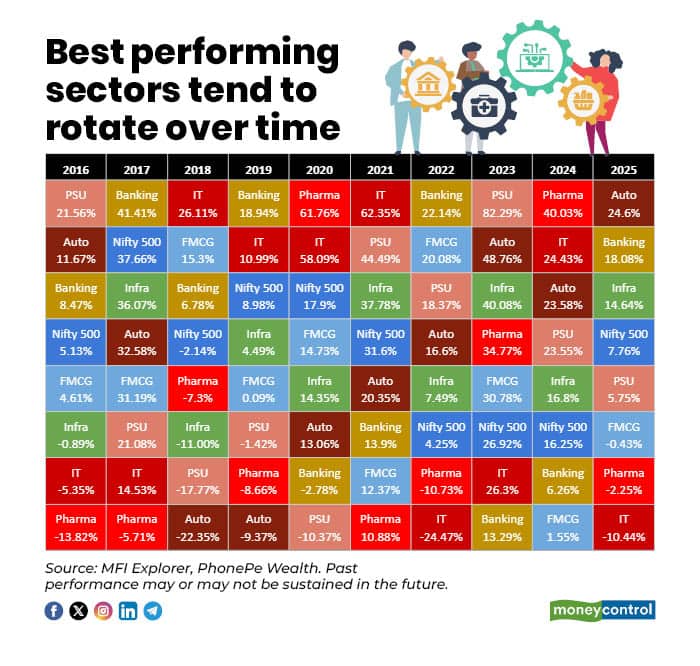
At any given point in time, there will always be one or two sectors which would have significantly outperformed the broad-based indices or diversified equity funds. The sectoral funds investing in those sectors then become the favourites of many investors. But, such performance tends to be cyclical and the outperforming sectors tend to rotate over time (refer table 1 below).
For example, among the seven sectors analysed in the table below, the IT sector was among the top two best-performing sectors in 2024, but it is the worst performing sector in 2025. Likewise, Pharma was the best-performing sector in 2024 but ended up in the bottom two in 2025. As such, choosing sectoral funds based on their past performance often leads to disappointment.
Who are sectoral funds suitable for?
We believe sectoral funds are niche products that are suitable for select investors who have:
Here are some basic principles that investors could consider, if they decide to add sectoral funds to their portfolio:
Sectoral funds can play an important role in one’s portfolio, if used in the right manner. However, the behavioral biases of investors, coupled with insufficient knowledge about investment cycles and sector dynamics often lead to entry and exit at the wrong time. Sectoral funds demand a higher degree of experience, risk appetite, and ability to evaluate cycles that may be hard to sustain consistently. Unless one has the discipline and expertise to navigate the sharp ups and downs, it is often wiser to avoid them and stick to core equity categories.

Discover the latest Business News, Sensex, and Nifty updates. Obtain Personal Finance insights, tax queries, and expert opinions on Moneycontrol or download the Moneycontrol App to stay updated!
Find the best of Al News in one place, specially curated for you every weekend.
Stay on top of the latest tech trends and biggest startup news.