

Indian stock markets traded lower on Friday morning, with the Sensex dropping over 350 points and the Nifty 50 slipping more than 100 points, as investors reacted cautiously to continuing geopolitical tensions and global market uncertainty.
After three sessions of declines triggered by escalating tensions in West Asia, Indian markets rebounded on Thursday, snapping a three-day losing streak during which both the Sensex and Nifty had fallen nearly 4 percent. The Sensex ended about 900 points higher on Thursday, while the Nifty 50 settled with a 1.2 percent gain, as buying picked up across sectors including metals, infrastructure and energy.
The recovery brought some relief, but these swings underline how quickly geopolitical shocks can reshape sectoral risks.
For mutual fund investors, such volatility can also translate into sharp divergence in returns across sectoral and thematic funds, depending on the industries they are exposed to.
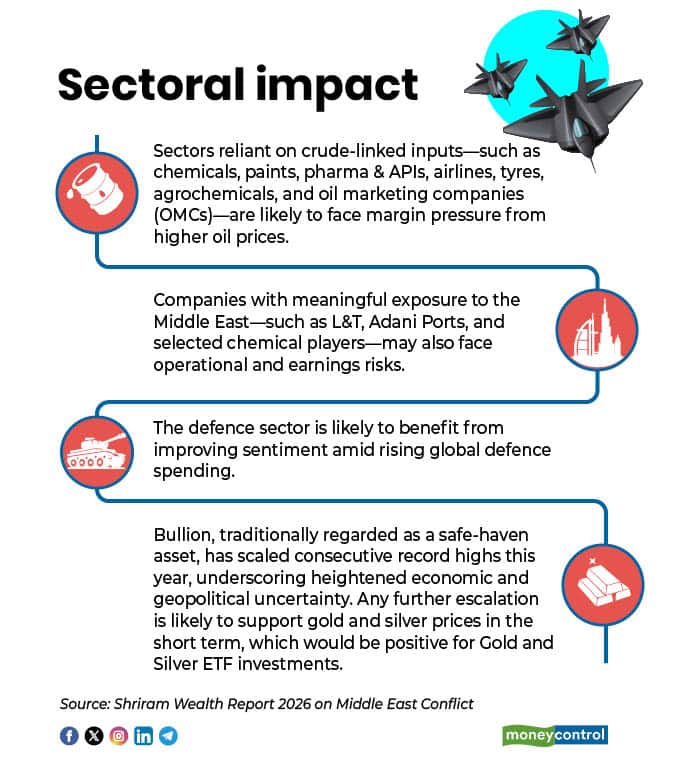
While energy and defence may benefit from higher crude prices and policy support, other pockets of the market could face earnings pressure if uncertainty persists.
Market experts say active investors may need to reassess exposure to sectors that are directly sensitive to oil prices, global trade routes or interest rates.
This is particularly relevant for investors holding sectoral or thematic mutual funds, where portfolios are concentrated in specific industries and therefore more sensitive to macro shocks.
Short-term recoveries do not necessarily remove the underlying sectoral risks created by higher crude prices and global uncertainty.
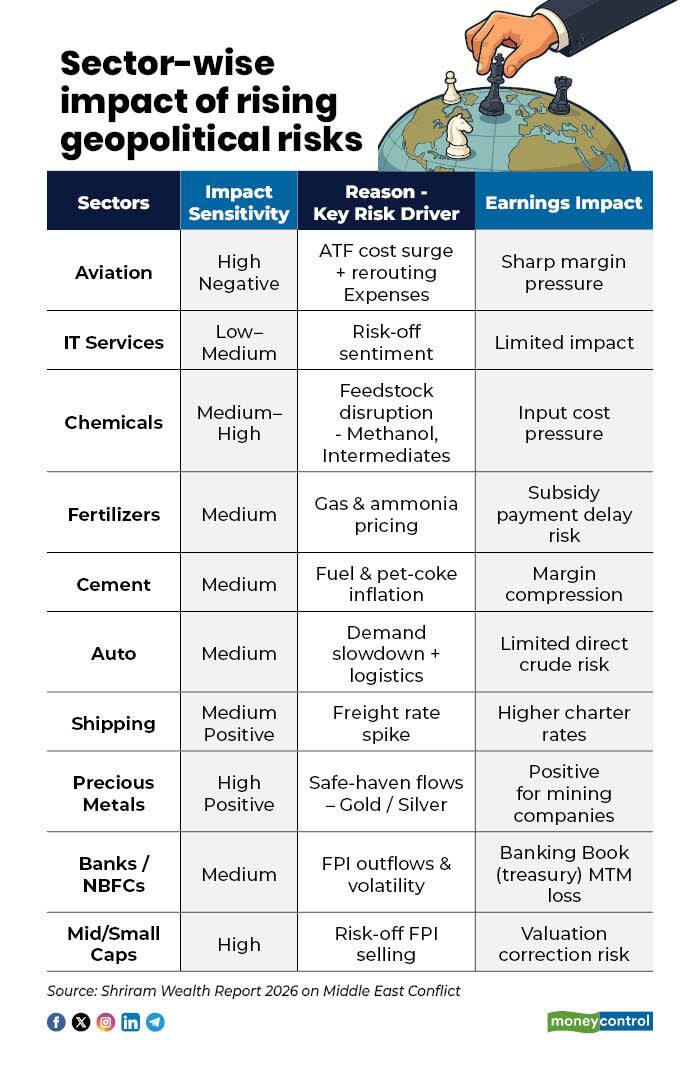
A report by asset management firm Shriram Wealth outlines how different sectors could be affected if geopolitical tensions continue to push crude prices and global risk premiums higher.
Aviation and tourism may face margin pressure
Aviation and tourism tend to be among the most sensitive sectors during periods of crude volatility.
Om Ghawalkar, market analyst at Share.Market explains, “Higher crude prices increase aviation turbine fuel costs, directly affecting airline profitability. In addition, any airspace restrictions or travel advisories can disrupt passenger traffic and raise operating uncertainty.”
In such scenarios, earnings visibility weakens quickly, making these sectors more volatile.
Mutual funds with meaningful exposure to aviation, travel or hospitality stocks may therefore see higher short-term volatility in their portfolio performance.
Paints and chemicals could see input cost stress
Ghawalkar points out, “Paints and chemicals companies are exposed to crude-linked raw material costs.” So, a sustained rise in oil prices can compress margins if companies are unable to immediately pass on higher costs to consumers.
He further adds, “In a market where sentiment has turned more sensitive to global developments, such margin pressure can lead to stock price underperformance.”
Engineering firms with Middle East exposure require balance
Engineering and construction companies with significant exposure to the Middle East could face risks if regional instability deepens.
The report by Shriram Wealth notes that companies with meaningful exposure to the region, such as Larsen & Toubro, Adani Ports, and selected chemical players, could see operational and earnings risks if disruptions intensify.
“The point is not that these companies are fundamentally weak, but that execution delays or payment risks could increase if geopolitical tensions escalate further,” says Ghawalkar.
The mutual funds that hold these companies in large weights may therefore experience higher earnings sensitivity during prolonged geopolitical stress.
High-debt capital goods and rate-sensitive sectors
Rising geopolitical stress can also lead to higher global risk premiums. If crude prices remain elevated, inflation concerns may resurface, keeping interest rates higher for longer.
In this context, highly leveraged capital goods companies could face higher borrowing costs. Experts say interest rate-sensitive sectors such as real estate and consumer durables may also see demand moderation.
Kirang Gandhi, a Pune-based financial mentor says, “Investors should be cautious about increasing exposure to interest rate-sensitive segments when global uncertainty pushes up risk premiums.”
Technology and expensive growth pockets
Some growth-oriented sectors have already seen pressure in recent months.
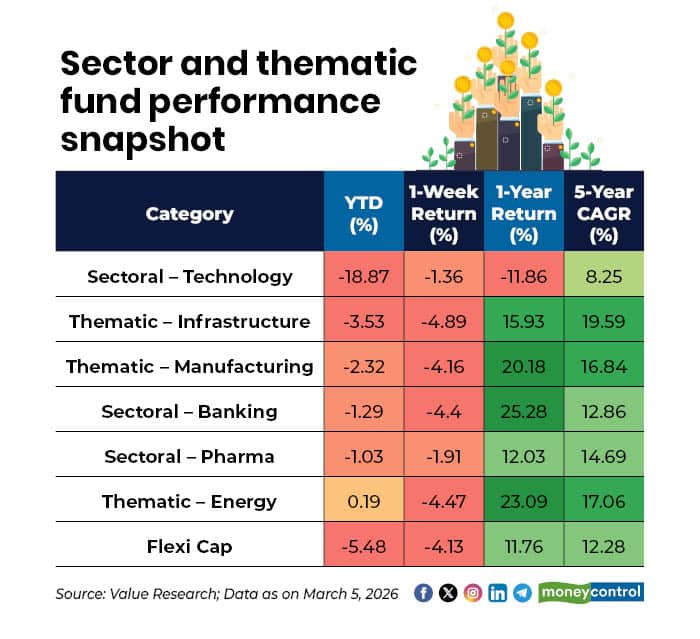
Data as of March 5, 2026 shows that sectoral technology funds are down nearly 19 percent over one year, even though their long-term track record remains strong.
Risk-off phases also tend to trigger sharper corrections in mid- and small-cap stocks as foreign investors reduce exposure to higher-risk segments. Ghawalkar notes, “High-valuation growth pockets such as small-cap IT and specialty chemicals can see sharper drawdowns in risk-off phases. When global demand visibility weakens, earnings assumptions tend to get revised quickly.”
In volatile markets, investors typically rotate toward sectors with stronger near-term cash flow visibility.
Do not crowd into safety at any price
While defensive sectors may offer stability, experts caution against blindly shifting capital.
CA Yash Sedani of 1Finance says, “Reacting aggressively to episodic geopolitical developments can distort portfolio balance. Sector rotation requires informed tactical decisions and comes with higher concentration risk.”
Hence, even so-called safe sectors can underperform if valuations are stretched.
Bottom line
Experts suggest that in a market marked by sharp swings and geopolitical uncertainty, active investors may consider reassessing exposure to aviation, energy-sensitive manufacturing, Middle East-exposed engineering firms, highly leveraged capital goods and expensive growth stocks.
This is not about panic action. It is about evaluating earnings sensitivity to crude prices, global demand and interest rates.
Geopolitical volatility reshuffles sector performance. Managing downside risk is as important as identifying opportunity. So, keep in mind that disciplined rebalancing may matter more than bold calls.
This highlights the concentration risk inherent in sectoral mutual funds compared with diversified categories such as flexi-cap or large-cap funds. The tactical allocation in theme based funds should be 10-15% of your portfolio as in volatile markets, investors typically rotate toward sectors with stronger near-term cash flow visibility.
For long-term mutual fund investors, maintaining diversification across sectors through diversified equity funds may help cushion such sharp rotations.
Disclaimer: The views and investment tips expressed by experts on Moneycontrol.com are their own and not those of the website or its management. Moneycontrol.com advises users to check with certified experts before taking any investment decisions.Discover the latest Business News, Sensex, and Nifty updates. Obtain Personal Finance insights, tax queries, and expert opinions on Moneycontrol or download the Moneycontrol App to stay updated!
Find the best of Al News in one place, specially curated for you every weekend.
Stay on top of the latest tech trends and biggest startup news.