








Indian stock markets rebounded on Thursday, March 5, with benchmark indices extending gains through the day as investors bought into beaten-down stocks after the sharp sell-off earlier this week triggered by escalating tensions in West Asia.
The Sensex surged over 900 points to close near 80,250, while the Nifty 50 settled with a gain of about 1.2 percent at 24,839. Buying was broad-based, led by metals, infrastructure, energy and auto stocks, even as volatility cooled significantly.
The rebound follows Wednesday's steep decline, when the Sensex dropped 1,122 points to close at 79,116 and the Nifty 50 fell 385 points to 24,480 amid heightened geopolitical concerns. Crude oil prices have also surged in recent days, hovering around $85 per barrel, dampening global risk appetite and leaving investors reassessing their next move.
Yet market volatility, while unsettling, often creates pockets of opportunity. Historically, investors who navigate such phases successfully are not those who panic, but those who identify sectors that can withstand uncertainty or benefit from shifting global dynamics.
Short-term fear, long-term resilience
Geopolitical shocks usually create sharp but temporary market drawdowns. Over the past 15 years, Indian markets have repeatedly demonstrated resilience. During the Russia-Ukraine war in 2022, the Nifty 50 fell about 5 percent on the day of the invasion but ended the year in positive territory. After the Balakot airstrikes in 2019, the impact was short-lived and the index closed the year with double-digit gains.
Krishna Sanghavi, CIO-Equities at Mahindra Manulife, says, “Markets tend to react sharply in the short term to geopolitical events. However, such events do normalise, and reversals can be equally swift.”
A report by wealth management firm Shriram Wealth also shows that while geopolitical conflicts often trigger near-term volatility, global markets have historically recovered within six months.
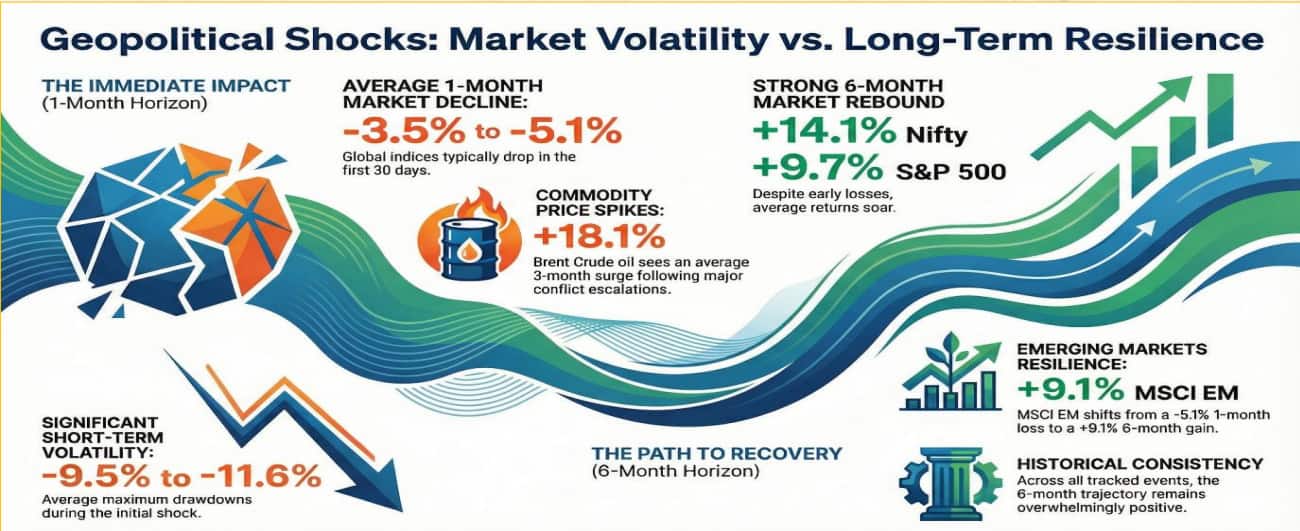 Source: Shriram Wealth Report 2026 on Middle East Conflict.
The pattern is consistent: fear is immediate, but recovery is driven by earnings growth and liquidity conditions. For investors with a short- to medium-term horizon of 1-3 years, sector selection becomes critical.
So which sectors could benefit from the current uncertainty and which ones may struggle if volatility persists?
Sectors that may benefit
There is a set of sectors that have historically done well during geopolitical stress, and the current situation is no different.
According to Om Ghawalkar, market analyst at Share.Market, “Upstream oil producers are immediate beneficiaries when crude prices rise due to supply concerns.” That benefits upstream oil producers as their realizations improve.
Thematic energy funds reflect this trend. They are among the few categories showing positive year-to-date returns of around 3 percent, with a one-year return of over 27 percent as of March 3, 2026 and have delivered close to 19 percent annualised returns over five years.
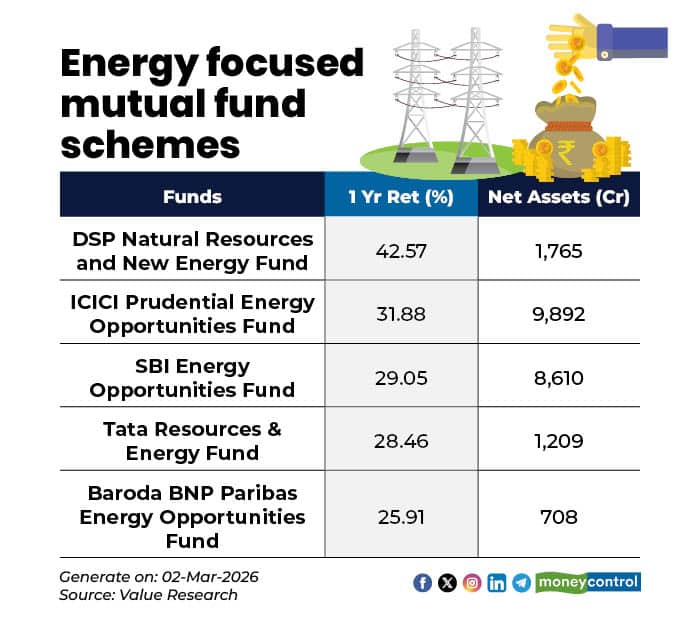
Ghawalkar notes, “This is largely a crude price-driven trade. If supply risks persist, earnings momentum may continue. However, if tensions ease and oil corrects, the reversal can be sharp.”
So, it is critical to monitor crude movements when taking exposure to this theme.
Every major global conflict over the last 50 years has pushed gold prices higher as investors move to safety. This time is no different. Gold thematic funds and ETFs tend to be non-correlated with equity markets, making them a useful hedge.
However, CA Yash Sedani, Assistant Vice President, Investment Strategy at 1 Finance, cautions against aggressive repositioning purely in reaction to episodic events. He explains, “Safe-haven assets have a role within a structured allocation framework, but increasing exposure purely due to short-term developments may distort portfolio balance.”
These thematic categories have delivered strong long-term returns. Infrastructure funds have returned about 23 percent over three years and over 20 percent over five years.
Industry experts say as governments ramp up domestic spending in response to global uncertainty, infrastructure and manufacturing themes tend to hold up relatively well.
Defence has structural support
Defence is not only a short-term geopolitical trade. The Union Budget 2026 has allocated about Rs 7.85 lakh crore to defence, providing long-term revenue visibility for companies in the sector.
The report by Shriram Wealth states that the defence sector is likely to benefit from improving sentiment amid rising global defence spending.
Kirang Gandhi, a Pune-based financial mentor, says “Defence remains a high-conviction structural theme in India due to rising national security spending and stronger order books.”
That said, he adds, “Valuations in parts of the defence space have expanded sharply over the past few years. Investors need to balance earnings visibility with entry price.”
Defensive pockets that offer stability
Among defensive sectors, pharma appears relatively better positioned.
Sectoral pharma funds have delivered over 14 percent in the past year and more than 12 percent annualised over five years. Demand for medicines remains steady even during economic slowdowns.
Ghawalkar says, “Pharma offers better relative safety compared to some other defensives, though export exposure should still be monitored if global tensions spread.”
He adds, “FMCG companies may face margin pressure if crude-linked packaging and logistics costs rise.”
Ghawalkar highlights telecom as a relatively insulated sector, driven largely by domestic demand and improving tariff structures.
“Power and utilities can also offer stability. Demand remains steady, and in some segments higher energy prices can improve realizations,” he explains.
This positioning makes the sector relatively defensive, with potential upside if energy prices remain firm. While it may not see sharp rallies, it can help steady portfolios during volatile phases.
How different fund categories have performed?
Recent performance data underlines how sector returns can diverge sharply.
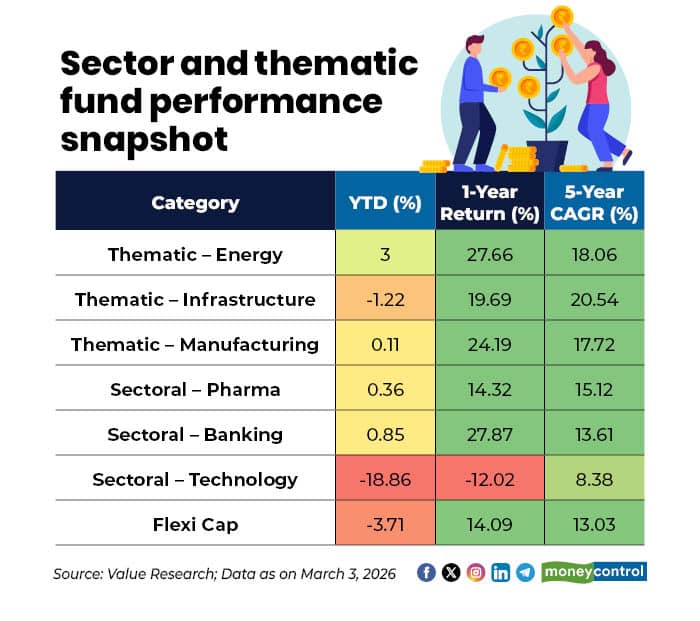
Sedani says, “While sectoral and thematic funds may appear attractive during such phases, they involve higher concentration risk and require informed tactical decisions.”
Wrap Up
Investors who want to take advantage of the current environment, selective bets in energy, defence, gold, and pharma can make sense, but only with a clear exit strategy.
As Sanghavi points out, “Geopolitical situations normalise, sometimes faster than expected.” Positions that work today can quickly turn into liabilities once uncertainty fades.
He adds, “For very short-term investors, business cycle funds can offer a middle ground, as managers can actively shift sector exposure based on evolving conditions.”
Business cycle funds give managers the flexibility to shift sector exposure based on how conditions are evolving. Thematic business cycle funds have delivered around 17 percent over three years with reasonable consistency
Geopolitical volatility feels uncomfortable, but it creates real opportunities for investors who approach it with a clear head.
(Disclaimer: The views and investment tips expressed by experts on Moneycontrol.com are their own and not those of the website or its management. Moneycontrol.com advises users to check with certified experts before taking any investment decisions.)
Discover the latest Business News, Sensex, and Nifty updates. Obtain Personal Finance insights, tax queries, and expert opinions on Moneycontrol or download the Moneycontrol App to stay updated!
Find the best of Al News in one place, specially curated for you every weekend.
Stay on top of the latest tech trends and biggest startup news.





