
Two key proposals—one from the regulator and the other from standalone health insurers— the surrender charges draft and cohort-based health insurance pricing, respectively—are currently seeing a heated debate among life and health insurance companies.
Kamesh Goyal, Chairman, GoDigit Group of Insurance Companies, spoke out against the industry’s stance on both proposals, terming them as anti-policyholder positions, in an exclusive interview with Moneycontrol. (The industry opposes IRDAI’s move to ensure higher surrender payouts to customers.)
He was particularly scathing while criticising the proposal to, in a way, reintroduce claims-based loading. It is “horrendous” and no regulator in the world allows any sort of loading on claims, said Goyal. He did not comment on the upcoming GoDigit IPO or his company’s plans, citing regulatory stipulations. Edited excerpts:
You have been vocal about how IRDAI’s proposal on higher surrender values would be in favour of policyholders. Your position is contrary to that of some of your peers…Data shows that if the premium payment term is more than five years, we are actually seeing less—just about 50 percent—persistency even for the best companies. Unless a customer pays three years’ premiums, they don't get anything at all.
So, when you see it from that perspective—if you look at the last ten years and, say, 100 households have bought a non-par policy, 90 percent would have lost money. Almost the entire commission is also up front. So, basically, this product is not long-term in nature. With the sort of losses that it is causing, it doesn't make any sense from a customer's perspective.
My sense is IRDAI will not get influenced and they should not, because at the end of day, their mandate is to do what is good for the customer. And, as I said, we don't have a problem at all with these norms. I am 100 percent certain that it’ll lead to growth.
We will also suffer with all these changes. In fact, our life will be even more difficult, because our expenses in the first five years will be higher. So, every surrender will cause a huge economic loss. But if we, as an industry, cannot give decent products to the customer, how will we ever grow?

Also read: Life insurers' pushback: Industry urges IRDAI to relax proposed higher surrender value norms
What are the kinds of products that would appeal to policyholders?Under the non-par category, if you’re buying a single-premium policy, even today you can get a guaranteed return of 7-7.5 percent. In a fixed deposit, post-tax, you will get a guaranteed return of 5.1-5.5 percent, depending on your tax slab.
Now, why doesn't the industry sell single-premium policies? This is because they have very low management expenses built in. People (insurance company officials) want to have lavish salaries, big offices, foreign travel and holidays. Who will pay for this? At the end of day, the customer is paying for this. So, you have good products, but they are not being sold because management has no interest in selling these.

So, let’s assume, 30 percent people have lodged claims over five years and 70 percent haven’t. For those who do not make claims, premiums will go up in line with health inflation. Then, you have people who are filing claims. Now, those who have, say, kidney or liver issues, cancer or any other serious illness, would likely make claims every year or every alternate year. So, (for such policyholders, as per the cohort-based pricing proposal), if the premium rate today is, say, 5 percent, over a period of time, it will rise to 20-25 percent. Over ten years, for a Rs 5 lakh cover, such policyholders might have to pay annual premiums of Rs 2-3 lakh.
So, the whole idea of insurance will be lost (if the proposal fructifies). Those people will go out (of the insurance net) and will not be able to afford insurance. So, (from companies’ perspective) people who are lodging claims will see their premium rates increase, and that business will be profitable. The other set of customers is anyway claims-free. So, (the proposal will ensure that) once you fall sick, if you are older and you’re suffering from a chronic problem, the industry will basically throw you out. Does that sound reasonable?
Nowhere in the world does a health insurance regulator allow any sort of loading on claims, because the logic is that you are distributing the risk of a few amongst many. But the industry wants to keep increasing the premiums of people who are not making claims, and then load significantly more premium on people who are filing claims. You (insurers) want to work with a 20 percent loss ratio. How logical or reasonable is this?
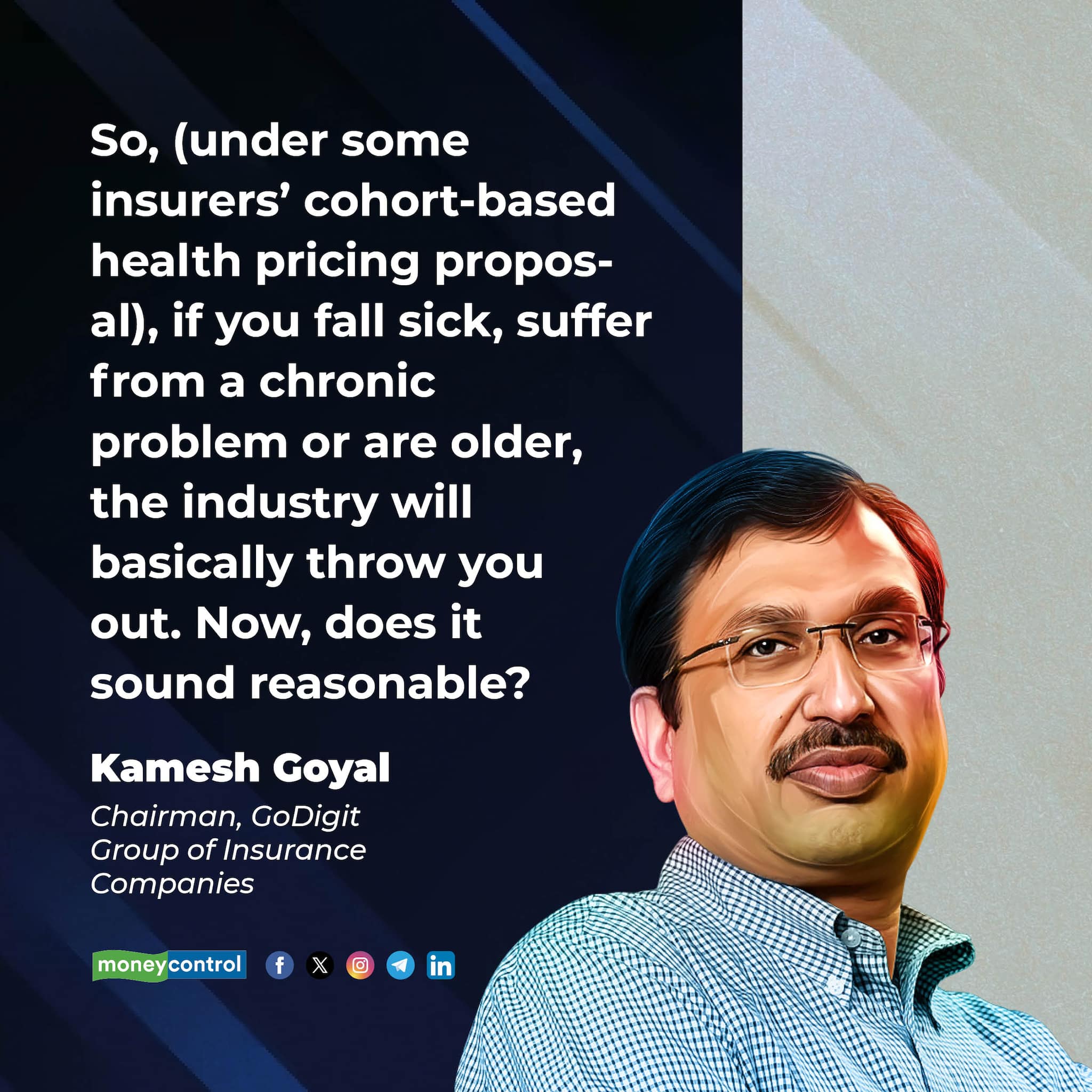 Kamesh Goyal talks tough on claim-based pricing proposalWhy, then, have some insurers come up with this proposal?
The industry, instead of doing things that are good for customers, actually wants to move in the direction of becoming more and more customer unfriendly. This (cohort-based pricing proposal) is horrendous.
This whole idea of lobbying bothers me—most CEOs will be around for two, three, four years. What about people who have a long-term stake in the business? Because these people are trying to protect their interests, they have nothing to do with customers. My sense is that even in health, the number of lives (covered) is not increasing after COVID-19, but all that people are doing is increasing premiums every year.
And for anyone who is above the age of 55 years today, for a 3-4 lakh cover, they are paying premiums of Rs 40,000-60,000. If they make claims, it will go up to Rs 2 lakh in 3-4 years (going by the cohort-based pricing concept). This is completely illogical and immoral, in my view.

There is. Look at standalone health insurance companies’ loss ratios on retail health—they are very good; most of them have loss ratios below 70 percent. And group health loss ratios are around 100 percent or more. Now, who buys group health insurance? Big companies. Do they need a subsidy in their premium from retail health customers? Retail health customers are subsidising group health customers. How logical is that? So, why keep increasing and making the life of retail health customers difficult, when that business is profitable?
Insurers say hospitals overcharge…That is true, and something needs to be done. I believe the General Insurance Council is taking some initiative. But when we say that health is loss-making, it is group health that is loss making, not retail. But the industry wants to take action on retail health because individual customers have no voice. And everyone is happy to go and lose money with a large corporate, by subsidising its group health insurance premium. How does it make sense?
Senior citizens in particular see these exorbitant premium hikes. And they also find it difficult to port policies, as other companies refuse to accept such proposals. Is there a solution to their problem?I personally feel the regulator has to define the quantum of increase in premiums every year. A lot of companies get people when they are a bit younger. And then, after 3-4 years, start increasing the premiums because they know they have nowhere to go. The regulator has to put a limit on the increase in individual health premiums for a period of say, three years, so that premium hikes are not exorbitant.
And secondly, insurance companies now play this game of acquiring customers at a lower rate and raising the premiums later. If insurers are not behaving in a responsible way, the regulator has to come in.
What steps can be taken to curb mis-selling — intermediaries, particularly banks, often push unsuitable, high-commission insurance policies and products linked to loans to their customers?So, in most developed countries, you cannot sell insurance linked with loans. If it was such a good practice, why have big countries stopped it? In South Korea, for example, there is a regulation that no bank can give more than 25 percent of its business to one insurance company. The idea is that there should be an element of competition. The customer is always given a choice. You take these two steps, and 90 percent of mis-selling will stop.
What are the three key trends that you foresee in the general and health insurance space over the next two years?The regulator will take a lot of steps to reduce mis-selling, as well as to make products more customer friendly. The second is that the profitability of the general insurance industry has been very tight as third-party premium rates have not increased and also due to nat-cat (natural catastrophe) events. There should be some correction in pricing or commissions in the coming year.
And third, I think life products have to become significantly more customer-friendly if the industry has to grow. I feel that both the life and general insurance industries will be pushed—by the regulator, government or self-awareness—to become more transparent and improve services.

Discover the latest Business News, Sensex, and Nifty updates. Obtain Personal Finance insights, tax queries, and expert opinions on Moneycontrol or download the Moneycontrol App to stay updated!
Find the best of Al News in one place, specially curated for you every weekend.
Stay on top of the latest tech trends and biggest startup news.