

The market slipped to its lowest in 11 months on March 9 morning, with the Sensex crashing over 2,300 points and the Nifty50 slipping below 23,730, as the Iran war pushed oil to a above $100 a barrel. The slide has also pushed both indices into a technical correction, after falling more than 10 percent from their all-time high of January 5.
The selloff has erased nearly Rs 15 lakh crore in market capitalisation of BSE-listed companies, intensifying investor anxiety as global and domestic headwinds weigh on risk sentiment.
For millions of retail investors, the turmoil revives a familiar question: should they continue investing or pause systematic investment plans (SIPs) until the volatility settles?
For the nearly 9.92 crore Indians with active SIP accounts, seeing mutual fund portfolios dip into the red can be unsettling. Financial planners warn against impulsive decisions and say stopping SIPs can could hurt long-term wealth creation.
Why stopping SIPs during corrections can backfire?
Market corrections often trigger the urge to reduce exposure to equities. However, experts caution that SIPs are designed precisely to navigate such uncertain phases.
"SIPs are a disciplined investment approach meant for long-term compounding. Pausing them during periods of volatility disrupts the strategy itself. These phases are exactly when SIPs play their most important role," said Kresha Gupta, director and fund manager at Steptrade Capital.
Ashish Anand, Partner at Fortuna Asset Managers, shared similar views. Market corrections are an inherent part of equity investing and should not derail long-term financial plans.
"Market declines allow SIP investors to accumulate more units at lower prices. Instead of focusing on short-term geopolitical or economic triggers, investors should stay aligned with their long-term financial goals," Anand said.
Volatility is temporary
Sharp declines triggered by geopolitical tensions, policy shocks or global economic uncertainty are not new to Indian markets. According to Gupta, such episodes have historically led to temporary corrections of around 5 to 10 percent, followed by recoveries over the next few months.
For SIP investors, exiting or pausing investments during such periods may mean missing out on the rebound that typically follows.
Lt Col Rochak Bakshi, CFP at Trunor Enterprises, says "Consistency is one of the biggest advantages SIP investors have during volatile markets. Short-term volatility, even when triggered by global events, should not derail a long-term investment strategy. Investors who stay invested through uncertain phases often benefit from a lower average purchase cost and stronger long-term returns."
While shorter investment windows can appear volatile, the picture changes significantly as the holding period increases.
A February 2026 Wealth Conversations study by FundsIndia analysing long-term Nifty 50 SIP returns shows that as the investment horizon stretches to around five to seven years, the downside seen in shorter time frames tends to diminish considerably. Historical SIP data shows that many five-year investment periods that began during volatile market phases still generated mid-single to double-digit annualised returns once markets recovered.
By the time the investment horizon reaches seven years, most rolling SIP periods have historically delivered positive returns.
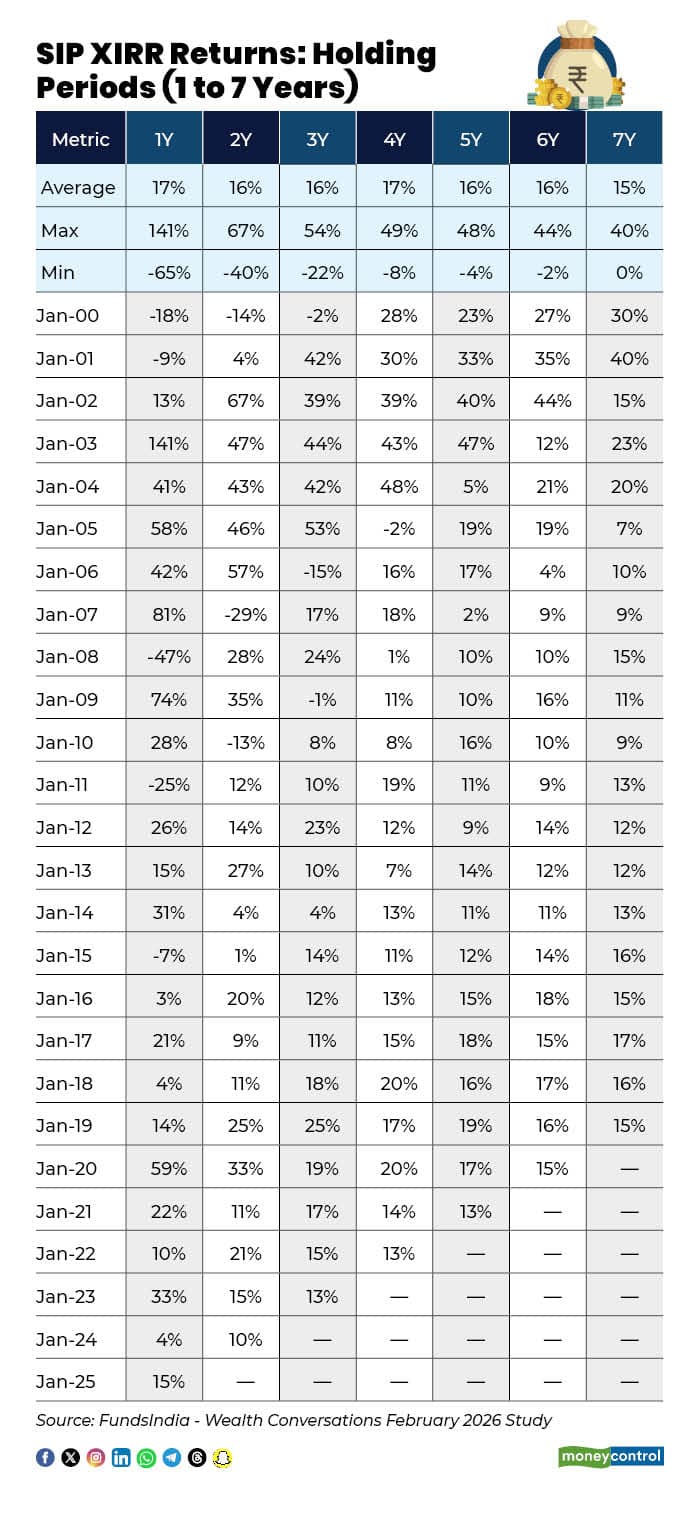
In practical terms, this means that the sharp fluctuations visible over one to three years tend to smooth out over longer horizons. Market corrections are often offset by subsequent recoveries, while the compounding effect of regular investments begins to play a more visible role.
Over time, gains accumulated in earlier years start contributing to future growth, helping create a steadier investment trajectory.
For investors, this is the stage where SIP investing becomes less about reacting to short-term market noise and more about staying aligned with long-term wealth creation.
The advantage of rupee cost averaging
One of the key reasons SIPs work well during falling markets is rupee cost averaging.
When markets decline and the net asset value (NAV) of a mutual fund falls, the same monthly investment buys more units. Over time, this helps bring down the average purchase cost of the investment.
For instance, if an investor puts Rs 10,000 into a SIP every month and the fund’s NAV falls from Rs 100 to Rs 80 during a market decline, the investor ends up buying more units for the same amount.
This mechanical advantage is built into the SIP structure, Vijay Maheshwari, CWM and founder of Stocktick Capital, said. "SIPs benefit from volatility because of rupee cost averaging. Even a temporary decline in NAV during a monthly investment cycle allows investors to accumulate additional units, which can meaningfully improve long-term returns when markets recover," he said.
What should investors should focus on?
While staying invested is crucial, experts say investors should also use periods of volatility to review their financial preparedness.
Maheshwari said investors should reassess their investment horizon and risk tolerance, ensure they have an emergency fund covering at least six to twelve months of expenses, and consider adding selectively if they have surplus cash available.
The key, however, is avoiding emotional decisions during downturns.
"Stopping SIPs during market corrections can weaken the long-term return potential of the strategy. Consistency is what ultimately drives compounding," Gupta said.
Market corrections may feel uncomfortable in the short term, but they are often the very phases that help disciplined SIP investors build stronger portfolios over time.
Discover the latest Business News, Sensex, and Nifty updates. Obtain Personal Finance insights, tax queries, and expert opinions on Moneycontrol or download the Moneycontrol App to stay updated!
Find the best of Al News in one place, specially curated for you every weekend.
Stay on top of the latest tech trends and biggest startup news.