BYD India, which had earlier drawn up plans to assemble its electric car portfolio in the country, has now decided to stick to the Completely Built Unit (CBU) route for the next few quarters. A senior official of the global electric vehicle (EV) giant stated that the current “business case” and “penetration levels” of EVs in the country are pushing the company to continue importing cars from China.
“There has to be a business case for putting up an assembly line. The volume that we see at the moment in India for electric cars and what BYD can achieve, in terms of penetration levels, the business case does not really allow us to take a firm decision. Secondly, the way the whole overall environment around the business in India is panning out. So there we have to be a little cautious,” BYD India Head of Electric Passenger Vehicles Business Rajeev Chauhan told Moneycontrol in an exclusive interaction.
At present, BYD India is selling three EVs in India — Atto 3 e-SUV (prices starting at Rs 29.15 lakh), BYD Seal e-sedan (prices starting at Rs 41 lakh) and e6 electric multiutility vehicle (now replaced with e MAX 7). The company is importing its models under the Economic Commission for Europe (ECE) vehicle certification, which puts a cap on the total number of vehicles allowed to be imported at 2,500 units.
"Fortunately, we have a huge cost deficit, or cost efficiency because BYD is a global giant. If they have good cost structures, we will definitely leverage those as well, " added Chauhan.
CBUs for nowThe Indian arm of the Shenzhen, Guangdong-based firm had earlier said that it is looking to establish a dedicated production line or indigenising its product lines. However, Chauhan clarified, “We were earlier going down the path of assembly operations. But now, we are not doing that. We do CBUs and are not restricted by the typical production capacity, we will be able to serve as many customers as possible, provided we have the homologation certification for the respective cars.”
Homologation is the process of certifying vehicles for roadworthiness under rules specified by the government for all vehicles made or imported into the country through a certified agency. Currently, the company is paying 70 percent import duty on the CBUs and is looking at the homologation route in the short term to meet the demand for its high-volume models in India.
Explaining the short-term strategy for BYD India, Chauhan said, “In the short term, we will continue to serve the market in the premium segment. That's where we want to stay with the kind of volumes that you're hearing. Let the market evolve (and) develop their higher penetration of electric cars. The atmosphere becomes little better, you know, only then this would fall in place,” he added.
While acknowledging that having a manufacturing plant gives some advantages, BYD India is not considering that. “I can confidently say that in the short term, we are not doing that," he said while declining to comment on the challenges due to geopolitics between India and China. However, he clarified, “We will never rule out the possibility, when the atmosphere is conducive, environment is conducive, there is a good business case. It's a big market and nobody can miss it.”
Meanwhile, BYD has also clarified that it is not ready to apply for benefits in the short term under India's new EV policy announced earlier this year which seeks to attract global manufacturers to the country.
“Representatives of our company, who have a good idea about that policy, went through that. The final conclusion is that we have decided that we are not ready to leverage on this policy in the short term. So, we are not applying," noted Chauhan.
In March this year, the government announced the new electric vehicle policy to attract major global players like Tesla, allowing them to import a limited number of cars at lower customs/import duty of 15 percent on vehicles costing $35,000 and above for a period of five years from the date of issuance of the approval letter by the government. The maximum number of e-4Ws allowed to be imported at the reduced duty rate will be capped at 8,000 units per year, as per the same policy.
However, the approved applicants will have to set up manufacturing facilities in India with a minimum investment of Rs 4,150 crore ($500 million) for the manufacturing of e-4-wheelers (e-4Ws) and provide a bank guarantee.
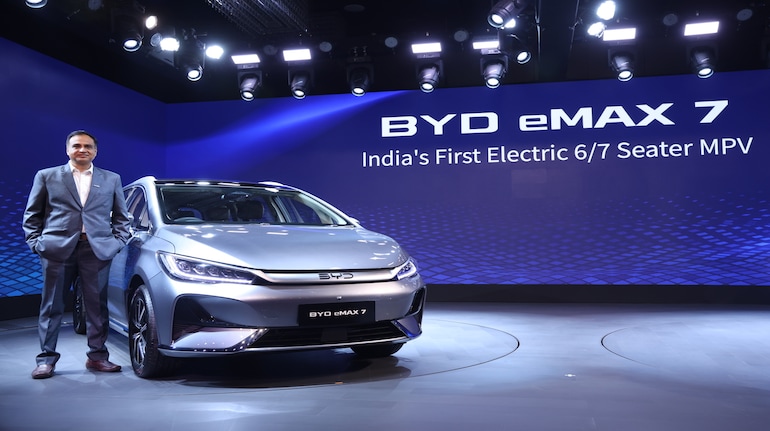
e-MPV launchMeanwhile, BYD India has launched its new electric multipurpose vehicle eMAX 7 priced between Rs 26.9 lakh and Rs 29.9 lakh. The new battery-powered multi-purpose vehicle (MPV) comes in two variants with six- and seven-seater options.
Without sharing any sales target for this model, Chauhan said, “It’s creating its own segment. There is no car in the market which is a six-seater and seven-seater electric MPV. It is for customers to really choose from the other models (like Toyota Innova) and an electric option. It’s not about how are we going to take up the fight with the competition. It's about customers who have been given an electric option in this segment.”
Discover the latest Business News, Sensex, and Nifty updates. Obtain Personal Finance insights, tax queries, and expert opinions on Moneycontrol or download the Moneycontrol App to stay updated!
Find the best of Al News in one place, specially curated for you every weekend.
Stay on top of the latest tech trends and biggest startup news.