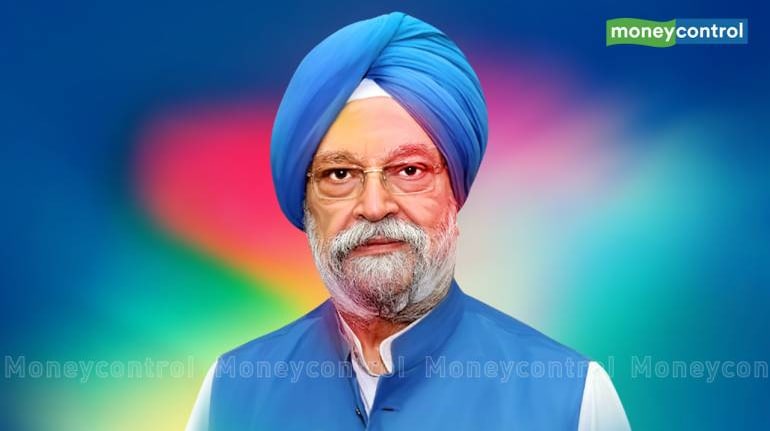
The G20 Leaders’ New Delhi Declaration, announced by Prime Minister Narendra Modi, was welcomed by all the countries and there were no negative comments barring some domestic political voices, said Union Minister Hardeep Singh Puri in an exclusive conversation with Moneycontrol’s Shweta Punj.
The launch of Global Biofuel Alliance and economic corridor were the other two biggest takeaways from the G20 Summit, Puri told Moneycontrol.
Edited excerpts:What, in your view, has India brought to the G20 presidency? What was different this time in terms of how we approached this presidency?The fact that India's presidency was a resounding success is a given. The honourable Prime Minister, by the sheer weight of his personal chemistry with world leaders, inspirational conduct, the instructions he gave to his team, his Minister of External Affairs, the Sherpa, the diplomats, pulled out an 83 paragraph declaration that has no footnotes, no interpretative notes. The declaration has been welcomed by the Chinese, it has been welcomed by the Africans, it has been welcomed by the President of Argentina, Brazil, the UK. I can go on naming countries. The content of those paragraphs add value and take forward the multilateral and plurilateral negotiation in each of these areas.
I don't want to get into that. China was represented here. The Prime Minister was here. The Chinese Sherpa and diplomats participated in full.
On biofuels, are you talking to other G20 countries? And what impact do you see on India, considering India imports over 80% of its overall oil requirements? Is there a target that you're working with?I think even prior to the Biofuel Alliance, the target that we are working on is 20 percent biofuel blending by 2025, instead of 2030. The second issue is, whom does it benefit? Well, if I save Rs 73,000 crore on the import bill in nine years because of biofuel blending, then we’re able to pay our farmers Rs 73,000 crore. I'll give you an example. If we do 1 percent biofuel blending as the norm for sustainable aviation fuel, we benefit 5 lakh farmers. If we raise that 1 percent biofuel blending norm and make it 5 percent, you know what happens? We benefit another 70 lakh farmers.
Coming to the India-Middle East-Europe economic corridor, this alliance was two years in the making. What do you think it will take now for India to build on this opportunity?The countries participating are countries that can afford to put something on the table. Saudi Arabia, UAE, India, on the Asia side. In Europe, you have France, Italy and Germany, also the European Union. And you have the United States. So, you’re looking at an … ambitious economic framework of connectivity, which will bring ports together, which will bring shipping lines in touch with each other, which will have seamless road transport, which will have railway networks, etc.
Also Watch | Union Minister Hardeep Singh Puri in an exclusive conversation with MoneycontrolAre there any FTAs that you think need to be prioritised?That's a separate exercise which is going on. That exercise will take place in the normal course. We'll have food exports from India, going there. You're talking about grid connectivity, in terms of power produced here going through a pipeline to countries that require power, Saudi Arabia and so on. In the coming months, you will see a lot of activity in terms of roadmapping conceptualisation, etc. No matter which angle you look at it from … it looks like an economic win-win for everybody.
Coming closer home, considering this volatility right now, and energy crises, what's a comfortable level of oil for India?I will be happier when it’s $51 a barrel. But I am also a realist. I’m more comfortable when oil prices are in the range of 70, 75, 80. We can take it up to that. I think they've crossed that point now.
I don't know about that. I wouldn’t worry too much about that. Because you know, how do you typically price energy? You take it at the point of production, you take the cost of insurance and trade, then you take the refiner’s margin, then you take the dealer’s margin, and then you’ve got central government taxes, then you’ve got saved government taxes. So, I think if you have a prime minister of the kind that we have, we are able to navigate it so everybody is taking a bit of the stick. But so far, I think we’ve ensured availability, we’ve ensured affordability and sustainability.
India is working on building its resilience in this energy crisis. We have relied on Russia in the past, but are we looking at other countries as well?Our resilience is much more than Russia. Our resilience comes from the dynamism of our marketplace. We consume 5 million barrels of oil a day. Global growth is about 1%. I think our rate of increase in demand is about 3 percent. We are simultaneously increasing E&P (exploration and production). Our gas production has gone up by 18-20 percent for the last two years. We are also buying from many more sources. We used to buy from 27 sources. We (now) buy from 39. We buy $20 million of energy from the United States. There are new players coming on the world market. Our OMCs will buy from whoever they have to at the most economical price. That is what gives us resilience.
We saw imports from Russia dip in August. Is that a trend that will continue?Imports from Russia were at 0.2 percent in February 2022. Then they shot up. Russia became one of the largest suppliers. They still are a very large supplier. I wouldn’t be surprised if Russia is still number one or two. So, these things will happen. The OMCs do the buying according to what is available in the market. If they can get cheaper oil from, let’s say, a country in the Gulf, they will happily buy from the Gulf. They won’t have to go all the way to Russian ports. Equally the traders buy and sell oil all the time. The basic point is we buy the cheapest oil from wherever we can get it, of course, depending on the grade of the oil.
Recently you've announced a Rs 200 reduction in LPG prices. Would that be financed by the government or by the OMCs?It's a very simple thing. There is some government part and there is the OMC part. This is something that goes on. In the past, OMCs incurred a loss of Rs 28,000 crore, I remember. The government gave them Rs 22,000 crore back. But this one is, you know, this is a decision taken politically.
Discover the latest Business News, Sensex, and Nifty updates. Obtain Personal Finance insights, tax queries, and expert opinions on Moneycontrol or download the Moneycontrol App to stay updated!
Find the best of Al News in one place, specially curated for you every weekend.
Stay on top of the latest tech trends and biggest startup news.