
Jyoti Budhia was among the first five women to enter the BSE trading ring. That was in 1986.
Budhia is a third-generation trader from both her father and her mother’s side. “This is all we talked about at home,” she recalls.
In fact, even when she was in school, her father made her do stock market-related jobs such as settling bills or helping with the paperwork for share-transfers. “Mazaa aata tha (It was fun),” she says.
Also read: Trader's Edge| An all-weather, low-risk strategy from an early bloomer
She saw the trading ring for the first time when she was 12. She loved the buzz and the camaraderie of the market floor, and she took every opportunity to accompany her father thereafter.
“I don’t know when I came to belong to the stock market,” she says. Therefore, her first day at work didn’t feel like a first day at all.
It may have been a male bastion, but she says she had never felt more respected and safe than in the market. “Even in the rush (on the market floor) and the crowding and the shoving, we were always given the right of way and treated with respect,” says Budhia. She now runs BK Training, which trains aspiring traders, and is a visiting faculty for courses conducted by the NSE and the BSE.
Being so embedded in the environment did not mean less structured learning. In fact, her peers reinforced the absolute necessity of it. A mentor once told her to make a conscious effort to keep up with the times. “Otherwise time will throw you out of the market,” she recalls.
Budhia internalised that lesson. Even today, before she goes to sleep, she keeps all distractions like her phone away and spends two hours studying chart patterns.
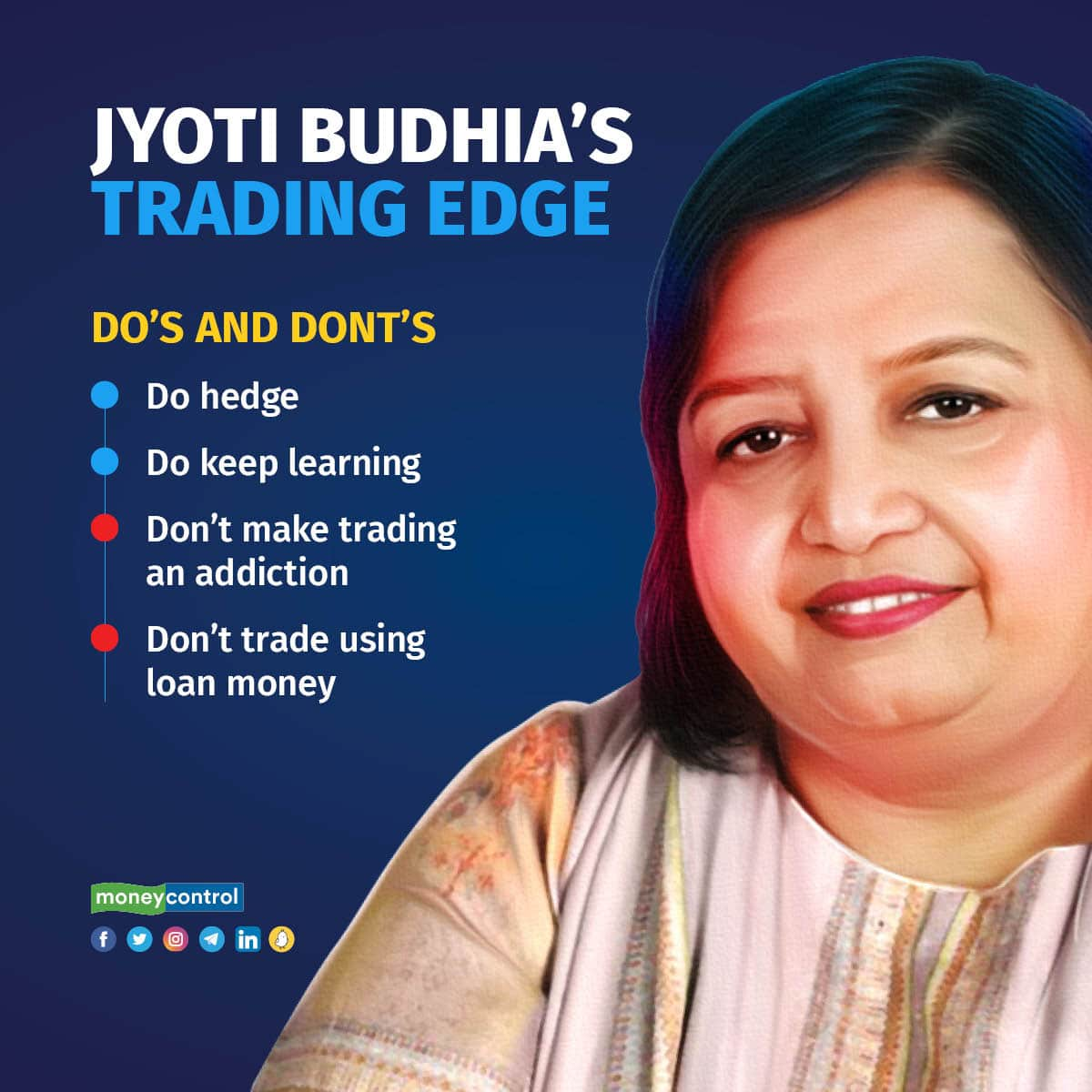 The veteran trader gives quick tips for investors (Graphics: Rajesh Chawla)Proprietary strategy
It is this spirit of constant learning that led her to design her proprietary strategy called Jodi Bhav. The idea came from a conversation with fellow traders. She asked how they figured out at what price to sell Nifty Options. They replied that they would sell a Call that is x number of points above the trading level, and sell a Put that is a similar number of points below the trading level.
But she still couldn’t figure out what the logic of picking those straddle prices was and no one would tell her. Intent on understanding the mechanics behind it, she studied charts for “very, very long,” and then it struck her. The strike prices could indicate the support and resistance levels of all F&O (Futures & Options) stocks, and helped her make a pivot table (that tracks the turning point of stocks).
In other words, she could use straddle prices from the monthly expiry day (usually the last Thursday of every month) and figure out when the stocks will change direction and how far they will go. She has christened this the Jodi Bhav strategy.
She has also internalised the importance of hedging. That came from the 2008 crash. She was introduced to trading many years after her entry into the stock market, in the early 2000s. Therefore, it had been just a year or two since she had heard about the importance of buying Puts. When the crash came, the puts she had bought capped her losses at Rs 5-7 lakh, while people around her lost crores.
“Till date I respect hedging immensely. I never sell without a hedge. It’s like taking out insurance,” she said.
Also read: Trader's Edge| A strategy that lets you own an asset for free
Market set-upBudhia has two market set-ups, one for the F&O market and another for the cash market. For F&O, she watches the long- and short-build up through the Open Interest (OI) data. If there is a long build-up in the daily charts — if the spread between the open and low prices is closing — and if the price is near the highest Put OI, then she buys a Call. Similarly, to buy a Put, she checks the short build-up — if the spread between the open and the high is closing, and if the price is near the highest Call open-interest, then she buys a Put.
The first 15 minutes of the market is dedicated to watching the long and short build-up. Only after 9.30 am does she start executing her trades. She tracks price changes every 15 minutes.
For the cash market, she goes purely by good fundamentals. Her hunting ground is the Nifty 500. Budhia tracks 200-300 stocks based on their fundamentals, and uses technicals such as trendlines and OI data for entry and exit points.
 She follows two market set-ups, one for F&O and the other for cash marketStop-loss essential
She never does a trade without a stop loss, and that is one advice she wants to give new investors. “Don’t fear your stop loss, thinking that you may lose an opportunity if you exit. Respect your stop loss,” she says. She warns against hoping for the trade to go their way.
“Umeed apne family se rakho, market se nahi,” she says. Keep faith in your family, not in the market.
The other things she warns investors against are going against their trading plan, being addicted to trading, and taking loans. “If you can’t stick to your trading plan, don’t come to the market. If you can’t treat the market like work, then don’t come to the market. If you don’t have money, don’t trade (on capital you don’t have),” she says.
“Trade only on the capital that you can afford to lose,” she adds.
Discover the latest Business News, Sensex, and Nifty updates. Obtain Personal Finance insights, tax queries, and expert opinions on Moneycontrol or download the Moneycontrol App to stay updated!
Find the best of Al News in one place, specially curated for you every weekend.
Stay on top of the latest tech trends and biggest startup news.