






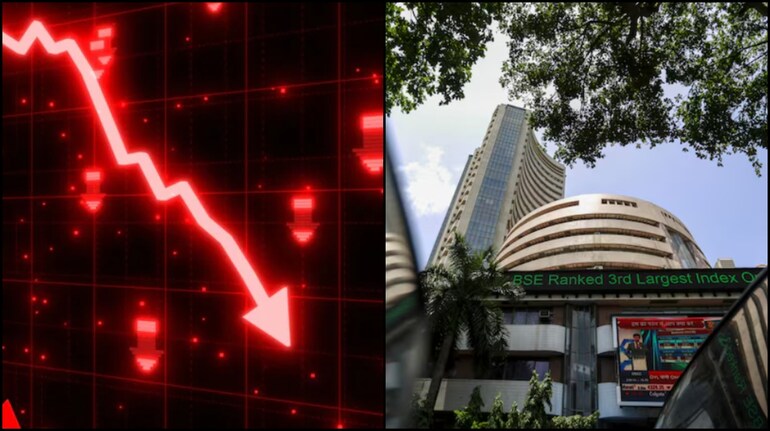

Markets have seen significant decline over three consecutive sessions, with Sensex crashing nearly 2,500 points this week so far. Analysts have highlighted which sectors seem attractive at this point of time, ahead of Union Budget on February 1.
Sensex plunged more than 1,056 points (nearly 1.3 percent) to hit an intraday low of 81,124.45 on January 21, before seeing a sharp recovery to briefly move into the green and then falling again.
Nifty 50 meanwhile fell 313 points (over 1.2 percent) to its day's low of 24,919.8 on Wednesday, which marks a decline of 775 points (more than 3 percent) this week so far. However, after falling below the crucial 25,000-level, the index sharply rebounded before slipping into the deep red again.
All the major sectoral indices were in red, with consumer durables, banks and IT leading losses. Broader markets were also in deep red, with smallcap and midcap indices underperforming benchmarks.
India's volatility index jumped to 14.43, highest since June, signaling increased market stress. The sharp uptick in volatility highlights elevated intraday swings and fragile sentiment, as reflected in a weak advance-decline ratio, said SAMCO Securities.
Citi prefers themes of defence and affordable housing before Finance Minister Nirmala Sitharaman presents Union Budget 2026 on February 1. Citi Research expects Union Budget for fiscal year 2027 to offer limited support for consumption and to stay anchored on targeted priorities such as affordable housing and health insurance
It sees the government maintaining a strong tilt toward public capital expenditure, with spending budgeted above nominal GDP growth and led by defence outlays. It added that fiscal consolidation must continue even as options to raise tax revenues narrow after major cuts to corporate tax, personal income tax, and the GST regime.
Markets are correcting ahead of the Budget largely due to global geopolitical uncertainty and risk-off sentiment, not because Indian businesses are fundamentally weak, said Tushar Badjate, Director of Badjate Stock & Share. He added that corporate balance sheets are stable, earnings are largely intact, and India continues to remain one of the strongest growth stories globally.
The start of 2026 has been turbulent following complex interplay between global trade uncertainties, aggressive foreign institutional investor (FII) outflows, and the proximity of the Union Budget, said Balaji Rao Mudili, Research Analyst at Bonanza. He added that the primary catalyst for this divergence is the looming threat of US-led trade tariffs following tensions surrounding the proposed Greenland policy and the subsequent threat of tariffs on multiple European and emerging market counterparts which is testing the traditional "buy the dip" mentality. The uncertainty surrounding India-US trade negotiations and depreciating rupee has been other factors adding fuel to the fire.
Pre-Budget sell-offs tend to be driven more by uncertainty than by a sudden deterioration in fundamentals, and that often creates selective value opportunities, said Anirudh Garg, Partner and Fund Manager, INVasset PMS.
“India’s underlying growth, corporate balance sheets and earnings visibility remain intact. For value investors, this correction is throwing up selective opportunities rather than reasons to panic,” he said.
Ahead of the Budget, Citi Research flags defence as a preferred theme. It named Bharat Electronics (BEL) as a top pick. It also favours affordable housing plays such as Aavas Financiers and Aadhar Housing Finance.
Citi says domestic manufacturing competitiveness could improve if the government overhauls the customs duty architecture. It added that any tweaks to buyback or dividend taxation, or to the STT and capital gains regime, would directly move capital markets and remain key monitorables.
The market volatility preceding the budget has unlocked some pockets of value for a long-term investor, said Pranav Koomar, Founder and CEO of PlusCash. Defensive areas like FMCG, healthcare, quality large-cap financial stocks, and some PSU banks look attractive on valuations, the analyst said.
He added that capex-linked spaces like infrastructure, defence, and the railway sector will continue to get government outlays, which could be a trigger.
In such phases, value investors are better served looking at businesses where earnings visibility remains intact but valuations have corrected due to broader risk aversion, Garg said. He added that rather than choosing between defensives or cyclicals in a binary manner, the focus should be on balance-sheet strength, pricing power, and cash-flow durability.
“Traditionally defensive pockets do provide relative stability during volatility, but several economically sensitive areas are also beginning to look attractive after meaningful price corrections, especially where order visibility or domestic demand drivers remain strong. What the market is penalising most right now are stocks that were priced for perfection. As history shows, pre-Budget corrections often reward investors who accumulate gradually, avoid leverage, and stay aligned to companies with sustainable earnings rather than reacting to short-term sentiment swings,” Garg said.
Badjate, meanwhile, said that history suggests that during periods of heightened volatility, metals, mining, oil & gas and select PSU stocks tend to outperform as they offer relative stability and act as a hedge against sharp drawdowns in small and mid-cap segments.
While defensives (FMCG, pharma, etc) offer a valuation safety net, the primary engines of India's GDP growth are expected to be banking (BFSI) and manufacturing, said Balaji Rao Mudili, Research Analyst at Bonanza.
"In manufacturing, defence sector can be focused due to higher allocation expectation in the budget following need of increasing security on the borders and a push towards indigenization efforts i.e. creating import substitution and promote Make in India initiatives. Additionally, global headwinds leading to war like situations can benefit defence stocks," he added.
Currently, "defensives" like pharma and healthcare offer a margin of safety, while the IT sector gains traction due to attractive valuations and AI-driven growth, said Sanchita Mukherji, Managing Partner, Talk The Walk LLP.
"Simultaneously, value is emerging in policy-driven sectors like Infrastructure, Railways, and Renewable Energy, where long-term government capex remains a structural tailwind. Rather than chasing momentum, investors may educate themselves on quality large-caps and sectors with high earnings visibility, as these "pockets of value" typically lead the recovery once the event risk subsides," she added.
In such uncertain phases, investors should avoid panic selling, except in illiquid, loss-making or very small microcap stocks, Badjate said.
"Commodities can be added cautiously with a long-term view, avoiding aggressive positioning. For investors unsure about direct stock selection, ETFs provide a sensible way to gain exposure. This is a phase to stay disciplined, not emotional," the analyst concluded.
Follow all LIVE updates from the stock markets here.
Disclaimer: The views and investment tips expressed by experts on Moneycontrol are their own and not those of the website or its management. Moneycontrol advises users to check with certified experts before taking any investment decisions.Discover the latest Business News, Sensex, and Nifty updates. Obtain Personal Finance insights, tax queries, and expert opinions on Moneycontrol or download the Moneycontrol App to stay updated!
Find the best of Al News in one place, specially curated for you every weekend.
Stay on top of the latest tech trends and biggest startup news.





