






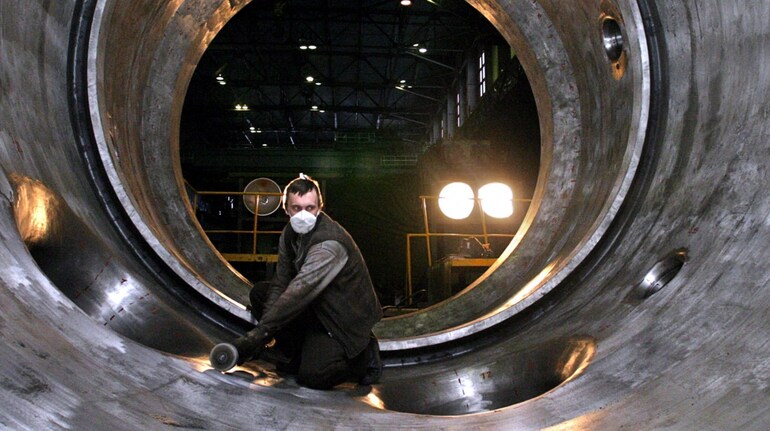
With Parliament clearing the Sustainable Harnessing and Advancement of Nuclear Energy for Transforming India (SHANTI) Bill, 2025, the government has put in place a new legal framework that allows private sector participation in nuclear power generation, while retaining state control over strategically sensitive areas of the nuclear value chain.
The law enables private companies and joint ventures to build, own, operate and decommission nuclear power plants under a government licensing regime, marking a shift from India’s long-standing state-dominated nuclear power programme. Domestically, companies such as Larsen & Toubro (L&T), Tata Power, Reliance Industries, Adani Group, JSW Group and Vedanta Group are expected to evaluate opportunities, while global reactor suppliers including US-based Westinghouse Electric and France’s EDF could also benefit as projects move forward.
However, foreign companies will not be permitted to solely operate nuclear power plants under the SHANTI Bill, which restricts eligibility to entities incorporated in India. “This effectively means that foreign investors will have to route their participation through a company incorporated under Indian law, as direct entry by overseas entities is not allowed,” said Ashish Suman, Partner at JSA Advocates & Solicitors.
Why is India turning to nuclear power now?
India is pushing nuclear energy to secure reliable, round-the-clock clean power as electricity demand rises with industrial growth and the expansion of digital infrastructure such as data centres, AI and semiconductor manufacturing, where intermittent renewables may fall short.
The move is also tied to climate and capacity goals. India has committed to net-zero emissions by 2070 and is targeting a scale-up of nuclear capacity to around 100 GW by 2047. The 2025 Union Budget announced a National Nuclear Energy Mission to accelerate capacity addition and the deployment of advanced reactor technologies, such as small modular reactors.
The SHANTI Bill places nuclear power within India’s long-term energy security framework, anchored in a closed fuel cycle and the country’s three-stage nuclear programme—starting with pressurised heavy water reactors using natural uranium, followed by fast breeder reactors, and eventually thorium-based reactors to utilise India’s domestic thorium reserves.
How the SHANTI Bill redraws India’s nuclear power framework?
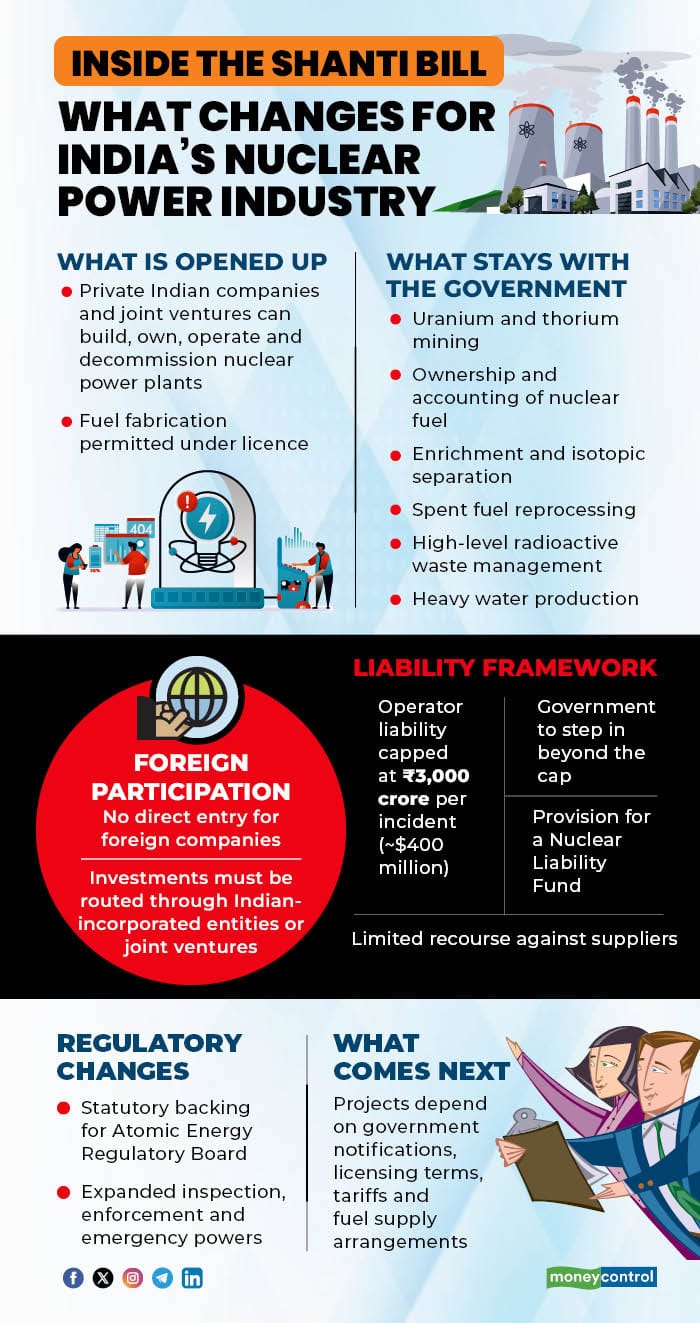
The SHANTI Bill marks a structural shift in India’s nuclear power architecture by opening electricity generation to private participation under a formal licensing regime. For the first time, private companies and joint ventures are legally permitted to build, own, operate and decommission nuclear power plants, a departure from the earlier framework where nuclear generation was restricted to state-run entities. The law also provides statutory backing to the Atomic Energy Regulatory Board, strengthening regulatory oversight, inspection and enforcement across nuclear and radiation-related activities.
On liability, the law caps the operator’s liability for nuclear damage at about Rs 3,000 crore per incident (around $400 million), with the Central Government stepping in beyond that limit. It also allows the government to set up a Nuclear Liability Fund and, in certain cases, assume full liability for installations in public interest. For equipment makers and technology providers, the law limits the operator’s right of recourse against suppliers, addressing long-standing concerns over open-ended liability exposure.
At the same time, the legislation draws clear boundaries around strategic control. Mining of uranium and thorium, enrichment, isotopic separation, reprocessing of spent fuel, high-level radioactive waste management and heavy water production remain exclusively with the Central Government or government-owned entities. All fissile and source material produced domestically or imported will continue to remain under government surveillance and accounting control, according to the Bill.
Who stands to gain from India’s nuclear sector opening?
The opening up of nuclear power generation is expected to impact a wide range of domestic industries, particularly power generation, heavy engineering, construction and capital goods manufacturing. Indian companies such as L&T, Tata Power, Reliance Industries and Adani Group are likely to assess opportunities across project development, engineering, procurement and construction, as well as long-term operations under the new licensing framework.
Praveer Sinha CEO and managing director of Tata Power, told Moneycontrol that the company is already exploring locations for its future nuclear plans and has put together a dedicated internal team to track developments in the sector. “We are looking at small modular reactors (SMRs) in the 20–50 MW range as and when the new legal framework is operational,” he said.
In February, Mukesh Ambani, Chairman and Managing Director of Reliance Industries, also said that the company will harness nuclear energy. “Our priority is to make Assam a hub for clean and green energy. This will include nuclear energy, in line with the government’s new policy to invite private participation in the nuclear industry,” he said at the Advantage Assam 2.0 Investment and Infrastructure Summit 2025.
For global reactor suppliers and nuclear technology providers, the SHANTI Bill potentially revives opportunities that have remained stalled for over a decade due to regulatory uncertainty and liability concerns. Companies such as Westinghouse Electric and EDF could find renewed scope to participate through technology supply, engineering services and partnerships with Indian licensees.
Ancillary sectors including specialised manufacturing, nuclear insurance, project finance and long-term operations and maintenance are also expected to see spill over effects as India’s nuclear ecosystem evolves under the new law.
Private entry subject to further notifications
While private participation is now legally enabled, actual projects will depend on future government notifications, licensing terms, tariff frameworks and clarity on fuel supply arrangements—making the SHANTI Bill a foundational step rather than an immediate market opening for India’s nuclear power sector, experts said.
“The sector faces inherent challenges including - extremely high capital cost (Rs 16–20 crore per MW), long gestation periods, and plant stabilization related issues. Private firms lack operational track record in this domain, raising concerns over execution risks and tariff competitiveness,” said Ankit Jain, Vice President and Co-Group Head, Corporate Ratings, ICRA Limited.
Discover the latest Business News, Sensex, and Nifty updates. Obtain Personal Finance insights, tax queries, and expert opinions on Moneycontrol or download the Moneycontrol App to stay updated!
Find the best of Al News in one place, specially curated for you every weekend.
Stay on top of the latest tech trends and biggest startup news.




