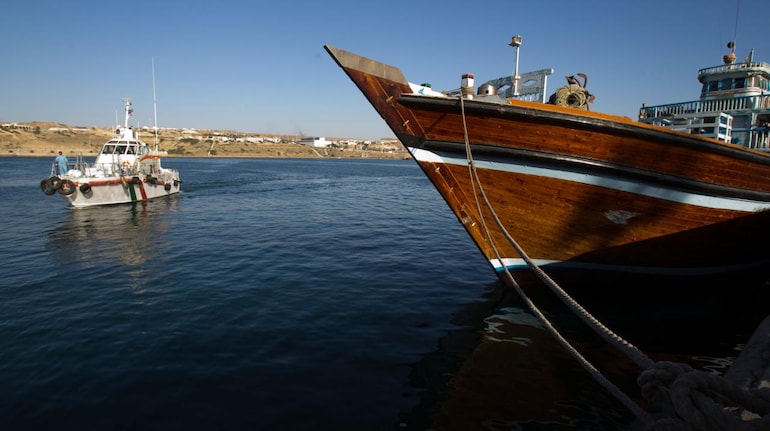

India is likely to recalibrate its connectivity strategy and increase focus on the India–Middle East–Europe Corridor (IMEC) as its strategic and commercial interests in the Chabahar Port face heightened risk following the United States–Israel military attack on Iran on February 28 and the sanctions on Tehran. However, India is unlikely to abandon its interests in Chabahar, experts said.
The escalation has injected fresh uncertainty into India’s 10-year engagement at Chabahar, which for New Delhi could have worked as a critical gateway to Central Asia and Russia, bypassing Pakistan. While India is unlikely to take a hard diplomatic position publicly, it will seek to safeguard its strategic investments through calibrated negotiations, they added.
Focus on IMEC for Gateway to Middle East
“India will not take a very hard stand on Chabahar port,” Tarun Agarwal, international relations expert, told Moneycontrol, indicating that New Delhi may seek quiet understandings to preserve its interests rather than adopt an overt position.
Agarwal noted that India is already attempting to build up IMEC and that Chabahar “is not part of that equation”. He added that trade may not be “very much affected” immediately, though “distrust in the market would be there”.
His remarks suggest that while Chabahar remains strategically important, IMEC — which does not depend on Iranian territory — could gain greater policy attention if sanctions risks intensify.
Geopolitical volatility will complicate engagement
N R Bhanumurthy, Director of the Madras School of Economics, cautioned that geopolitical volatility will complicate engagement.
“Continuing similar engagement with Iran is going to be extremely difficult,” Bhanumurthy said, pointing to the “volatile world condition”.
Critical Minerals
Beyond energy and trade routes, Chabahar holds long-term strategic value for India’s industrial ambitions.
“Chabahar is not only about oil from Iran. It is actually our entry gate to Central Asia, where the critical minerals are located. These are very necessary for our supply chains, especially when it comes to semiconductors and other strategic sectors,” Agarwal said.
He added that the port is “a strategic place where we can counter Pakistan and China in Central Asia”, emphasising its geopolitical importance.
From a trade diversification standpoint, Biswajit Dhar, trade expert and former Professor at Jawaharlal Nehru University, said Chabahar plays a central role in India’s outreach to Eurasia.
“Chabahar port is one of the key points of India’s connectivity with Central Asia and Russia,” Dhar said.
Chabahar was embedded in India’s broader strategy to widen export markets and strengthen Eurasian economic integration, Dhar said.
Will not abandon Chabahar
While IMEC may receive increased policy thrust as a relatively less exposed corridor, Chabahar’s long-term relevance — particularly for access to Central Asia and mineral resources — ensures that New Delhi is unlikely to abandon the project outright.
The coming weeks, they said, will test India’s ability to balance sanctions risks, regional instability and its ambitions to build resilient trade corridors across West and Central Asia.
What Is IMEC and How It Differs From Chabahar
The India–Middle East–Europe Corridor (IMEC) is a proposed multi-modal connectivity project announced on the sidelines of the G20 Summit in 2023. It aims to link India to Europe through a network of shipping routes, rail corridors and logistics infrastructure passing through the United Arab Emirates, Saudi Arabia, Jordan and Israel before reaching European markets. The project is still under development, with infrastructure agreements, financing structures and implementation timelines being worked out.
Unlike Chabahar, which is located in Iran and designed primarily as India’s gateway to Afghanistan, Central Asia and Russia by bypassing Pakistan, IMEC does not depend on Iranian territory. Chabahar is a port-centric bilateral project rooted in India–Iran cooperation, with extensions toward Eurasian land corridors.
IMEC, in contrast, is a broader multilateral framework involving India, the United States, European partners and key Gulf economies, and is positioned as an alternative supply chain route connecting Asia to Europe.
Another key difference lies in strategic orientation. Chabahar provides India access to landlocked Central Asian markets and critical mineral reserves, serving long-term geopolitical and resource security goals.
IMEC is more focused on enhancing trade efficiency between India, the Gulf and Europe through faster logistics, digital connectivity and energy corridors. While Chabahar strengthens India’s continental outreach toward Eurasia, IMEC strengthens maritime-rail connectivity westward toward Europe.
With IMEC still at an early stage of execution and Chabahar already operational under a long-term agreement, the two projects serve complementary but distinct strategic purposes. However, as sanctions risks rise around Iran following the US–Israel attack, IMEC may appear relatively less exposed to geopolitical disruption compared to Chabahar, which is directly tied to Tehran, they said.

Discover the latest Business News, Sensex, and Nifty updates. Obtain Personal Finance insights, tax queries, and expert opinions on Moneycontrol or download the Moneycontrol App to stay updated!
Find the best of Al News in one place, specially curated for you every weekend.
Stay on top of the latest tech trends and biggest startup news.