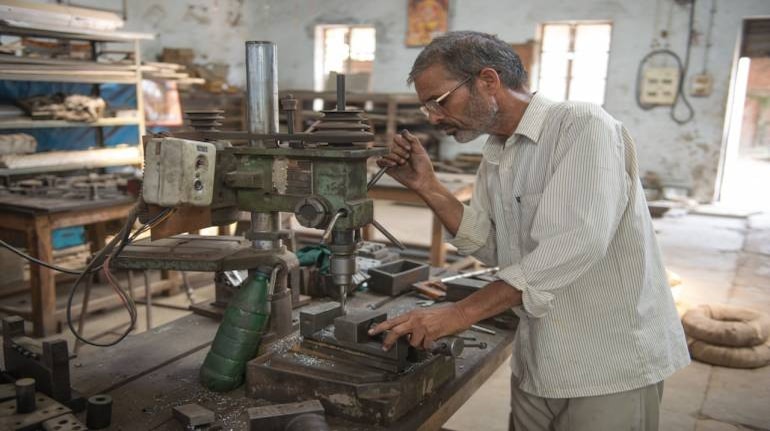
It wasn't that long ago that the downturn of India's micro, small and medium enterprises (MSMEs) was being used to explain the economy's slowdown. Admittedly, growth had been declining even before the note-swap exercise, but economists have theorised that the double blow from demonetisation and the rollout of the goods and services tax led to the closure of some of these small firms, causing India to import the products they made.
Even as recovery was being charted, the coronavirus pandemic struck in early 2020, forcing the government to announce measures to boost credit flow to support these small firms.
"The MSME sector is charting a new story post-pandemic," Soumya Kanti Ghosh, State Bank of India's group chief economic adviser, said in a report in January.
"In the post-COVID period, credit growth to MSMEs has been distinctly and consistently higher on both year-on-year basis as well as in comparison with credit growth to large industries," Ghosh added.
Months after Ghosh's comment, the numbers continue to bear it out.
As per the latest data from the Reserve Bank of India (RBI), bank credit growth to large industries was 5.3 percent as on April 21. Meanwhile, credit growth to micro and small industries was 9.7 percent. Medium industries were on a whole different level altogether, as bank credit growth to them was at a staggering 19.1 percent.
The government must get some credit for MSMEs' financial health. Launched in the early days of the pandemic, the Emergency Credit Line Guarantee Scheme (ECLGS) saved at least 14.6 lakh MSME accounts and prevented around 12 percent of outstanding MSME loans from becoming non-performing, according to Ghosh.
Beyond creditBut it's not just a case of improved credit flow. With the government focusing on the manufacturing sector through its flagship production-linked incentive scheme, MSMEs are becoming more integrated with the supply chain and growing in size — something that has been an issue in India.
A key role here is being played by the government itself, with central public sector enterprises' making 35.6 percent of their purchases from micro and small enterprises in 2022-23, up from 32.5 percent in 2021-22. Both these figures are significantly higher than the floor of 25 percent placed on annual procurements from these units.
As per the 73rd round of the National Sample Survey, conducted during 2015-16, there were 6.3 crore unincorporated non-agriculture MSMEs in India. Of this, more than 95 percent were micro enterprises.
Data from registrations on the government's UDYAM portal shows this remains the case, with 96 percent of the 1.3 crore MSMEs registered at the end of December 2022 belonging to the micro category (as an aside, on June 21, MSME registrations on UDYAM crossed the 2 crore mark).
According to SBI's Ghosh, while micro enterprises will need assistance in growing organically, it could result in an "MSME revolution in India".
An MSME revolution can only be good news for jobs. The 1.3 crore MSMEs registered as on December 31, 2022, employed 9.5 crore people, with micro enterprises accounting for 82 percent of the jobs.
Challenges remainThis is not to say that MSMEs' troubles are over. A long-standing issue for them has been the delayed payments for the goods and services they provide to both the government and larger firms. In September 2022, Finance Minister Nirmala Sitharaman called on industry leaders to ensure MSME vendors are paid in a timely manner.
The finance ministry followed it up with more concrete action, with the budget for 2023-24 proposing an amendment that ensures buyers can claim expense deduction only after payments have been made to the supplier.
Another likely hurdle will probably be MSME profitability, which has been affected by volatile commodity prices, with the export slowdown also hurting prospects. At the same time, MSMEs that gained from the government's interventions during the pandemic must now deal with tighter financial conditions and higher input costs coinciding with the beginning of repayments on their restructured loans.
"About 60 percent of the downgrades in the second half of 2022-23 were in the sub-investment grade category and these largely comprised MSMEs. As much as 70 percent of the downgrades were because of a decline in profitability and/or liquidity pressure," ratings agency CRISIL cautioned in April.
No turnaround is complete without a few wobbles. India's MSMEs must traverse a similar path.
Discover the latest Business News, Sensex, and Nifty updates. Obtain Personal Finance insights, tax queries, and expert opinions on Moneycontrol or download the Moneycontrol App to stay updated!
Find the best of Al News in one place, specially curated for you every weekend.
Stay on top of the latest tech trends and biggest startup news.