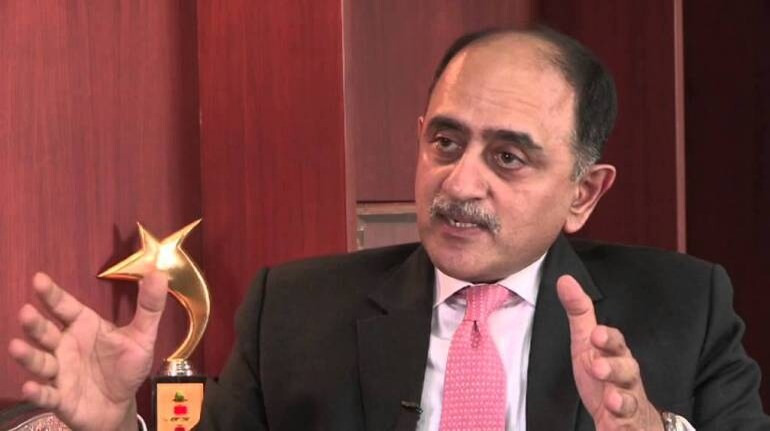
Shyam Srinivasan, the Managing Director and CEO of Federal Bank, is a veteran banker who has worked with two foreign banks before starting his stint at the Kerala-based lender in 2010. Srinivasan's present term is coming to an end in September this year.
Heading the bank for over a decade, Srinivasan has changed the image of the old generation private lender to that of a fast-growing, tech-savvy mid-sized bank. Under his watch, the bank has done well compared with the competition. To give an example, the bank has been consistently maintaining its Gross NPAs at less than 3 percent over the last decade.
In a detailed interview with Moneycontrol on March 18, Srinivasan spoke about a range of issues including his vision for the bank in the next few years, the key challenges he faces, and the opportunities before him.
Edited excerpts:
You are an engineer by education. Why did you decide to become a banker?
After I finished my IIM, I went for a Citibank interview in 1988, and because I had done my summer project with Wipro, I already had a job in hand. I didn’t get the Citibank job after the final interview, so Wipro became my default option. After a year, I joined Citibank. Always wanted to be a banker.
Are you happy with your stint at Federal Bank so far?
I’m never unhappy but always dissatisfied. Because, if I am satisfied, then the game is over. In any long journey, there are hits and misses. We are working hard. In the recent past, there have been some recognitions. So, that helps.
You chose to grow the bank steadily, not too quickly as some of your competitors did.
If I make a comparison, in the sporting world I respect Rahul Dravid (cricketer). That’s the kind of profile we want to be. We are working hard to be that.
But Federal Bank still has the tag of an old generation private bank.
You know I hate that term (laughs). On every platform, I have been arguing saying please explain what is old and what is new. I mean, there is nothing wrong in being old, but I think I should not be constrained to ‘boring and old’. I’m happy to be a 75-year-old young bank.
Is there a transition plan underway?
I don’t want to give any label to it. But through whichever lens you look at us, we compare with any new bank. We have now moved from the small to medium bank category. I guess people are now realising that we are no longer the ‘old bank’.
Ten years back I said we will be like Ayurveda which is the world’s biggest and most popular exports from Kerala. Nobody calls Ayurveda a Kerala (medicine system) today. But, it has its origins in Kerala. I would love to be the new Ayurveda of the world. Federal Bank was born here but we are growing up in India.
How do you want to position the bank going ahead—as a retail bank?
I wouldn’t say that. This is all situational, right? The strategy is adapting to different models depending on the environment. But, certainly, we focus on 2-3 things. We want to be the most admired bank, digitally enabled for micro, small and medium establishments to bank on. That is the vision statement of the bank. Middle India has a huge opportunity ahead.
You have over 1,280 branches…will you expand further?
When I joined the bank, I added 600 branches in five years. In the last five and half years, I have added only 20 branches. In 2015, we stopped adding and our mantra became—branch light and distribution heavy. I believe branches should become more productive.
That means you are not looking at physical branch expansion…
Certainly not in large numbers. This fiscal year (FY21) we may have added only about 17 or 18 branches. Next year too, we may add about 30 branches but every year we may not add more than that. That is unless we find an inorganic opportunity. That is a different story.
Are you looking at acquisitions?
Certainly we will be interested in that. Two to three years back we explored an opportunity. It didn’t come through. But, at the right time, we would be happy. But right now nothing is on hand.
What type of institutions are you looking at?
Microfinance.
Why microfinance?
In our entire range of offering, the gaps we are talking about are three things. One is the relatively higher-margin retail product. Two, selective expansion in unsecured in retail, and third a business which has higher margin like microfinance.
We have launched our credit card business, we have launched our own commercial vehicle business, we have launched our own microfinance. But microfinance is an expertise business. You need specific expertise, specific local geography capabilities so we thought that’s a gap we can fulfil inorganically if something is available. Otherwise, we will build it organically.
Is something looking good at this stage?
Right now, nothing. Absolutely nothing.
Increasing competition, the pandemic—how tough was last year?
We are inherently a good bank. Any bank that is built on a granular liability franchise is a good bank. You see our liability profile. In 2012, we de-bulked the book. If you look at our book in 2013, we stopped depending on bulk deposits. About 93-95 percent of the liability is retail now, which I think even an SBI may not have.
Was this shift part of a conscious plan?
If you see the last seven, eight years, each passing year, it is only becoming more retail on the liability front.
Is that the same approach on the asset side as well?
Asset tends to be largely retail, small ticket. But, because our liabilities have grown so nicely--at different points in time we approach the asset strategy based on opportunities. For example, when we were at 68 percent CD (credit deposit) ratio, we were happy to grow corporate. When we came to 82 percent, we slowed down our corporate. But the underlying idea has always been it has to be a risk-adjusted margin close to 2.7 percent and risk credit cost should never cross at the worst 80 basis points (bps) to 100 bps. Again with some confidence, I can say, not more than two banks—HDFC Bank and Kotak-- in the country will have such a credit profile. Over a ten-year period, there are very few banks with gross NPAs less than 3 percent. That with some pride I can say about our approach.
Is there room for improvement in your cost-to-income ratio?
There is always scope for improvement. It is around 49-50 percent and we would love to bring it to 45 percent. But, this is the unfortunate part of the analyst world. They go by the textbook formula which is not wrong. That is what they have to do. But they lose context. If you take high-income growth strategy, somewhere you are running a high credit cost. We have taken a reverse strategy and decided we will be more conservative. I have 93-95 percent of my retail book secured. We have not done much unsecured consciously. Hence, our slippages and credit costs have been lower.
There seems to be an aggressive focus on gold loans.
I think it is an opportunity, right? If you see the last 12 months, the pandemic period particularly, availability of credit was lower for people across the country. And, gold is a great product and a great hedge for bank and the customer because it is secured. And customers are able to get a loan against that product, where with respect to other credit lines, banks were uncomfortable to do for six to eight months. Naturally, there was a massive focus on gold. We did remarkably well. Incidentally, our gold loan growth is in Tamilnadu, Karnataka and Maharashtra. It has nothing to do with any particular geography. Usually, Tamilnadu and Karnataka are the biggest gold loan markets for Federal Bank.
Where do you want to take the gold loan portfolio?
I think our mantra has been no segment will dominate more than 15 percent of the total loan outstanding. Right now, gold loans are 11 percent inching closer to 12. It may remain there because gold prices have again started to moderate. You may not see a big growth in gold loans as you saw in the last 12 months.
The RBI has introduced uniform gold loan regulations for banks and NBFCs. How will it affect you in terms of LTV?
We never went to the 90 percent LTV. Our average portfolio LTV is now 73-74 percent. So, the new RBI regulations do not matter for us much. That was given by the RBI for customers in the pandemic period.
What are your growth forecasts?
Before the break of the pandemic, we said we would like to grow at 15-18 percent per annum. In the pandemic period, this financial year, we may grow at 8-9 percent. Next financial year, hopefully 15-16 percent.
How is the loan portfolio mix now?
Our mix between wholesale and retail is 45 and 55 now. Within wholesale there is commercial banking and corporate banking. Corporate banking used to be 90 and commercial banking at 10. That we are moving to 75 and 25 over a two-year period. In retail, it is secured and unsecured. Secured has been 93 percent and 7 percent unsecured. Maybe we will be 85 and 15 over a three-year period.
Can you list key risks for the bank going ahead, say in the next 5 years?
Credit cost has always been in the 60-75 bps and it should not go beyond that even if we do high margin business. Second, the advantage of the liabilities portfolio is retail. That advantage should not change with the nature of the new financial instruments coming in, say new retail-focused G-sec products. It should not mean shifting of bank savings to such products. These are two risks banks have to worry about.
What is your outlook on asset quality?
The year ending on March 31 is turning out to be better than what we thought when the pandemic was at its peak. Our restructuring book looks much better than what we had visualised. In the September quarter, we thought it will be higher—even 3 percent of the book can be restructured—but thankfully it may be half or even lower.
Can you give some numbers?
At the end of December, our restructuring figures were a little over Rs 1,000 crore which is about less than one percent of our book. These were more retail borrowers. In fact, our SME book has not sought much restructuring. It was secured retail borrowers who probably wanted the comfort of lower EMIs or deferring EMIs.
How do you look at big corporate loans now? Banks used to love the segment till a few years ago.
Every bank has to build its corporate book based on its liability profile. If they have access to longer-term liabilities, it is okay to go for longer-term corporate lending. In India, usually, your liability profile is much shorter than the client’s multi-year loan requirement. Second, you need a balance sheet and capital strength to do business with riskier corporate loans. We look at top corporates but we cannot be a primary banker to them. We can be banker number 3 or 4.
Banks used to think big corporates are safe. Has that changed?
A lesson we have all learned is the premium one must pay for governance. Less the size but more the governance is what everyone pays attention to now. That is why in banking or in the stock market today you see people spending a disproportionate amount of time analysing the governance rather than size or ownership. What kind of governance mechanism, reporting transparency, etc.
We have seen big-scale bank bailouts like Yes Bank and LVB. Your view?
I think there are two parts to it. I think it is not so much about bailing out the bank as much as ensuring the system doesn’t get disrupted. Second, the instruments and tools used in both cases are very different in both cases. In LVB, they only permitted a good international name to come in quickly. The government didn’t put in any money. In the case of Yes Bank, the situation was different—the size of the bank and the profile of the bank. We were an equity investor in Yes. They opened the doors for banks to come in and thankfully SBI jumped in.
It's been a year since Yes Bank bailout..
In hindsight, it was a good decision because they saved a major problem. Whether this is a sustainable model, I think everybody has learned a lesson and maybe such things will never happen again because the governance mechanism has changed so much, the inspection levels have changed so much. These are two models. I think, if you take the LVB model, it is a good model for future.
Sebi has imposed restrictions on AT1 Bonds. Your views?
Without commenting on what Sebi or the finance ministry saying, my approach to this whole thing is banks have to be watchful of capital. If you are not watchful, you may have a problem. I can give my experience; in ten years, we raised money only once and we have been more conservative in the use of capital.
Any plans to raise capital going ahead?
We have shareholder approval to raise capital of up to Rs 4,000 crore. We haven’t used it yet. Sometime in calendar 2021, there may be an opportunity. But, as we speak, our CRAR is close to 14 percent. Whether this year or early next year, we haven’t finalised. But there could be an opportunity.
What will be the instruments?
QIP (Qualified Institutional Placement) is an option. But in every 3-4 months we have to evaluate and decide which the best instrument is. Currently, all options are open but nothing on the cards.
Your term is ending in September this year.
The application (for extension of the term) has gone to the RBI. We are waiting for the response.
Do you think the bad bank is a good idea?
As a concept for big-ticket bad loans, if it is coming to one place, then the negotiating power of that institution increases. The debate is who will capitalise it, what is going to be the structure, and so on. As long as we have clarity on that and if it is a well-run entity, then it makes sense. Banks can put their bad assets into that and continue to do their job. There is a lot of conversations surrounding it.
But who will buy those assets?
Yes. Initially, someone will have to capitalise. Someone has to carry the pain for a few years. Those are challenges. Setting up is the toughest part. The only way this can happen is if the government comes forward and grandfathers it for 2-3 years and then makes it widely held.
But the government has said it will not put in money.
The government may set up an architecture, put some capital but run it through a private sector model. I think there will be two layers—a holding company and a running franchise. The former will be at the government level and the franchise in the private sector.
The Supreme Court stay on asset classification still stays. Isn’t that an issue?
Banks are reporting their proforma NPAs. We are also doing that. We are doing it at two levels. One is from an accounting treatment, you are treating an asset as an NPA but at a customer level, you are not tagging it as an NPA. Now, this is a matter the court has to come with its final version. We are all waiting for it. That is a challenge. But all of us have come to terms with the fact that it may take time to come.
There are a lot of talks on cryptocurrencies. Your view?
Maybe we are a little old school and conservative. Anything that has such high volatility can never be a fiat currency. Will there be a regulatory approved digital currency in two or three years? Absolutely, yes. Will it form an alternative form of currency, it may. But, cryptocurrencies like Bitcoin have too much volatility and cannot form a currency. It may be a great asset, like gold. In fact, it is. People who invested two or three years ago must be sitting on tonnes of money. But it is speculative. And anything that is speculative cannot be a mainstream currency.
Would you look at Bitcoin as an asset?
As Shyam Srinivasan, I won’t. Because I don’t have the risk appetite. I’m a conservative investor. As an organisation, banks are not permitted to look at speculative assets.
Could you talk about the 'Sanjeevani – A Shot Of Life' drive?
Our Corporate Social Responsibility focus has usually been centered around Healthcare and Education. The successful “Speak for India” programs in recent years were an effort to help students across India showcase their oratory skills. With the onset of the pandemic, we pivoted our attention to focus more on the area of preventive Healthcare.
On World Health Day, we launched the ‘Sanjeevani – A Shot Of Life’ campaign which is aimed at creating and increasing awareness as vaccine hesitancy is a major barrier to stemming this pandemic. We will focus on making the vaccine accessible and available to the extent possible.
How do you want to take the campaign ahead?
Our focus is to spread wide awareness and reach people with this relevant and important information about the COVID-19 vaccine. Our campaign has a three-point agenda: to spread awareness regarding vaccination and vaccines among all Indians, adopt villages and carry out vaccination drives targeting the needy folks in these areas.
What kind of response do you expect for this campaign?
We must understand that vaccine hesitancy could slow the pandemic recovery. While the second wave stares at us, we must realize that trust is the key ingredient in any vaccine and we can defeat this pandemic only if our optimism spreads faster than the virus!
Our ‘Sanjeevani Gaadi’, which was flagged off from the Attari border, is that Optimism on 4 wheels. The vehicle will travel across the following locations: Nashik, Guntur, Indore, and Dakshina Kannada and spread information about COVID-19 vaccines and clearing myths. We will also organize many vaccination camps across locations. The Sanjeevani Gaadi will move through 500 villages.
While the government is trying its best to spread awareness and to inoculate the masses, we should realize that we are a very big nation and it'll require a massive effort. We intend to do our small part and ask everyone the question: 'Lagaya Kya'.
Note to readers: This interview has been updated with details of the CSR partnership between Network 18 and Federal Bank.

Discover the latest Business News, Sensex, and Nifty updates. Obtain Personal Finance insights, tax queries, and expert opinions on Moneycontrol or download the Moneycontrol App to stay updated!
Find the best of Al News in one place, specially curated for you every weekend.
Stay on top of the latest tech trends and biggest startup news.