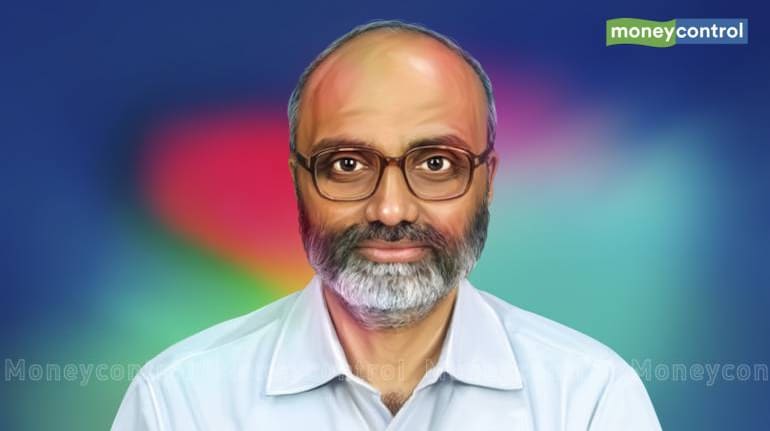
In a freewheeling conversation with Moneycontrol, Prof. Jayanth R Varma, a member of the MPC, spoke about the necessity to front-load rate hikes, the direction of interest rates, the impact of global liquidity tightening, and how the schooling of central bankers influences larger policy making.
Also read: Magic prices warned of sticky inflation, so why didn't RBI take note?
In India, till about a quarter ago, there was a strong feeling that the RBI has been behind the (inflation) curve. And you had also maintained that. Do you still believe we are behind the curve with the 40 bps hike? (One basis point is one-hundredth of a percentage point.)Like I have said, I think we need a 100 bps hike very soon.To me, the biggest thing that has happened is that we have completely unshackled the MPC now. Which is what I wrote in the statement that, in April, even if we wanted to, we could not have raised rates because we’re more or less committed that we will not do so. Now, we have discarded all that language… even the word ‘stance’ has been dropped. There is no stance really now. There is only a statement that monetary policy is accommodative, which is just a fact… that if your real interest rate is minus 3%, then the monetary policy is highly accommodative.So, that's just a statement of fact.But if you read that with the statement that the accommodation has to be withdrawn, it's very clear what direction the MPC is taking.The most important thing was to convey clearly that the MPC is very much focused on inflation, and will not let inflation go out of control. In a way, the 10-year government bond yield rising dramatically is the market doing our job for us. The tightening had to happen, tightening is happening.A lot of the effect of monetary policy actually comes from the long rate, whether it is for corporate borrowing or whatever. The long-term interest rate is a lot more important than the short-term interest rate. So the fact that the long-term interest rate has climbed dramatically indicates that there has been a tightening.For India, what will be a bigger concern? The possibility of stagflation in the US or the interest-rate hikes moving money out of emerging markets?My rule of thumb is that not only India, but every country does well when the rest of the world is doing well. This is because so much of growth comes from exports; the foreign trade is the most dynamic sector of every economy. In that sense, we would like the US, the Eurozone, and China to do well. This is where the economy is very different from the Olympics. In the Olympics, you can get a gold medal because your competitors stumbled and fell. Or you can hope that your competitor doesn't do well. But the global economy is not a zero-sum game, you know. It isn’t that their loss is our gain. The economy works more like ‘everybody's loss is also my loss, and anybody's gain is also my gain.’ So the best outcome would be that the global economy is firing on all cylinders. We are a sufficiently open economy for which exports are crucial. More than the share of exports in GDP, the critical thing is that the export sector is the most modern, most vibrant sector of the economy. So, you want exports to be at the cutting edge of the economy. Then, when the world economy does well, the cutting edge of our economy also does well and then that builds up the rest. So, definitely, a world economy which is growing at 3-4% is the most desirable outcome.But aren’t fund flows a zero-sum game, especially if you were to bifurcate the world into emerging and developed?The money that is poured into emerging markets was simply the liquidity unleashed by the central banks. That liquidity had to find its way somewhere. When these global central banks unleashed liquidity, it flooded their home markets first. Then, it overflows (into other markets). It is not that we are getting the water at their cost. It is their excess money that is coming back here. Therefore, when the central bank begins tightening, then the liquidity goes away from everywhere. So, I always think about this interesting phrase that people use, that there is one ocean and many shores. When the water level rises in the ocean, it rises on all shores, it's not just in India, or US or Europe. When the water level falls, it falls everywhere.On the currency front, if you were to place in order the driving forces for the currency, how would you stack them up?Firstly, the Russia-Ukraine war has delivered a severe terms-of-trade shock to the external sector, because the price of what we import has gone up drastically. Price of oil, our biggest import, has doubled in a short time. Obviously, the price of what we export has not gone up commensurately. It is a very big shock to the current account. Our current account deficit has widened.Now, the question is how do we respond to this terms-of-trade shock and widening current account. That is a concern and one way to respond would be with currency depreciation. But that would make the inflation problem worse. We are already importing inflation with crude prices; with currency depreciation we will be importing even more inflation from the rest of the world. That is really the concern. For the last several decades, we didn't have to worry much about importing inflation from the rest of the world. The inflation in the rest of the world was close to zero. But clearly we have to worry about that now, which is what makes the task of monetary policy a lot harder. We will have to take stronger action. But the exchange rate is not part of the MPCs remit. So we will just have to respond to whatever happens when it happens.(This is part one of a two-part series. Read part two here.)
Discover the latest Business News, Sensex, and Nifty updates. Obtain Personal Finance insights, tax queries, and expert opinions on Moneycontrol or download the Moneycontrol App to stay updated!
Find the best of Al News in one place, specially curated for you every weekend.
Stay on top of the latest tech trends and biggest startup news.