
Prime Minister Narendra Modi’s three-nation visit to Jordan, Ethiopia and Oman, which is expected to underscore strategic and diplomatic partnerships, has renewed attention to two trade relationships that have lost momentum after a sharp post-pandemic spike.
On December 15, India and Jordan signed five key agreements, as Modi made his first visit to the Arab nation.
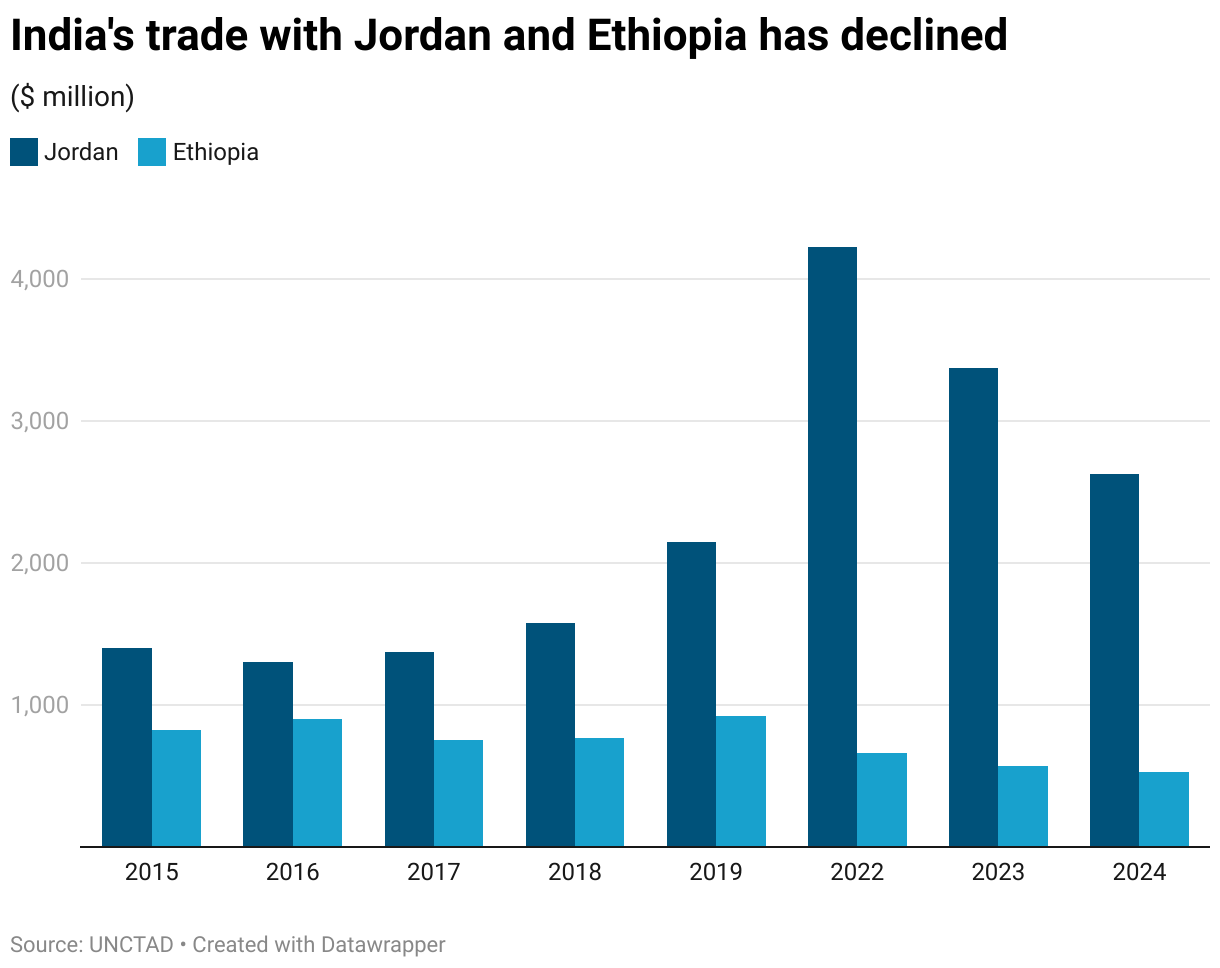
Data shows that India–Jordan merchandise trade surged in 2022, with total trade jumping to $4.23 billion from $2.15 billion in 2019, before cooling rapidly.
By 2024, it fell to $2.63 billion, a 38 percent decline from the 2022 peak. The slowdown was driven primarily by exports. India’s shipments to Jordan dropped to $954 million in 2024 from $1.84 billion in 2022, a 48 percent fall. Imports also eased, declining to $1.67 billion from $2.39 billion during the same period.
A closer look at product composition suggests the 2022 surge was unusually concentrated. Mineral fuels were the single biggest swing factor.
India’s exports of mineral fuels to Jordan collapsed to about $233 million in 2024 from nearly $910 million in 2022, accounting for a large share of the overall export decline.
Outside fuels, traditional categories have been more resilient, though insufficient to offset the loss.
Tobacco and manufactured tobacco substitutes continued to grow, rising to about $33 million in 2024 from $16 million in 2022.
Cereal exports held up at roughly $113 million, broadly in line with earlier levels. Pharmaceuticals have remained steady but volatile, slipping to around $26 million in 2024 after peaking in 2023.
Chemicals, plastics and engineering goods have stagnated or declined from their 2022 highs. Overall, data points to a weakening export base once large energy consignments fell away.
India–Ethiopia trade shows a similar, though less pronounced post-pandemic cooling.
Total bilateral trade with the African country, which is the second country that the Prime Minister will visit, declined to $529 million in 2024 from $661 million in 2022, a drop of about 20 percent. Exports led the decline, falling 28 percent to $443 million from $611 million. Imports from Ethiopia rose to $86 million from $49 million but the increase was too small to offset the export slowdown.
Category-wise, the export relationship with Ethiopia remains stable but narrow.
Pharmaceuticals continue to dominate, valued at about $168 million in 2024, largely unchanged from 2022, underscoring the stickiness of healthcare supplies.
In contrast, engineering goods, vehicles and machinery have seen sharp declines since 2022, while textiles and plastics have also trended downward.
Some smaller categories such as processed foods, select chemicals and consumer goods have shown growth in 2023–24 but from a low base and without materially altering aggregate trends.
Imports from Ethiopia remain concentrated in agricultural commodities and raw materials, including vegetables, oilseeds and natural inputs.
Taken together, the data suggests that India’s trade ties with Jordan and Ethiopia have struggled to sustain the momentum generated during the pandemic recovery.
In Amman, Modi announced India’s commitment to double trade with Jordan to $5 billion over the next five years.
As diplomatic engagement intensifies, reviving trade will require targeted efforts to deepen non-energy exports, stabilise demand for manufactured goods and build on relatively resilient segments such as pharmaceuticals and food products.
Discover the latest Business News, Sensex, and Nifty updates. Obtain Personal Finance insights, tax queries, and expert opinions on Moneycontrol or download the Moneycontrol App to stay updated!
Find the best of Al News in one place, specially curated for you every weekend.
Stay on top of the latest tech trends and biggest startup news.