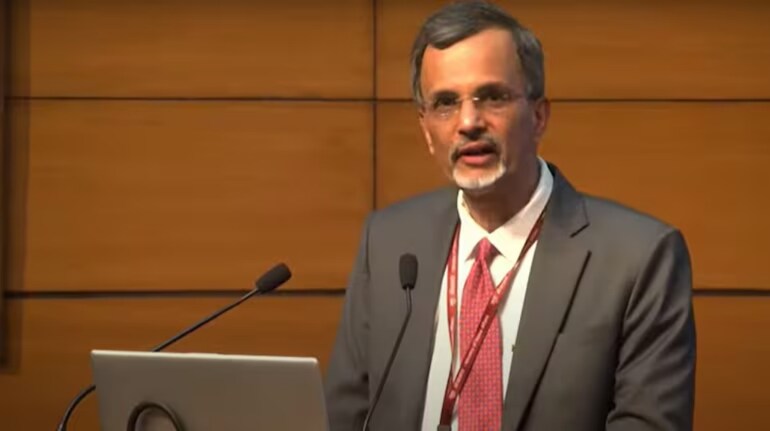

Banks must stop treating successful micro borrowers as permanent beneficiaries of small-ticket loans and instead help them move into mainstream finance, Chief Economic Adviser V Anantha Nageswaran said, arguing that failure to enable this “graduation” weakens the very idea of inclusive finance.
“Graduation is the missing link in too much inclusive finance. We are good at entry, but we are very poor at ascent. A person should not remain a micro borrower forever. If her business grows, her financial options should go with it,” he said at the Global Inclusive Finance Summit on February 13 in New Delhi.
He said mainstream banks cannot remain spectators while millions of small entrepreneurs prove their creditworthiness through microfinance and government-backed schemes.
“The question now is whether the formal banking system is willing to recognise that reality and offer them overdrafts, MSME loans, insurance and working capital lines, not as beneficiaries of a scheme, but as ordinary clients,” Nageswaran said.
Inclusion is not just about access
Nageswaran said inclusive finance is often judged by how many people are brought into the system, not by what happens to them afterwards.
“We often speak of inclusion as though it were an end in itself. We count the number of bank accounts opened, the number of loans disbursed and the number of mobile wallets activated,” he said. “But inclusion, properly understood, is not a destination, it is a journey.”
He said the real test of inclusion is whether people become economically stronger.
“The real question is not whether people have entered the financial system, but whether finance is helping them move towards economic independence,” he said.
Street vendors and PM SVANidhi
Nageswaran cited the experience of street vendors under the PM SVANidhi scheme to show how aligned credit can change livelihoods.
“Street vendors were among the hardest hit during the lockdown when economic activity came to a halt. Their working capital disappeared overnight,” he said. “What the scheme did was simple. It restored liquidity.”
He said independent assessments show that many vendors have gone beyond recovery.
“Vendors who entered the scheme did not merely recover. Many of them expanded, invested and strengthened their livelihoods in a sustained way,” he said.
He added that those who moved through multiple loan cycles grew faster than the broader economy.
“Those who progressed through successive loan cycles have seen their business grow faster than even the economy around them,” he said.
“These were credit-constrained entrepreneurs, not debt-trapped households,” he added.
Health shocks and social protection
Nageswaran said even well-designed credit cannot protect people from shocks.
“One of the main reasons people fall behind on repayments is not laziness or irresponsibility, but unexpected events, especially health-related shocks,” he said.
He said inclusive finance must be supported by affordable healthcare, insurance and social security.
“Without that, lenders face higher risk and borrowers face higher vulnerability,” he said.
Investors and responsible capital
He also spoke about the role of investors in inclusive finance.
“Inclusive financial institutions are not ordinary commercial lenders,” he said. “They are intermediaries between capital markets and some of the most economically vulnerable yet entrepreneurial people in society.”
He warned against demanding high returns.
“If capital insists on high returns, institutions will chase volumes and margins,” he said. “The result may look like inclusion in the short run, but it is extraction in the long run.”
He said true impact investing requires accepting lower financial returns in exchange for social impact.
Timely payments matter most
Nageswaran said the most powerful inclusion tool is not a new loan.
“The most powerful financial inclusion tool is not a loan, but a timely payment,” he said.
He said when governments and companies pay small suppliers on time, working capital stress falls sharply.
“Fair contracts and prompt settlement do more for small enterprises than micro credit ever will,” he said.
He said inclusive finance must lead to independence.
“The goal of inclusive finance is not merely to create more borrowers. It is to create more independent, productive and confident economic citizens,” Nageswaran said.
Growth strongest form of inclusion
The Chief Economic Adviser said economic growth itself is the most powerful driver of inclusion.
“The first and most fundamental truth in this regard is that most economic growth itself is the strongest and most sustainable form of financial inclusion,” he said. “When an economy is generating jobs, incomes, markets and demand, people do not need to be forced into the financial system. They enter naturally.”
He added that finance cannot substitute for real livelihoods.
“Finance is a complement to growth, not a replacement for it. Where livelihoods are stagnant, inclusion becomes fragile. Where livelihoods are expanding, inclusion becomes a self-reinforcing process,” he said.

Discover the latest Business News, Sensex, and Nifty updates. Obtain Personal Finance insights, tax queries, and expert opinions on Moneycontrol or download the Moneycontrol App to stay updated!
Find the best of Al News in one place, specially curated for you every weekend.
Stay on top of the latest tech trends and biggest startup news.