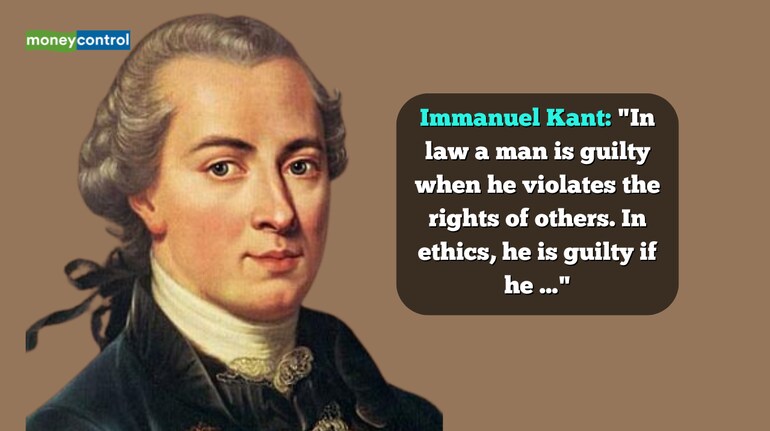

The great philosopher Immanuel Kant, who devoted his work to understanding morality, drew a powerful line between what society can judge and what a person must judge within themselves. He captured this in a clear, two-part statement:
"In law a man is guilty when he violates the rights of others. In ethics, he is guilty if he only thinks of doing so."
This simple contrast is a profound lesson on the difference between public justice and private character.
The Court of Law: Guilt by Action
The first part of Kant’s statement deals with the law. This is the realm of visible action and social consequence. A person is legally guilty only when they commit a wrongful act—when they steal, harm, or defraud someone. The law deals with what we do, because it can only govern observable behavior. It punishes the deed that infringes on another’s rights and disrupts the peace of society. Here, your private thoughts are your own; the court cannot put an intention on trial.
The Court of Conscience: Guilt by Intention
The second part enters the deeper realm of ethics. This is the internal court of conscience, where Kant suggests the standard is far higher. In ethics, a person is guilty the moment they consider violating another’s rights for their own gain. The harmful thought, the selfish intention, the silent wish to exploit—these themselves are moral failures. Why? Because true morality, for Kant, is about the purity of our will and our duty to treat others as ends in themselves, not as tools. If you entertain the thought of using someone, you have already betrayed the ethical principle, even if fear or circumstance stops you from acting.
The Gap Between the Two
Kant highlights a crucial gap between the two courts. You can be legally innocent but ethically guilty. A person might think of stealing from a neighbor, plan it, and then decide not to out of fear of getting caught. In the eyes of the law, they are innocent. No crime occurred. But in the quiet court of their own conscience—and in the eyes of a moral philosophy concerned with intention—they bear guilt. Their character was compromised by the choice to entertain a wrongful intent.
This distinction asks a vital question of us: Are we only concerned with what we can get away with, or are we committed to integrity in our most private thoughts? It suggests that being a good person is not just about controlling your actions, but about disciplining your mind and cultivating a will that aligns with respect for others.
In the end, Kant’s quote is a call for rigorous self-honesty. It reminds us that while society judges our hands, we must judge our hearts. The most important accountability is not to a police officer, but to the moral law we carry within ourselves.
Discover the latest Business News, Sensex, and Nifty updates. Obtain Personal Finance insights, tax queries, and expert opinions on Moneycontrol or download the Moneycontrol App to stay updated!
Find the best of Al News in one place, specially curated for you every weekend.
Stay on top of the latest tech trends and biggest startup news.