






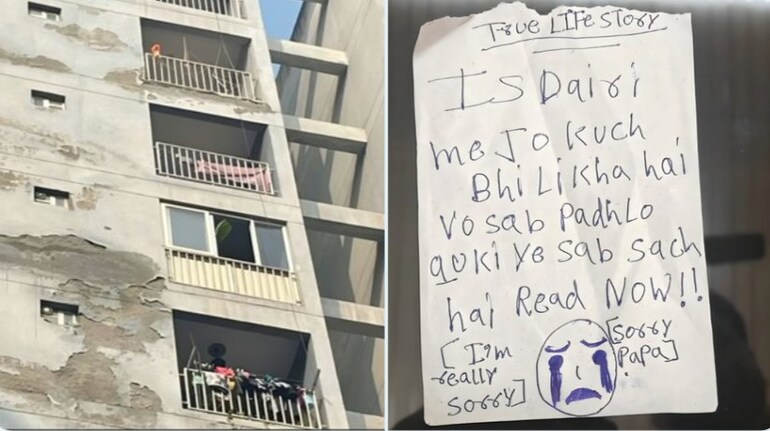

In a quiet residential tower in Ghaziabad, a family’s worst fears about the digital world were realised in the most devastating manner. On the early hours of Wednesday, three sisters, aged 12, 14 and 16, died by suicide after jumping from a ninth-floor building.
Preliminary reports from local authorities indicate the tragedy is linked to the girls' alleged addiction to a task-based "Korean love game" where suicide was allegedly listed as the final objective. Their parents, who had objected to a gaming obsession that began two to three years prior and led to irregular school attendance, are left grappling with an incalculable loss.
Read: 'Papa, you can't separate us from Korean games'
Read: Ghaziabad sisters' suicide note
Read: What happened before Ghaziabad sisters jumped from 9th floor
This heart-breaking incident in Uttar Pradesh has amplified a pressing, global conversation: How should governments protect adolescents from the potential harms of social media and online gaming? From Canberra to Paris, legislators are moving with unprecedented urgency to impose age-based digital bans, framing the issue as one of child safety and public health.
The spectre of the ‘Blue Whale’ and evolving digital threats
The Ghaziabad case chillingly echoes the dynamics of the infamous “Blue Whale challenge”, an online phenomenon that proliferated nearly a decade ago. That sinister “game” similarly manipulated vulnerable teenagers through a series of escalating tasks, culminating in self-harm and suicide.
While the specific Blue Whale threat has largely subsided, child safety experts warn that its underlying mechanics — algorithmic manipulation, social isolation and task-based engagement leading to extreme outcomes — persist in new digital guises.
Emerging platforms and games, even popular ones like Roblox, are now under heightened scrutiny for their potential to create unsafe spaces for young minds. The tragedy in India underscores a persistent fear: that despite increased awareness, the evolving nature of online content continues to outpace protective measures.
A global legislative crackdown gains momentum
In response to mounting evidence linking adolescent mental health crises to excessive screen time, cyberbullying and addictive design, a wave of legislative action is sweeping across continents.
Australia has taken the most stringent stance, enacting the world’s first national social media ban for under-16s, effective late 2025. The policy requires platforms to deactivate over a million underage accounts using age verification, compelling companies to take “reasonable measures” to block minors.
Following closely, France’s National Assembly passed a bill in January 2026 banning social media access for children under 15. The legislation, supported by President Emmanuel Macron and now headed to the Senate, mandates robust age verification on platforms like TikTok to combat addiction and harassment, with enforcement potentially beginning by September 2026.
This European momentum intensified this week as Spain’s Prime Minister, Pedro Sanchez, announced a proposal to prohibit social media for under-16s — a move that drew immediate criticism from tech billionaire Elon Musk. Greece is also preparing a similar ban for children under 15, according to a senior government source.
Asian precedents and India’s nascent debate
Asia presents a mosaic of regulatory approaches. China enforces some of the world’s strictest digital curbs, limiting online gaming for under-18s to just one hour on weekends and holidays since 2021, employing facial recognition for enforcement. Conversely, South Korea repealed its decade-old youth gaming curfew in 2022, opting instead for a parental “choice system” to set playtime limits.
Within India, the Ghaziabad tragedy has injected new urgency into a simmering debate. An ally of Prime Minister Narendra Modi, lawmaker LSK Devarayalu, has proposed a bill to ban social media for children. In an exclusive statement to Reuters on Friday, Devarayalu framed the issue in both protective and economic terms.
At the state level, Goa is exploring an under-16 social media ban modelled on the Australian example, while national discussions around using the Aadhaar digital identity system for age verification are gaining traction.
Divergent paths in the west and enforcement hurdles
The legislative push is encountering varied political and legal landscapes elsewhere. In the United Kingdom, the House of Lords voted in January 2026 to restrict social media access for under-16s via age verification, though the government has indicated it will challenge the move.
In the United States, a patchwork of state laws is emerging: Nebraska will mandate parental consent and age verification for under-18s from July 2026, while Florida has enacted an under-14 ban (with 14- and 15-year-olds requiring parental consent) after a court lifted a prior injunction.
Other nations are also joining the fray. New Zealand has proposed fines of up to NZ$1.2 million for platforms that allow under-16s access and Italy is considering bans for under-14s or 15s to curb online exploitation.
A complex road ahead for digital governance
While the impulse to legislate is strong, experts caution that age-verification technology poses significant privacy and implementation challenges.
Furthermore, digital rights advocates warn that blanket bans may limit beneficial online resources and social connections for young people, advocating instead for comprehensive digital literacy education and parental oversight tools.
The suicide of the three sisters in Ghaziabad is a stark, local tragedy with profound global resonance. The answer, emerging in the form of restrictive laws from diverse capitals, suggests a world increasingly leaning toward hard digital borders for its youth.
DISCLAIMER: If you or someone you know needs help, call any of these helplines: Aasra (Mumbai) 022-27546669, Sneha (Chennai) 044-24640050, Sumaitri (Delhi) 011-23389090, Cooj (Goa) 0832- 2252525, Jeevan (Jamshedpur) 065-76453841, Pratheeksha (Kochi) 048-42448830, Maithri (Kochi) 0484-2540530, Roshni (Hyderabad) 040-66202000, Lifeline 033-64643267 (Kolkata)Discover the latest Business News, Sensex, and Nifty updates. Obtain Personal Finance insights, tax queries, and expert opinions on Moneycontrol or download the Moneycontrol App to stay updated!
Find the best of Al News in one place, specially curated for you every weekend.
Stay on top of the latest tech trends and biggest startup news.





