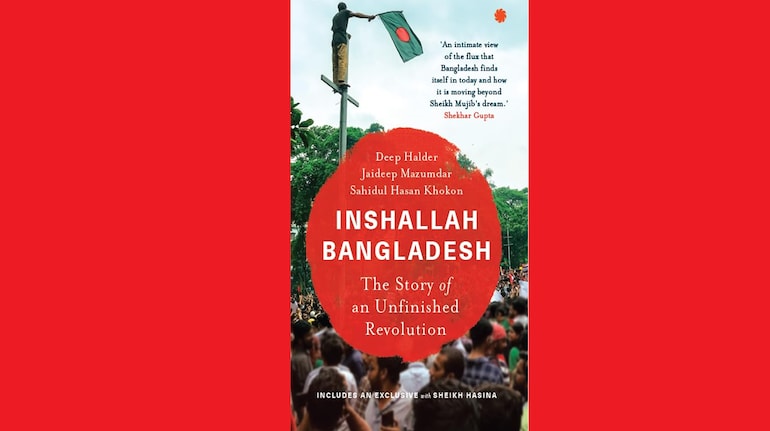
In the backdrop of Bangladesh Nationalist Party leader Tarique Rahman descending upon Dhaka after years of exile—greeted by a sea of jubilant supporters waving flags and banners ahead of February's pivotal elections—and amidst simmering unrest marked by surging anti-India fervour and the harrowing lynching of Hindu garment worker Dipu Chandra Das over unsubstantiated blasphemy claims, Inshallah Bangladesh: The Story of an Unfinished Revolution emerges as a beacon of profound insight and urgent relevance.
Crafted by the deft hands of seasoned journalists Deep Halder, Jaideep Mazumdar, and Shahidul Hasan Khokon, this volume weaves a masterful tapestry of the cataclysmic events of 2024: how modest student protests against job quotas ignited into a fiery mass uprising, culminating in the breathtaking fall of Prime Minister Sheikh Hasina on August 5, her hurried exile to India, and the ascent of Muhammad Yunus's interim stewardship.
Yet, in prose as vivid and gripping as a monsoon storm over the Padma, the authors unveil a deeper, more haunting truth—this revolution remains achingly unfinished, its promises shadowed by deep societal fractures, geopolitical tempests, and the stealthy resurgence of Islamist currents, notably the Bangladesh Jamaat-e-Islami, gliding from the margins to the heart of influence.
Economic despair fertilizes creeping Islamization
Like a river carving through ancient deltas, the book charts the nation's precarious path, illuminating how economic despair and youthful disillusionment have fertilized a creeping Islamization, where radical alliances exploit the vacuum, eroding the secular dreams of 1971.
In this moment of renewed volatility—from communal shadows to ideological tides—these pages offer not mere chronicle, but a poetic clarion call, an indispensable mirror to Bangladesh's soul, reminding us that revolutions, like prayers uttered "Inshallah," hang suspended between hope and peril, awaiting the grace of resolution.
Shattered hopes of 2024
The volume's relevance sharpens amid Bangladesh's ongoing turbulence into late 2025, where anti-India rhetoric has intensified, cultural institutions face assaults for perceived foreign ties, and minority communities endure heightened vulnerability, exemplified by the lynching of individuals accused of blasphemy.
Under Muhammad Yunus's interim stewardship since August 2024, the fraying of law enforcement has permitted extremist assertions to dominate public spaces, reversing gains in minority protections and secular governance. This work illuminates these patterns, revealing how the "unfinished revolution" has inadvertently catalyzed a deeper entrenchment of religious nationalism, with profound consequences for internal cohesion and regional dynamics.
Structured around three core dimensions—society, politics, and people—the book systematically unravels the interplay of forces reshaping Bangladesh.
Diminishing India’s contribution
The society section probes the ideological fractures exposing the nation's social underpinnings to erosion. Here, the authors chronicle a deliberate campaign of historical revisionism post-2024, where India's instrumental contributions to the 1971 Liberation War are systematically diminished or excised from currency, monuments, educational materials, and official narratives.
This erasure aligns with a burgeoning religious nationalism that recasts India as an existential foe, leveraging its secular yet Hindu-majority character, unresolved border frictions, and domestic policies affecting Muslim populations. The narrative underscores the emboldenment of organizations like Jamaat-e-Islami, whose prohibitions were revoked shortly after the upheaval, enabling renewed mobilization. Communal incidents proliferated dramatically, with thousands documented against Hindus and other minorities in the immediate aftermath, often unaddressed due to institutional paralysis. Testimonies from affected families, rights advocates, and observers depict a society where youth disillusionment—stemming from economic inertia and job scarcity—intersects perilously with Islamist recruitment, transforming "otherization" into a mechanism for societal consolidation.
Shrinking space
Cultural confrontations abound: prohibitions on artistic expressions in conservative enclaves, constraints on women's public engagement, and targeted vandalism of symbols associated with liberal or external influences. This segment highlights a generational pivot, wherein younger cohorts increasingly prioritize religious solidarity over the eclectic Bengali heritage championed during independence, exacerbated by narratives framing transnational grievances as justifications for domestic radical assertiveness.
The politics section delivers a meticulous autopsy of institutional maneuvers and power shifts. The authors contend that Hasina's downfall transcended mere popular discontent, involving strategic defections, notably from security apparatuses that failed to contain the escalation. The interim phase under Yunus is portrayed as a fertile void exploited by radical factions, with the rapid unbanning of Jamaat-e-Islami and affiliates signalling accommodation rather than containment.
The book details how this enabled Jamaat to advance agendas like rehabilitating Pakistan's image through shared faith, evidenced by revived military dialogues, commemorative events, and strategic alignments tilting toward Islamabad and Beijing at India's expense. Judicial reshuffles favoring ideologically aligned figures, selective prosecutions sidelining secular voices, and inadequate responses to vigilantism further entrenched these gains. Discussions among Islamist leaders post-ouster openly envisioned governance rooted in religious precepts, with Jamaat positioned centrally.
The analysis critiques the interim framework's inability—or unwillingness—to stem mob dominance, permitting radicals to maneuver toward electoral influence. This political vacuum, the authors argue, has accelerated Islamization trends: from curriculum alterations downplaying secular founders to policy inclinations favoring conservative constituencies, marking a departure from the liberation-era ethos.
Whether this ascent was meticulously orchestrated or seized opportunistically forms a recurring thread. The book leans toward the latter, depicting radical elements as adept at capitalizing on chaos rather than masterminding the initial protests, which originated in secular demands for equitable opportunities. Yet, their swift post-ouster maneuvers—lifting restrictions, forging alliances with emergent student entities, and infiltrating reform processes—suggest preparedness to exploit instability. Hasina's exclusive insights reinforce perceptions of external orchestration amplifying domestic fissures, though the narrative balances this by acknowledging genuine public fury at governance failures.
The people section anchors these abstractions in visceral human accounts, from protest initiators navigating co-optation to officials witnessing regime disintegration, military personnel torn by divided allegiances, reporters evading reprisals, and minority households confronting targeted aggression. These vignettes illuminate the upheaval's toll: fractured communities, aspirations derailed by ideological capture, and figures like Hasina depicted as flawed stewards whose suppressions inadvertently preserved radical energies for later eruption.
Hasina's candid exile interview anchors the book's revelations, where she denounces the events as engineered destabilization involving Western interests dissatisfied with autonomous leadership and her stance on strategic assets. She implicates Yunus in facilitative roles, framing the unrest as masked terrorism rather than organic reform, while defending her tenure's advancements in growth and relative stability for minorities against predecessors' lapses.
Ultimately, the authors navigate complexities without absolving Hasina's excesses—repression, nepotism, impunity—yet caution that the successor landscape has amplified destabilizing ideologies. Field immersions convey anarchy's immediacy: desecrated memorials, mobilized arsenals, unchecked retribution. The work probes hypotheticals of alternative resolutions, underscoring power's transience.
Inshallah Bangladesh endures as indispensable for its illumination of radical resurgence in contemporary contexts: the perils of unchecked vacuums, ideology's exploitation of discontent, and revolutions' propensity to devour foundational principles. As Bangladesh navigates electoral horizons amid persistent communal strains and diplomatic recalibrations, this chronicle's foresight into an unresolved transformation demands engagement from those tracking South Asia's volatile trajectories—a poignant alert that divine invocations alone cannot safeguard against self-inflicted ideological tempests.
(Sayantan Ghosh teaches journalism at St. Xavier’s College (Autonomous), Kolkata, and is the author of The Aam Aadmi Party: The Untold Story of a Political Uprising and Its Undoing. He is on X as @sayantan_gh.)Views are personal and do not represent the stand of this publicationDiscover the latest Business News, Sensex, and Nifty updates. Obtain Personal Finance insights, tax queries, and expert opinions on Moneycontrol or download the Moneycontrol App to stay updated!
Find the best of Al News in one place, specially curated for you every weekend.
Stay on top of the latest tech trends and biggest startup news.