







Book Extract
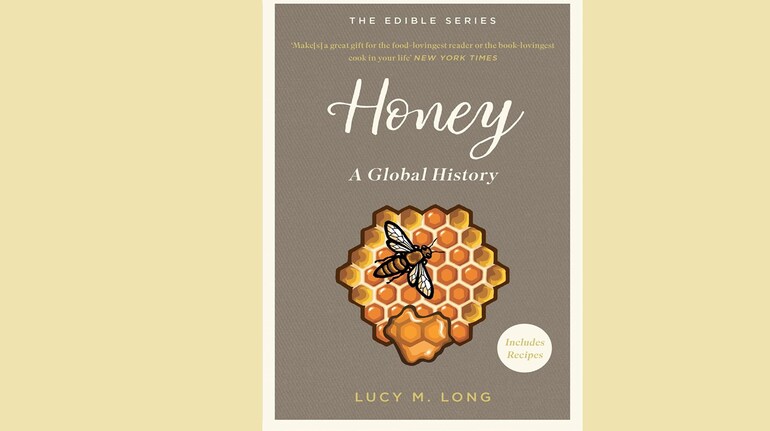
Excerpted with permission from the publisher Honey: A Global History (The Edible Series), Lucy M. Long, published by Pan Macmillan India.
******
The Cultural History of Honey
Although the exact nature of honeybees’ relationship to honey was not understood until the seventeenth century, humans have been making use of it for thousands of years. Cave paintings from the eastern coast of Spain dating to 8,000 years ago show figures collecting honey from a cliff, and archaeological evidence suggests that honey was known in Europe as far back as 10,000 years ago. Honey vessels found in Georgia in Eastern Europe are 5,000 years old, mentions of honey have been discovered in cuneiform writings from Sumeria and Babylonia from as early as 2100 BC, and references to the substance are recorded in ancient Indian and Egyptian texts. There is also evidence of honey being used by the early Chinese, Indians and Mayans as well as in areas of Africa. Honey’s history as a part of human culinary culture is ancient and rich.
Origin Myths
For centuries, humans did not know how honey actually came into being. Colourful myths developed around it, and it was thought to be a divine substance, or a gift from the gods. It is no wonder, then, that it often carried symbolic meaning and was used in religious rituals, frequently as an offering to the gods. Some of these associations have continued into the present, with honey featuring in a number of religious holiday and ceremonial foods. Also, until the seventeenth century, bees were thought to be sexless, and to somehow self-create (autogenesis), which led to the bee’s many diverse symbolic associations, such as representing the power of the gods, fertility, chastity, orderliness and obedience.
Ancient Egyptians believed that honey came from the gods, particularly their primary god, Ra (also spelled ‘Re’), and was collected by bees, which were then deemed to be sacred manifestations of the gods and used as a symbol of power. Translations of writings found on the Salt Papyrus show how honey was considered to have a divine origin, and was an appropriate gift for the gods:
The god Re wept and his tears fell to the ground and were turned into bees. The bees began to build and were active on all flowers of every kind belonging to the vegetable kingdom. Thus wax came into being and thus was created honey.
Honey was used for embalming the dead, and it was placed in tombs for the deceased to enjoy in their afterlife. Royalty, who were believed to be the incarnations of gods on earth, were anointed with honey, and a hieroglyph of a bee represented the king of lower Egypt.
Ancient Semitic cultures believed honey to be a gift of the earth mother Astarte, the goddess of fertility, maternity and love (and, surprisingly, war). Early civilizations understood that honey represented fertility, of both the land and the people: ‘As the land flows with milk and honey, so life-giving fluids flow from the genitals of men and women.’6 It was often used to represent the Promised Land.
Honey was similarly associated with the gods in ancient India. In the 1,028 sacred hymns of the Vedic scriptures dating from 1500 BC, many frequently mention honey (madhu in Sanskrit) and claim that it came from the clouds. They use the name ‘Madhava’ (meaning ‘honey-born ones’) for the gods Vishnu, Krishna and Inra, and call honey the food of the gods. Honey was presented as a source of life and protection, and was therefore given as a gift to newborn males. ‘I give thee this honey food so that the gods may protect thee, and that thou mayst live a hundred autumns in this world.’ Bees furthermore were seen as liaisons between gods and men, and honey was often used in offerings to the gods. This has carried over into Buddhism as well as other cultures influenced by Indian culture and Hinduism. In Thailand, for example, honey is ritually offered in acknowledgement of the honeycomb that a monkey gave to the Buddha when he needed strength while seeking enlightenment.
Similar legends abounded in ancient Greece, where honey (melis) was again thought to come from the clouds. It was considered a food of the gods, endowing them with immortality, and apparently consumed as nectar, mead or in ambrosia (ἀ-βροτός) – the prefix ἀ- means ‘not’, while βροτός (brotos) translates as ‘mortals’ (in other words, ‘not for mortals’). It was given by the gods to humans when Dionysus, the son of Zeus and Semele, directed bees to fill a hollow tree in a forest with honey after a night of partying with the satyrs. Bees also came from the gods, specifically Zeus, who turned a beautiful girl named Melissa (whose name comes from the Greek word for honey, meli) into a bee. She then fed him milk and honey. Bees were called ‘Melissae’ and were ‘caretakers, confidantes, and co-conspirators of the gods’. They could lead pilgrims to the Oracle at Delphi. Homer, in the Iliad and the Odyssey, probably written sometime around the eighth century BC, refers to both bees and honey as divine.
Even those Greeks who tried to be more scientific by observing the bees at work did not realize that bees made honey. The philosopher Aristotle (384–322 BC) experimented with beekeeping and included his observations in his Historia animalium (History of Animals) and De generatione animalium (Generation of Animals). He insisted, though, that ‘the honey is what falls from the air, especially at the risings of the stars, and when the rainbow descends . . . it fetches in what falls from the air.’
The Roman poet Virgil (70–19 BC) claimed that honey was ‘heaven-borne, the gift of air’. (Like others, he also thought that bees did not produce offspring, but harvested their babies from flowers or sprang from the carcasses of lions and bulls.) Pliny the Elder, in his first-century AD Natural History, wrote about honey: ‘whether this is the perspiration of the sky or a sort of saliva of the stars or the moisture of the air purging itself . . . it brings with it the great pleasure of its heavenly nature.’ The Romans offered honey to Proserpina, the goddess of spring and queen of the underworld, as it was intended to appease her and to encourage her to appear on earth as a harbinger of spring, rather than as volcanic lava.
Islamic texts also employed divine imagery, describing paradise as having rivers of wine, milk and honey. In contrast, though, the Qu’ran states that Allah told bees to make honey for humans, giving them a natural medicine: ‘There comes from within [the bee] a beverage of many colors, in which there is healing for men.’
Whatever beliefs were held about the origin of honey, it was significant enough for humankind to make records of it. One of the oldest-known cave paintings – from the Cuevas de la Araña (Spider Caves) in Valencia, Spain – shows the gathering of wild honey, and the earliest evidence of writing makes reference to the activity. Observations of honey’s qualities and benefits as well as of bees were written by some of the earliest and most influential Greek and Roman philosophers, and, when the printing press was invented in Europe in the fifteenth century, treatises on beekeeping became, aside from the Bible, some of the most sought-after publications.
********** Lucy M. Long, Honey: A Global History (The Edible Series), Pan Macmillan India, 2025. Pb. Pp. 176
Sticky, sweet and a natural substance that can be consumed without any human processing, honey is now thought of mostly as a sweetener. In its long history around the world, however, it has been much more. Many cultures have treated it as a staple food, as well as tonic, medicine and preservative. It also has played a role in religious rituals, as a sacred food from the gods. It is seen as a healthy, natural product untainted by human intervention, with flavours and nutritional qualities that stem from its physical surroundings, since it is created from flowering plants that are local and in season. And its creators – bees – are just as mysterious as honey itself. Vital to the pollination of wild plants as well as many domesticated crops, the health of bees is of utmost concern today.
In Honey: A Global History, Lucy M. Long explores honey’s fascinating history, tracing its use and meanings through numerous cultures world-wide. Focusing on its role as food and drink, this book includes recipes and discussions of its place in global cuisines. Honey also demonstrates how this simple substance is connected to politics, religion, economics, popular culture, and beliefs about the natural and supernatural world. Written in a lively and engaging style, and illustrated with many striking colour images, Honey will encourage readers to appreciate how ‘sweet’ honey really is.
Lucy M. Long is a folklorist, food studies scholar and Director of the non-profit Center for Food and Culture in Ohio.
Discover the latest Business News, Sensex, and Nifty updates. Obtain Personal Finance insights, tax queries, and expert opinions on Moneycontrol or download the Moneycontrol App to stay updated!
Find the best of Al News in one place, specially curated for you every weekend.
Stay on top of the latest tech trends and biggest startup news.





