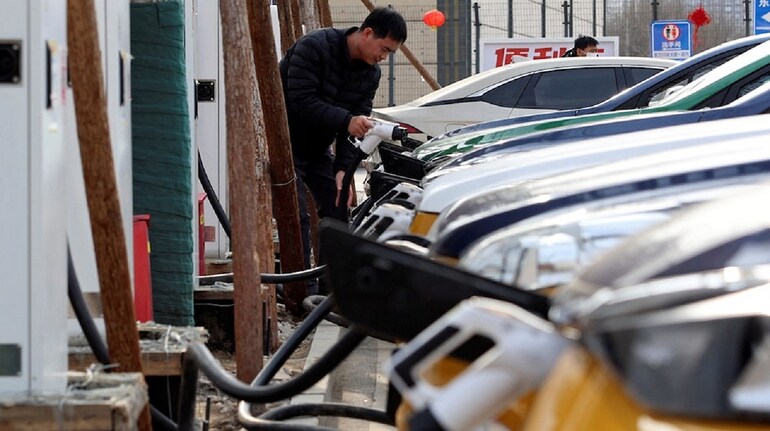
India’s top electric carmakers, Tata Motors, Mahindra & Mahindra, and Hyundai Motor India, have opposed the Delhi government’s draft policy proposing equal incentives for hybrid and electric vehicles (EVs), Mint reported, citing people familiar with the matter.
The proposal, circulated among automakers on April 22, recommends waiving road tax and registration fees for both EVs and hybrid vehicles, currently benefiting exclusive to EVs. A crucial meeting on the contentious issue is scheduled at Niti Aayog on May 30, Mint said.
The move has triggered sharp resistance from pure EV players who argue that hybrids, which still rely on internal combustion engines alongside electric motors, do not deserve the same green incentives as battery-only electric vehicles. “Hybrid is an old technology... incentivising it equally discourages investments into pure EVs,” a person familiar with the matter told Mint.
Moneycontrol could not independently verify the report.
Tensions escalated further after a May 2 advisory by the Commission for Air Quality Management (CAQM) that encouraged government departments to purchase clean fuel vehicles, including EVs, hybrids, and CNG-powered cars. The advisory said Strong Hybrid Electric Vehicles (SHEVs) offer significant improvements in fuel efficiency and emissions compared to conventional petrol/diesel vehicles.
In response, Tata Motors, Mahindra, and Hyundai reportedly flagged their concerns to the Union Ministry of Heavy Industries (MHI), the nodal agency for EV schemes, and to Niti Aayog, Mint noted.
On May 14, company representatives met Union Heavy Industries Minister H.D. Kumaraswamy to raise objections. While the minister later tweeted that the meeting focused on India’s clean mobility roadmap, people cited by Mint said the core agenda was the automakers’ opposition to including hybrids under the clean vehicle definition.
Industry voices argue that government support should prioritise technologies aligned with zero-emission goals. “Incentives are most effective when they help emerging technologies reach scale and maturity, particularly those that contribute meaningfully to long-term sustainability goals of zero emissions, such as EVs,” said Shailesh Chandra, MD of Tata Motors Passenger Vehicles and Tata Passenger Electric Mobility, in a written statement to Mint.
State-level EV policies are evolving rapidly. Delhi’s draft policy is still under review, but Uttar Pradesh and Maharashtra have already notified their EV guidelines, with UP also including incentives for hybrid vehicles, Mint noted.
Government data, cited by Mint, shows that over 107,000 electric cars were sold in FY25, marking an 18 percent year-on-year growth. Hybrid car sales stood at 83,000 during the same period, according to the Vahan portal.
While Tata, Mahindra, and Hyundai currently only offer pure EVs alongside conventional vehicles, companies like Maruti Suzuki and Toyota Kirloskar dominate the hybrid segment. Maruti plans to launch its first EVs later this year, primarily for export.
Defending the hybrid push, Rahul Bharti, senior executive officer of corporate affairs at Maruti Suzuki, told Mint that EV penetration in India remains below 3 percent. “While all efforts are to maximise this 3 percent, we cannot say we will do nothing about the balance 97 percent,” he said.
He added that strong hybrids help displace pure ICE vehicles by boosting fuel efficiency and lowering emissions. “Data shows wherever SHEV incentives have been given, EV sales have not reduced but increased,” Bharti told Mint. “We want both EV and SHEV sales to grow.”
Emailed queries sent to Toyota and other stakeholders remained unanswered till press time, Mint said.
Discover the latest Business News, Sensex, and Nifty updates. Obtain Personal Finance insights, tax queries, and expert opinions on Moneycontrol or download the Moneycontrol App to stay updated!
Find the best of Al News in one place, specially curated for you every weekend.
Stay on top of the latest tech trends and biggest startup news.