When Prime Minister Narendra Modi announced a year ago that Rs 500 and Rs 1,000 notes would cease to be legal currency in a matter of hours, it wasn't just the public that was caught off guard. Equally clueless was the banking community - whose job is to ensure that the public's savings in safe hands.
“No one knew that demonetisation would happen. We were as shocked as the rest of the country,” says Manuj Khurana, a branch head with a leading private sector lender in Delhi.
The Prime Minister's announcement was accompanied with the rider that citizens only had a few weeks to deposit their old notes and exchange them for new ones, which meant that the banking system would take centre-stage in the demonetisation exercise.
After digesting the news, it was time for bankers to take stock. They were given 24 hours to get their houses in order before the public came calling.
“The next was a holiday where we met and planned a strategy,” says Khurana.
Their task was cut out. ATMs had to be recalibrated and arrangements needed to be made in anticipation of hundreds of customers who would come to exchange their old notes. But nothing could have prepared them for what followed.
Over the next few weeks, the 9-to-5 stereotype associated with the profession quickly became a thing of the past as a panicked public rushed to banks to deposit and exchange notes.
“The lines used to be at least a kilometre long. People started lining up from 2-3am itself,” says Vishal Vijay, who works with a leading public sector bank in Mumbai.
ALSO READ — One year of demonetisation: We've said goodbye to two notes and hello to four
As it turned out, banks were being forced to bite off more than they could chew. The supply of new Rs 500 and Rs 2,000 fell well short of the demand. In addition, the government abruptly stopped the over-the-counter exchange of notes in late November despite initially announcing that the exchange would be allowed till the end of the year.
“The norms were frequently changing and the crowds were increasing,” said Vijay. “The short supply of currency was the biggest problem.”
CV Sundara Moorthy, Chief Manager at Syndicate Bank in Tamil Nadu’s Tirupur, concurs. “It was total chaos,” he says. “There were long lines, a lot of confusion and the ATMs were not working.”
Watch | One Year Of Demonetisation - A Look Back At The TimelineSome citizens were entering a bank for the first time – either to exchange old notes for new ones or to open a bank account, only adding to the enormity of the task.
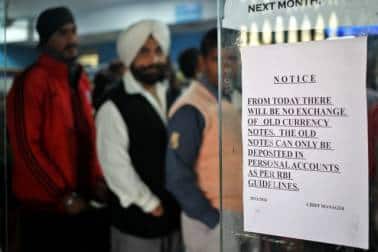
"There was a lot of pressure on the staff. We worked till midnight every day and then came back again early the next day,” says Moorthy, adding that one of the biggest difficulties was verifying the huge piles of old Rs 500 and Rs 1,000 notes.
Vijay remembers a similar atmosphere.
“The workload was immense," he says. "Our normal banking routine had come to a standstill. Our leaves were getting cancelled and all of us were working for extended hours.”
Meals, too, had become an afterthought for overworked staff. "We worked till 12-1 am and we hardly ate food in that period," recalls Khurana.
At the time, there were reports from several quarters about stressed bank employees throwing in the towel. But these bankers tell a different story.
Priya Lakshmi, a Personal Banking Branch Manager at State Bank of India in Coimbatore, said: "Yes, our workload had increased. But nobody quit. We got a lot of support from our retired and administrative staff as well. Overall, the process went smoothly."
It took more than a month for a semblance of normalcy to return, and as the dust settles a year on, these bankers believe their hard work and sacrifices have paid off and the disruption was worthwhile.
According to Moorthy, the note ban helped clean up the black money “mess” in the economy, which in turn has helped the banking sector.
ALSO READ: One year after demonetisation, the government has data to show it worked
But they think that the biggest benefit of demonetisation is that it helped customers realise the importance of banking and to deposit their hard-earned money instead of storing it at home.
"Within a year, our digital payments and other banking channels have gone up,” said Khurana. “Customers have realised that their money is safe in bank accounts."
Discover the latest Business News, Sensex, and Nifty updates. Obtain Personal Finance insights, tax queries, and expert opinions on Moneycontrol or download the Moneycontrol App to stay updated!
Find the best of Al News in one place, specially curated for you every weekend.
Stay on top of the latest tech trends and biggest startup news.